

Key takeaways
- For a first siphon: Choose the Hario Technica TCA-3. Its 360 ml size uses less water, reaches brewing temperature relatively quickly, and is easier to steady while learning how to seat the upper bowl and control the flame.
- For two to four regular drinkers: The Hario Technica TCA-5 or a comparable 600 ml Yama model is more practical. A 360 ml brewer often requires a second batch when everyone wants coffee.
- For an existing gas or electric range: A stovetop-compatible Yama-style brewer avoids storing fuel and makes heat positioning simpler. Confirm that the lower bowl and stand are intended for the burner you use.
- For induction cooking: Select a model specifically labeled induction-compatible, or use the manufacturer-approved induction interface. Ordinary borosilicate glass will not heat on induction, and a metal stand alone does not guarantee compatibility.
- For frequent brewing or shared kitchens: Consider a stainless-steel lower chamber or a mixed metal-and-glass design. It is less vulnerable to a knock than a fully glass lower bowl, though it removes some visual feedback.
- For limited storage: A 240–360 ml model takes less shelf space and is easier to wash in a small sink. Measure the assembled height as well as the footprint; many siphons stand roughly 30–35 cm tall.
The best siphon coffee makers for most home brewers are the Hario Technica for compact, repeatable brewing, a Yama stovetop siphon for a larger glass setup, and a stainless-steel or metal-bodied siphon when durability and induction compatibility matter more than watching the brew develop.
A siphon brewer can produce a clean, aromatic cup, but the right choice depends less on appearance than on heat source, batch size, replacement seals, and how much cleanup you are willing to do after each brew. The comparison below focuses on those ownership details rather than just brewing style.
Our top picks
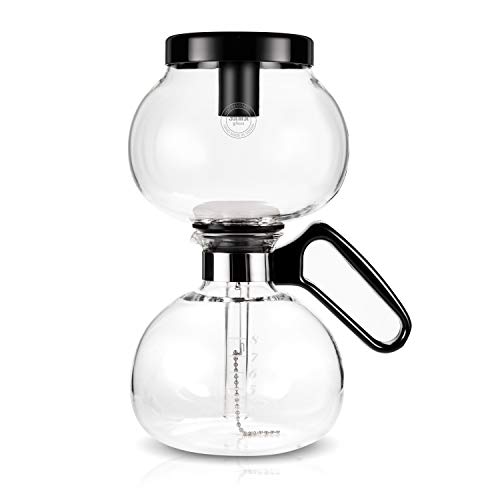
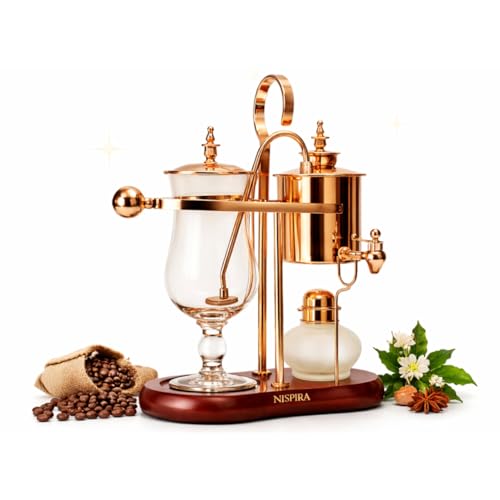


As an Amazon Associate we earn from qualifying purchases at no extra cost to you. Ratings are shown as listed on Amazon.
Quick comparison of the best siphon coffee maker types
| Type or example | Typical capacity | Main construction | Heat-source fit | Approx. empty weight | Best for |
|---|---|---|---|---|---|
| Hario Technica TCA-3 | 360 ml, about 3 small cups | Borosilicate glass, metal stand, cloth or paper-compatible filter assembly | Alcohol burner supplied; verify instructions before using another burner | About 0.9 kg | Beginners, small kitchens, 1–2 drinkers |
| Hario Technica TCA-5 | 600 ml, about 5 small cups | Borosilicate glass with metal stand | Alcohol burner supplied; alternative heat sources depend on the model and manual | About 1.2 kg | Regular household brewing and entertaining |
| Yama stovetop siphon, 5-cup class | About 600 ml, depending on version | Heat-resistant glass, metal or wood-accented support components | Designed for stovetop use on compatible gas or electric burners; check the exact model | Roughly 1–1.5 kg | Brewers who want a larger batch without a separate alcohol flame |
| Metal-bodied siphon brewer | Usually 600–1,000 ml | Stainless steel or mixed metal and glass | Some versions work with gas, electric, or induction; induction requires a magnetic base or adapter | About 1–2 kg | Frequent use, transport, and lower breakage risk |
Capacities are commonly measured as small siphon servings rather than large mugs. A “5-cup” brewer holding 600 ml may produce three generous 200 ml cups, or four smaller servings after allowing for coffee grounds and water retained in the upper chamber.
Best picks by brewing situation
- For a first siphon: Choose the Hario Technica TCA-3. Its 360 ml size uses less water, reaches brewing temperature relatively quickly, and is easier to steady while learning how to seat the upper bowl and control the flame.
- For two to four regular drinkers: The Hario Technica TCA-5 or a comparable 600 ml Yama model is more practical. A 360 ml brewer often requires a second batch when everyone wants coffee.
- For an existing gas or electric range: A stovetop-compatible Yama-style brewer avoids storing fuel and makes heat positioning simpler. Confirm that the lower bowl and stand are intended for the burner you use.
- For induction cooking: Select a model specifically labeled induction-compatible, or use the manufacturer-approved induction interface. Ordinary borosilicate glass will not heat on induction, and a metal stand alone does not guarantee compatibility.
- For frequent brewing or shared kitchens: Consider a stainless-steel lower chamber or a mixed metal-and-glass design. It is less vulnerable to a knock than a fully glass lower bowl, though it removes some visual feedback.
- For limited storage: A 240–360 ml model takes less shelf space and is easier to wash in a small sink. Measure the assembled height as well as the footprint; many siphons stand roughly 30–35 cm tall.
Glass versus metal: the important trade-off
Glass construction
Borosilicate glass is the traditional choice because it lets you see water rise, coffee steep, and brewed coffee return to the lower chamber. That visibility helps new users diagnose problems: water that never rises suggests insufficient heat or a poor seal, while an unusually vigorous boil may indicate excessive heat.
The disadvantages are handling and thermal shock. Do not place a hot glass bowl on a cold, wet, or stone surface, and do not rinse it immediately with cold water. Small scratches, chips around the rim, or a hairline crack are reasons to retire the part rather than continue heating it.
Metal construction
Stainless steel tolerates knocks and is often easier to take outdoors or use in a busy kitchen. It can also retain heat differently from glass, so timing may need adjustment. The lower chamber is opaque, meaning you cannot visually monitor the water level or bubbling. Mixed designs preserve a glass upper chamber while protecting the lower section with metal.
Metal does not automatically mean easier maintenance. Coffee oils can cling to brushed surfaces, and mineral scale may be harder to spot. If induction is important, check for a magnetic stainless-steel base and an explicit induction rating; “stainless steel” by itself is not enough.
Heat source compatibility is a buying decision
An alcohol burner is compact and gives fine manual control, but it requires fuel storage, trimming or replacing the wick, and careful flame handling. A butane burner can provide stronger, more adjustable heat, although not every siphon stand is designed for its flame pattern. A stovetop model is convenient when your range is compatible, while an electric or induction solution can be preferable where open flames are unsuitable.
Never assume that a burner included with one siphon is safe for another. The stand height, flame clearance, and lower-bowl shape matter. Follow the model’s instructions, keep the burner on a stable heatproof surface, and never leave an open flame unattended.
Assembly and brewing: where ownership gets easier or harder
Siphon assembly is not difficult, but the seal and filter must be positioned correctly. A typical workflow is:
- Inspect the glass and seal. Look for chips, cracks, hardened rubber, or a filter chain that is detached.
- Add measured water to the lower chamber. Use the chamber markings when available. For a 600 ml batch, begin with about 600 g of water and expect some retention in the coffee bed.
- Install the filter in the upper bowl. The chain or spring should sit centrally, and the gasket should be clean and evenly seated.
- Heat until the water rises. Insert the upper bowl without forcing it. A poor seal allows steam to escape and can prevent a stable transfer.
- Add coffee and stir gently. A useful starting point is 36 g of medium-ground coffee for 600 g of water, approximately a 1:16.7 ratio. Adjust to taste and grinder performance.
- Steep briefly, then reduce or remove heat. Start with about 60–90 seconds of contact time. Too much heat can create aggressive bubbling and a muddier cup.
- Allow the coffee to return below. Once the lower chamber cools and pressure falls, the brew will draw down through the filter. Remove the upper bowl carefully by its handle or support.
The exact time is less important than stable heat and a good seal. A common mistake is turning the burner up to force a faster brew; this can cause splashing, over-extraction, or a filter that clogs during drawdown.
Seals, filters, and replacement realities
The rubber gasket is usually the first wear item. Heat, coffee oils, repeated washing, and incorrect storage can make it stiff, sticky, or unable to grip the lower chamber. Depending on the brand and model, replacement gaskets may be sold separately, while proprietary filter holders or chains can be harder to source.
Before buying, search the manufacturer’s parts catalog for the exact model number. A generic-looking gasket may have the wrong diameter or profile. Cloth filters also need regular replacement: rinse them immediately, store them wet according to the manufacturer’s instructions, or replace them when they retain stale aromas. Paper filters reduce washing but can change body and flow rate.
Cleanup effort: glass is visible, not maintenance-free
After brewing, discard the grounds, rinse the filter, and wash both chambers with mild dish soap. Do not use abrasive pads on glass or metal finishes. Pay attention to the gasket groove, filter spring, and the underside of the upper bowl, where oils and fine grounds accumulate.
For occasional brewing, a cloth filter may be manageable. For daily brewing, paper filters or a removable stainless-steel filter can reduce odor and drying time. Allow every part to dry fully before storage, but avoid stretching the gasket by leaving the chambers permanently assembled.
Every few weeks, depending on water hardness, descale compatible non-porous parts with the manufacturer-approved method. Do not immerse burner components or use acidic cleaners on parts whose instructions prohibit them.
Bottom line
Choose the Hario Technica TCA-3 if you value compact size and a forgiving learning curve. Choose a 600 ml Hario or Yama-style siphon if serving several people matters more than storage space. Choose a metal-bodied or induction-rated model when breakage, open flames, or frequent use are your main concerns. In every case, prioritize available replacement seals, a clearly supported heat source, and a capacity that matches your real serving size—not the number printed as “cups.”





Write Your Review
No reviews yet. Be the first to share your experience!