

Key takeaways
- Scheduling: A 24-hour clock is enough for a fixed weekday routine. If your wake time changes, look for separate weekday/weekend programming or an easy-to-reset clock.
- Clock recovery: Many budget machines lose the time after a power interruption. A machine that remembers the schedule, or a clearly visible clock, reduces missed brews.
- Thermal carafe: It preserves heat without continuously cooking the coffee, but it cannot make coffee stay fresh indefinitely. Preheating the carafe with hot water can improve temperature retention.
- Glass carafe: It is cheaper and lets you see the remaining amount, but coffee quality usually declines faster on a hotplate.
- Auto-off: A two-hour shutoff is safer and usually kinder to coffee than a four-hour setting. If you often leave home immediately after brewing, do not disable the safety feature.
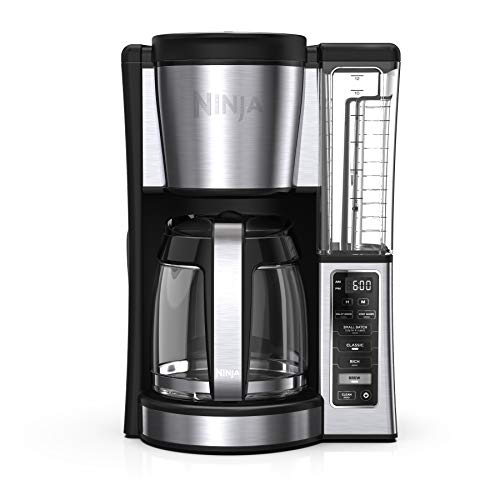
The best programmable coffee maker for most busy mornings is the OXO Brew 8-Cup Coffee Maker if you want compact size and simple operation, while the Breville Precision Brewer is the stronger choice for control and larger-batch flexibility; for a lower-cost, high-capacity option, choose a programmable 12-cup drip machine such as the Cuisinart DCC-3200.
The important difference is not just how well a machine brews. A useful morning coffee maker must start at the right time, make enough coffee without taking over the counter, keep it drinkable without scorching it, shut itself off safely, and remain easy to clean when you are in a hurry.
Our top picks



As an Amazon Associate we earn from qualifying purchases at no extra cost to you. Ratings are shown as listed on Amazon.
Best programmable coffee makers at a glance
| Model or type | Capacity | Scheduling | Keep-warm approach | Auto-off | Approximate market range | Best for |
|---|---|---|---|---|---|---|
| OXO Brew 8-Cup Coffee Maker | 8 cups; single-serve option | Programmable delayed start on applicable versions | Glass carafe and warming plate | Automatic shutoff; confirm current regional specification | $170–$230 | Small kitchens and mixed serving sizes |
| Breville Precision Brewer | 60 fl oz, about 12 five-ounce cups | Programmable start time | Thermal or glass-carafe configurations, depending on version | Programmable or automatic shutoff behavior varies by configuration | $280–$330 | Experienced users who want brew control |
| Technivorm Moccamaster KBGV Select | 1.25 L, about 10 five-ounce cups | Not a true delayed-start programmable machine | Thermal carafe with automatic hotplate control | Hotplate safety shutoff is built in | $350–$380 | Fresh-brew quality over scheduling |
| Cuisinart DCC-3200 | 14 cups | 24-hour programmable start | Glass carafe and adjustable warming plate | Adjustable automatic shutoff, commonly 0–4 hours | $80–$130 | Families and budget-conscious high-volume use |
| Programmable 12-cup drip machine | 60 fl oz, nominally 12 five-ounce cups | Usually 24-hour delay start | Glass carafe; warming plate | Usually 2–4 hours | $40–$100 | Basic weekday coffee at the lowest cost |
Manufacturers use a five-ounce “cup,” not a typical 8- to 12-ounce mug. A nominal 12-cup machine therefore makes about 60 fluid ounces: five 12-ounce mugs, or roughly six 10-ounce servings after allowing for coffee absorption and pouring.
Which one should you buy?
Best overall for a small or mixed household: OXO Brew 8-Cup
The OXO is a practical fit when one person sometimes wants a mug and other mornings require a larger pot. Its brew basket supports both a carafe and a single-serve configuration, and its compact footprint is easier to accommodate than many 12-cup machines. The trade-off is capacity: eight nominal cups will not comfortably serve a large household without a second cycle.
Choose it if you value a straightforward interface, a showerhead-style water distribution system, and a carafe designed to reduce drips. Check the exact model listing before purchase because scheduling and auto-off details can differ between regional or updated versions.
Best for maximum control: Breville Precision Brewer
The Precision Brewer is the head-to-head winner for users who care about more than pressing “auto start.” It offers multiple brewing modes, adjustable temperature and strength-related controls, and compatibility with different batch sizes. Its programmable start function is useful, but the machine’s main advantage is flexibility rather than the cheapest cup.
It is a better choice for a coffee enthusiast who changes beans, experiments with brew styles, or wants a larger batch than the OXO provides. It also takes more counter space and has a more involved control panel. If your normal routine is one fixed pot every weekday, its extra modes may be unnecessary.
Best for a budget and a large household: Cuisinart DCC-3200
The DCC-3200 is the sensible value pick when a 24-hour timer and a large carafe matter more than a thermal serving system. Its 14-cup rating gives families more headroom, and its adjustable auto-off setting lets you choose whether the warming plate remains on for a shorter or longer period.
A glass-carafe design is inexpensive and easy to monitor, but the warming plate can gradually flatten or darken coffee if the pot sits for hours. For the best flavor, schedule the machine close to breakfast and pour leftovers into a separate insulated container rather than leaving them on the plate.
Best when freshness matters more than automation: Technivorm Moccamaster KBGV Select
The Moccamaster KBGV Select is a high-quality drip brewer, but it should not be chosen as a programmable coffee maker in the strict sense: it does not provide the same delayed-start convenience as the Breville, OXO, or Cuisinart. Its appeal is fast, consistent brewing and a thermal carafe that avoids prolonged hotplate heating.
Choose it if you can load it and start it manually, or if a smart plug is permitted by the manufacturer and used within its safety guidance. Do not assume a third-party timer is suitable for every coffee maker; verify electrical and manufacturer requirements first.
Scheduling, keep-warm, and auto-off: the features that change daily use
- Scheduling: A 24-hour clock is enough for a fixed weekday routine. If your wake time changes, look for separate weekday/weekend programming or an easy-to-reset clock.
- Clock recovery: Many budget machines lose the time after a power interruption. A machine that remembers the schedule, or a clearly visible clock, reduces missed brews.
- Thermal carafe: It preserves heat without continuously cooking the coffee, but it cannot make coffee stay fresh indefinitely. Preheating the carafe with hot water can improve temperature retention.
- Glass carafe: It is cheaper and lets you see the remaining amount, but coffee quality usually declines faster on a hotplate.
- Auto-off: A two-hour shutoff is safer and usually kinder to coffee than a four-hour setting. If you often leave home immediately after brewing, do not disable the safety feature.
Counter-space and capacity decision matrix
| Your situation | Prioritize | Best fit | Why |
|---|---|---|---|
| One or two drinkers; limited counter depth | Compact footprint and smaller batches | OXO Brew 8-Cup | Less excess coffee and supports single-serve brewing |
| Three or more daily coffee drinkers | At least 60 fl oz capacity | Cuisinart DCC-3200 or Breville Precision Brewer | Fewer refill and brew cycles |
| Irregular schedule | Easy clock changes and flexible modes | Breville Precision Brewer | More control when batch size and brew style change |
| Small budget; fixed weekday routine | 24-hour delay start and adjustable auto-off | Programmable 12-cup machine | Delivers the core convenience at the lowest price |
| Freshness is more important than automatic start | Thermal holding and rapid brewing | Technivorm Moccamaster KBGV Select | Avoids extended hotplate heating |
Cleaning and ownership costs
The part most likely to create trouble is not the heating element; it is the water path, brew basket, carafe lid, and rubber seals. Coffee oils accumulate in the basket and carafe, while mineral scale can restrict water flow and make a machine brew slowly or inconsistently.
After every brew, discard the paper filter and grounds, rinse the basket, and leave the reservoir lid and basket area open to dry. Wash the carafe and lid with warm soapy water rather than leaving old coffee overnight. Every one to three months, run the manufacturer-approved descaling process; use the shorter interval if your water is hard or the machine is used several times daily. Descaling frequency is not a substitute for washing coffee-contact parts.
A simple ownership calculation explains why capacity matters. Suppose two people each drink one 12-ounce mug every weekday. That is 120 ounces per week. An eight-cup machine may make enough in one batch if its usable output is close to 40 ounces, but a 12-cup machine can cover the same routine with more room for a third drinker or guests. The larger machine may cost more initially, yet avoiding an extra brew cycle saves roughly 5–10 minutes per day and reduces repeated filter and cleaning work.
Common mistakes to avoid
- Do not fill the reservoir to the maximum line when you only need two mugs; stale water can remain in the reservoir.
- Do not use a thermal carafe as a storage container for an entire day and expect the coffee to taste freshly brewed.
- Do not put a glass carafe on an active warming plate without checking that it is seated correctly.
- Do not assume “14 cups” means fourteen ordinary mugs.
- Do not descale with vinegar unless the manufacturer permits it; some machines specify a dedicated descaling solution.
- Do not leave a programmable machine enabled while traveling. Empty the reservoir and unplug it according to the manual.
Bottom line
Buy the OXO Brew 8-Cup for the best balance of compactness, flexibility, and weekday convenience. Choose the Breville Precision Brewer when programmable scheduling is only one part of a broader need for brew control. Select the Cuisinart DCC-3200 or another programmable 12-cup machine for inexpensive, high-volume mornings. Choose the Moccamaster KBGV Select only when excellent drip brewing and thermal holding matter more than delayed-start automation.





Write Your Review
No reviews yet. Be the first to share your experience!