

Key takeaways
- Buy the Outin Nano if you want the best compromise between portability, battery operation, grounds, and capsule compatibility. Choose the Makita DCM501Z when a 240 ml cup and interchangeable batteries matter more than small size. Choose a CONQUECO-style 12-volt capsule machine for car-based travel and…
The best battery powered coffee makers for travel are the Outin Nano for a compact commute or campsite, the Makita DCM501Z for a full mug and long off-grid use, and a 12-volt capsule machine such as the CONQUECO Portable Espresso Machine for car travel.
The right choice depends less on maximum pressure than on four practical questions: how quickly the machine heats, how many drinks the battery can make, whether its water tank is large enough, and whether you prefer coffee grounds or capsules.
Our top picks
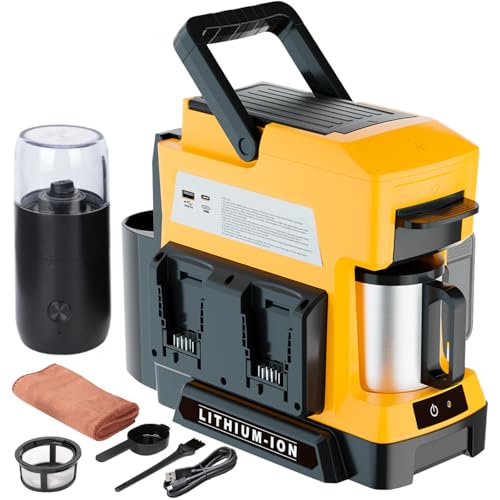
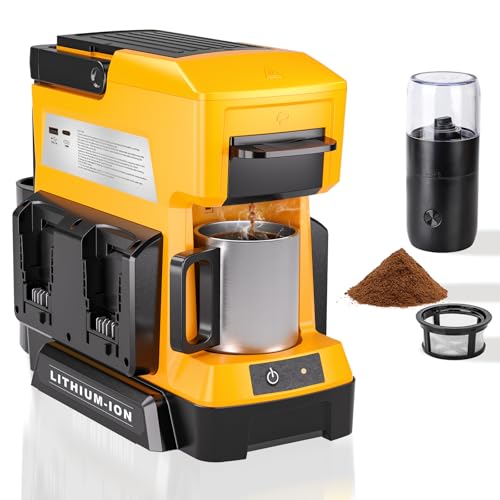


As an Amazon Associate we earn from qualifying purchases at no extra cost to you. Ratings are shown as listed on Amazon.
Best battery powered coffee makers at a glance
| Model or type | Brew method | Water capacity | Typical heating or brew time | Battery or power | Best for |
|---|---|---|---|---|---|
| Outin Nano | Grounds or compatible capsules | 80 ml | About 3–4 minutes with cold water; brewing follows heating | Rechargeable 7,500 mAh battery; USB-C charging | Small espresso-style drinks on commutes and campsites |
| CONQUECO portable espresso machine | Compatible capsules; some versions support ground coffee | About 50–80 ml, depending on version | Roughly 4–8 minutes with cold water | Rechargeable battery or 12-volt car power, depending on model | Driving, road trips, and capsule convenience |
| Makita DCM501Z | Ground coffee or paper filter | 240 ml | Approximately 5 minutes with hot water; longer from cold | Makita 18V LXT or 12V CXT battery; battery sold separately | A larger coffee while camping or working outdoors |
| Battery-powered drip coffee maker, general category | Grounds and filter | 200–400 ml | About 5–10 minutes | Usually proprietary rechargeable battery or tool battery | Users who want drip coffee rather than espresso |
Specifications vary by regional package and battery condition. Treat the figures above as useful buying benchmarks, then confirm the manual for the exact model, capsule standard, and included accessories.
Our picks by travel situation
Best overall for a small bag: Outin Nano
The Outin Nano is the most balanced option for people who want a self-heating espresso maker without carrying a separate kettle. Its 80 ml reservoir keeps the body relatively compact, and it can use ground coffee with its reusable basket or compatible coffee capsules. That flexibility matters when camping: grounds are cheaper and easier to pack in a small container, while capsules are cleaner when you are commuting.
The limitation is serving size. An 80 ml extraction is an espresso-style drink, not a large travel mug. You can add hot water for an Americano, but carrying enough water for multiple drinks quickly becomes more important than the machine’s battery capacity. Cold-water heating also takes several minutes, so it is not an instant push-button brew.
Best for a full cup: Makita DCM501Z
The Makita DCM501Z is a better fit for a campsite, job site, or vehicle where a 240 ml cup is more useful than compact espresso. It uses ground coffee and a filter rather than capsules, so it avoids capsule waste and lets you choose any roast and grind suitable for drip brewing. Its strongest advantage is battery compatibility: people already invested in Makita 18V LXT or 12V CXT tools may be able to use batteries they own.
It is larger and heavier than a pocket espresso maker, and the battery is commonly sold separately. Tool batteries add weight, but they also make replacement and extended use easier than relying on a small built-in cell. Use hot water when possible if you want a shorter wait and more predictable battery consumption.
Best for capsule convenience in a car: CONQUECO
A CONQUECO portable espresso machine is worth considering if you mainly use compatible capsules and travel by car. Depending on the version, it can operate from an internal rechargeable battery or a 12-volt vehicle connection. The capsule workflow is simple: add water, insert the capsule, and press the brew control.
Check the capsule specification carefully before buying. “Compatible with capsules” does not mean every pod system fits. Many portable machines are designed around Nespresso Original-style capsules, while larger or proprietary formats may not fit. Models that advertise ground-coffee support may require a separate filter basket and can be more fiddly to clean.
Grounds versus pods: which is better on the move?
| Criterion | Ground coffee | Capsules or pods |
|---|---|---|
| Packability | A small airtight container can hold several servings | Neat and pre-portioned, but bulky for longer trips |
| Cleanup | Requires emptying a wet basket and rinsing grounds | Usually faster; the used capsule still needs carrying out |
| Cost per drink | Often lower, especially with supermarket coffee | Usually higher, depending on capsule brand |
| Flavor control | More control over roast, grind, and dose | Consistent and convenient, but less adjustable |
| Failure risk | Too-fine or overfilled grounds can restrict flow | Incorrect capsule size can prevent proper sealing |
Choose grounds if you already own a grinder or want the lowest ongoing cost. Choose capsules if your priority is repeatable preparation with minimal measuring. For shared travel, a machine supporting both is more versatile, although its reusable basket adds another part to wash and dry.
Battery life: calculate drinks realistically
Manufacturers often quote the number of brews under favorable conditions, but cold water, repeated heating, low temperatures, and an aging battery reduce the practical figure. A simple estimate helps: divide the battery’s usable energy by the energy needed to heat your water, then allow for pump and control electronics.
For example, heating 80 ml of water from 20°C to approximately 90°C requires about 23 kilojoules before heat losses. After allowing for inefficiency, a compact machine may use roughly 35–45 kilojoules per drink, or about 10–13 watt-hours. A 7,500 mAh battery rated around 3.7 volts stores approximately 28 watt-hours before conversion losses. That suggests roughly two full cold-water heating cycles under demanding conditions, rather than assuming unlimited espresso from the headline capacity.
In practice, a machine may produce more drinks if you fill it with already-hot water, while cold weather and repeated back-to-back heating can produce fewer. If you need several drinks, carry a USB-C power bank that meets the machine’s input requirements, a spare tool battery, or a thermos of hot water.
Decision matrix
| Your situation | Most suitable choice | Why | Trade-off |
|---|---|---|---|
| Daily commuter with limited bag space | Outin Nano | Compact, rechargeable, and supports grounds or capsules | Small serving and several-minute heat cycle |
| Frequent camper who owns Makita batteries | Makita DCM501Z | 240 ml brew size and interchangeable tool batteries | Heavier system; grounds only |
| Occasional road-tripper who values speed and simplicity | 12-volt capsule machine | Easy portioning and vehicle power options | Capsule compatibility and waste require attention |
| Lowest ongoing coffee cost | Grounds-based drip or espresso machine | Ground coffee generally costs less per serving | More cleanup and preparation |
| Two or more large cups at camp | Battery drip machine or separate kettle and brewer | Larger water capacity is more practical than repeated espresso cycles | More equipment or a larger battery system |
Setup and maintenance that prevent most problems
- Use the correct grind. For a drip machine, use medium ground coffee. For a portable espresso basket, use the grind recommended by the manufacturer; very fine coffee can slow or block the pump.
- Measure the water. Do not exceed the reservoir’s marked maximum. Extra water will not necessarily produce a larger drink and may cause leaks or poor extraction.
- Warm the machine when practical. Starting with hot—but not boiling—water reduces heating time and battery drain. Avoid boiling water unless the manual explicitly permits it.
- Rinse immediately. Flush the water path after brewing, remove wet grounds or the used capsule, and wipe the sealing area. Coffee oils and grounds are common causes of stale taste and difficult sealing.
- Dry before storage. Leave the reservoir, basket, and capsule chamber open until dry. Storing a damp machine in a bag encourages odors and can affect seals.
- Descale periodically. Hard-water deposits reduce heating efficiency and may restrict flow. Follow the manufacturer’s descaling instructions rather than improvising strong chemicals.
Ownership costs and durability
Expect general market prices of roughly $80–$180 for compact rechargeable espresso machines, about $100–$200 for a battery drip machine before the battery, and additional cost for compatible tool batteries or chargers. Capsules can make a convenient machine more expensive over time; grounds, filters, and occasional replacement seals are usually the main consumables for grounds-based models.
The parts most likely to wear are silicone seals, reusable filter baskets, pump valves, and battery capacity. Heat and moisture are harder on a portable appliance than occasional home use, so avoid leaving it in a hot car. Do not run the pump dry, force an incompatible capsule, or pack the machine while it is still wet.
Bottom line
Buy the Outin Nano if you want the best compromise between portability, battery operation, grounds, and capsule compatibility. Choose the Makita DCM501Z when a 240 ml cup and interchangeable batteries matter more than small size. Choose a CONQUECO-style 12-volt capsule machine for car-based travel and minimal preparation. If your priority is several large cups rather than espresso, a battery-powered drip brewer—or a compact kettle paired with a manual brewer—will usually be more practical than any self-heating espresso maker.





Write Your Review
No reviews yet. Be the first to share your experience!