

Key takeaways
- Water, milk, or other liquid as the first ingredient
- Protein powder or soft ingredients next
- Fresh fruit cut into pieces of roughly 1 inch or smaller
- Small amounts of frozen fruit added gradually
Best Portable Blenders
The best portable blender for most commuters is the Ninja Blast if you want stronger blending and a more substantial travel cup, while the BlendJet 2 is the better choice for lighter packing, quick single servings, and simpler carry-around use.
Portable blenders are most useful for smoothies, protein drinks, sauces, and soft fruit away from a full kitchen. They are not all-purpose replacements for a countertop blender: frozen ingredients, ice, thick nut mixtures, and large batches quickly expose the limits of a small motor and battery. The right choice depends on whether you value blending power, low weight, capacity, or easy cleaning most.
Our top picks


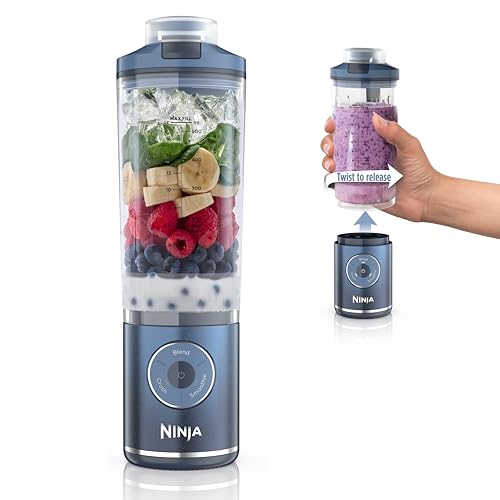

As an Amazon Associate we earn from qualifying purchases at no extra cost to you. Ratings are shown as listed on Amazon.
Best portable blenders by situation
| Best for | Recommended type or model | Why it fits | Main compromise |
|---|---|---|---|
| Daily office smoothies | Ninja Blast | 18-ounce vessel, USB-C charging, stronger performance than many small personal blenders | Heavier and wider than the lightest travel models |
| Light luggage and commuting | BlendJet 2 | 20-ounce capacity, compact shape, USB-C charging, relatively low carry weight | Needs more liquid and smaller pieces for difficult ingredients |
| Occasional use on a tight budget | USB-rechargeable portable blender | Often available in the general $25–$45 range and adequate for soft fruit drinks | Battery, seals, and blade quality vary widely |
| Thicker blends and frequent use | Portable personal blender with a higher-powered motor and removable cup | Better circulation and more consistent texture | Usually costs more, weighs more, and may still struggle with ice |
| Maximum capacity | 20-ounce portable blender | More useful for a meal-sized smoothie or two smaller drinks | A full cup is heavier and harder to blend evenly |
Head-to-head: BlendJet 2 versus Ninja Blast
| Feature | BlendJet 2 | Ninja Blast |
|---|---|---|
| Advertised capacity | 20 ounces | 18 ounces |
| Charging | USB-C rechargeable | USB-C rechargeable |
| Typical claimed battery endurance | Up to about 15 blends per charge, depending on ingredients and age | Up to about 15 blends per charge, depending on ingredients and age |
| Container material | Plastic travel jar | Plastic travel jar with drinking lid |
| Blade arrangement | Small integrated blade assembly | Integrated blade assembly designed for portable use |
| Approximate empty weight | About 1.5 pounds, depending on version | About 1.6 pounds, depending on version |
| General market price | About $50–$75 | About $50–$80 |
These are manufacturer-style specifications and can differ by color, bundle, or regional version. Battery claims also assume favorable ingredients and a healthy battery; they should not be interpreted as a guaranteed number of full frozen smoothies.
Choose the BlendJet 2 for lighter, simpler travel
The BlendJet 2 makes sense when the blender will spend most of its time in a backpack, desk drawer, or carry-on. Its 20-ounce capacity is generous for the size, and USB-C is convenient because the same cable may charge a phone, earbuds, or laptop accessories. It works best with liquids, protein powder, yogurt, and soft fruit cut into small pieces.
Its limitations appear with frozen fruit and ice. The compact blade and motor need enough liquid to create circulation, so filling the jar with dense ingredients can leave an unmixed layer around the blades. A short pause to shake the vessel, followed by another cycle, is often more effective than running it continuously.
Choose the Ninja Blast for a sturdier everyday option
The Ninja Blast is a better fit for someone who makes a drink at work most days and does not mind carrying a slightly larger appliance. Its 18-ounce vessel is a little smaller than the BlendJet 2, but the design places more emphasis on usable blending performance and a practical drinking lid. It is still a small personal blender, not a substitute for a high-powered countertop model.
The Blast is preferable for smoothies containing soft frozen fruit, provided the pieces are small and the recipe includes enough liquid. It can usually produce a more even drink than the weakest generic portable blenders, but ice-heavy recipes may still leave chunks. For frequent use, that difference matters more than a two-ounce capacity advantage.
What to check before buying
Battery life and charging port
Look for USB-C rather than a proprietary charging connector. USB-C simplifies travel and makes replacement cables easier to find. A claim such as “15 blends” is most useful for short cycles with liquid-heavy recipes. Thick mixtures, repeated attempts, a cold battery, and an aging battery can reduce runtime considerably.
For office use, calculate charging frequency rather than relying only on the headline number. If you blend once per weekday, a claimed 15-cycle battery might theoretically cover three weeks. In practice, allowing for difficult recipes and battery aging, planning to recharge weekly is more realistic.
Capacity and useful fill level
An 18- to 20-ounce jar does not provide 18 to 20 ounces of usable smoothie in every recipe. You need headspace for circulation, and the contents expand slightly when blended. A practical working load is often around 14–17 ounces, depending on the ingredients and the jar’s fill markings.
For one drink, 16 ounces is usually enough. Choose 20 ounces if you want extra room for a bulky fruit-and-yogurt mixture, but remember that every ounce of liquid also adds weight to your bag. A full 20-ounce drink weighs approximately 1.25 pounds before counting the blender itself.
Blade performance
Blade count alone does not predict results. Motor torque, blade shape, jar geometry, ingredient order, and liquid level matter just as much. Portable models are generally strongest with:
- Water, milk, or other liquid as the first ingredient
- Protein powder or soft ingredients next
- Fresh fruit cut into pieces of roughly 1 inch or smaller
- Small amounts of frozen fruit added gradually
Do not judge a portable blender by whether it pulverizes ice once. Repeated ice-heavy cycles increase battery and motor strain, and some manufacturers do not recommend using loose ice at all. If crushed ice, nut butter, fibrous vegetables, or large frozen portions are central to your recipes, a corded personal blender is usually the better purchase.
Leak resistance
A leak-resistant lid is not the same as a leak-proof guarantee under every condition. Inspect the silicone gasket, threaded lid, drinking spout cover, and any removable blade seal. Before placing a filled blender in luggage, run a short test with water, close the lid firmly, and keep the vessel upright inside a washable bag.
Do not transport a recently blended drink with the blending button enabled or with the blade base loosely attached. Pressure from a warm liquid, a poor seal, or accidental activation can create a mess. For a commute, a separate bottle with a secure cap may be safer for storage after blending.
Cleaning and ownership
The easiest portable blender to own is one that can be rinsed immediately. Add warm water and a small drop of dish soap, secure the lid, and run a brief cycle. Rinse afterward and leave the components separated to dry. This removes residue before protein powder, dairy, or fruit fiber hardens around the gasket.
Never immerse the motor base or charge port. Do not assume every blade assembly is dishwasher-safe; check the product instructions for the specific version. A small cleaning brush is useful around the seal, where pulp and powder collect.
Durability realities
The first parts likely to cause trouble are usually the silicone gasket, lid hinge or drinking cover, charging port, and battery—not the stainless-steel blade itself. Repeatedly blending overly thick mixtures can also stress the motor coupling. A blender that begins to smell hot, stalls repeatedly, or needs several charges for one normal drink should be allowed to cool and inspected rather than forced through more cycles.
Replacement lids, gaskets, or blade assemblies may not be available for every inexpensive generic model. Before buying, check whether the manufacturer sells those parts and whether the warranty covers the battery. A slightly higher purchase price can be cheaper than replacing an entire blender after a worn seal causes leaks.
Best buying decision
Choose the Ninja Blast if blending consistency, a practical workday capacity, and a more substantial design matter most. Choose the BlendJet 2 if low-fuss USB-C charging, a 20-ounce jar, and easy packing are the priorities. Choose a generic portable blender only when your recipes are simple and you have confirmed the charging type, seal design, return policy, and availability of replacement parts.
Whichever model you select, treat it as a compact blender for liquid-based single servings. Cut ingredients small, add liquid first, avoid overfilling, clean immediately, and keep the motor base dry. Those habits have more effect on daily reliability than a small difference in advertised battery cycles or blade count.




Write Your Review
No reviews yet. Be the first to share your experience!