

Key takeaways
- Record your busiest-hour batch count, not your average daily volume.
- Measure counter width, depth, overhead clearance, and the distance to the sink.
- Choose a 48- to 64-ounce jar for mostly individual drinks and a larger jar for genuine batch production.
- Select programmable cycles for standardized menus and variable speed for chef-controlled textures.
- Prioritize noise reduction when customers or staff remain within a few feet of the machine.
- Compare warranty terms and replacement-part availability before comparing motor ratings.
The best commercial blenders for high-volume use are the Vitamix The Quiet One for customer-facing counters, the Blendtec Stealth 885 for programmable batch consistency, and the Vitamix Vita-Prep 3 or Waring MX1500XTX for kitchens that prioritize throughput over low noise.
Our top picks
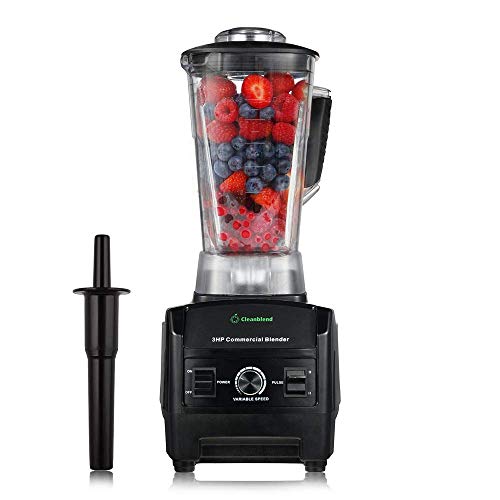
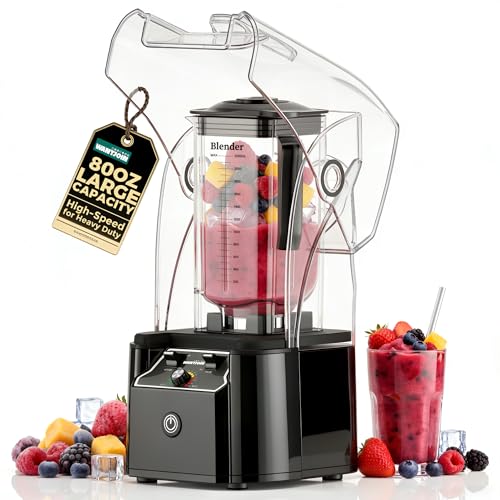


As an Amazon Associate we earn from qualifying purchases at no extra cost to you. Ratings are shown as listed on Amazon.
Best commercial blenders at a glance
| Model | Motor rating | Jar capacity | Controls | Best fit |
|---|---|---|---|---|
| Vitamix The Quiet One | 3 peak horsepower | 48 oz / 1.4 L | Six programmed cycles, pulse, manual controls | Cafés, smoothie bars, and open counters |
| Blendtec Stealth 885 | 3.8 peak horsepower | 90 oz / 2.7 L WildSide+ jar | Programmable cycles, pulse, manual speed control | High-volume drinks and repeatable recipes |
| Vitamix Vita-Prep 3 | 3 peak horsepower | 64 oz / 1.9 L | Variable-speed dial and pulse | Chefs who need tactile control |
| Waring MX1500XTX | 3.5 peak horsepower | 64 oz / 1.9 L | Variable speed, pulse, electronic controls | Bars, restaurants, and prep kitchens |
| Hamilton Beach HBF900S | 4 peak horsepower | 64 oz / 1.9 L | Programmable cycles and manual controls | Commercial operations seeking a large control set |
Horsepower figures are manufacturer ratings and are not a direct measure of finished drink speed. Jar shape, blade design, ingredient temperature, ice size, and programmed ramping can matter just as much. A blender with a slightly lower advertised rating may produce faster service if staff can load it, blend it, and unload it without delays.
Our top picks by operating situation
Best for an open customer-facing counter: Vitamix The Quiet One
The Quiet One is designed around noise reduction rather than maximum jar volume. Its sound enclosure makes it a strong choice where a blender operates beside customers, cashiers, or conversational seating. The 48-ounce container is smaller than the 64- or 90-ounce vessels on several competitors, but that can be an advantage when recipes are portioned individually and staff need a manageable jar.
Its programmed cycles help different employees produce more consistent smoothies, frappés, and other blended drinks. The main trade-off is capacity: a business serving large batches may need more cycles or an additional prep blender. The enclosure also occupies valuable counter space and must be kept clear of spilled ingredients so its vents and moving parts remain accessible.
Best for repeatable high-volume drinks: Blendtec Stealth 885
The Stealth 885 combines a sound enclosure with a large 90-ounce WildSide+ jar and programmable operation. That combination suits a juice bar or concession operation where several employees repeat a limited menu throughout the day. A large container can reduce the number of batches, although the operator must still respect the recipe’s minimum and maximum fill levels.
Its value is greatest when recipes have been standardized. Programmed cycles can reduce variation caused by employees stopping a blend too early or running it longer than necessary. The larger jar is less convenient for small individual portions, and a fully loaded container is heavier to lift, pour, and wash.
Best for chef-controlled prep: Vitamix Vita-Prep 3
The Vita-Prep 3 uses a variable-speed dial and pulse control instead of focusing on a large menu of automated programs. This is useful for sauces, soups, dressings, purées, and other preparations where a chef wants to change texture during the blend. The 64-ounce container is a practical middle ground for restaurant prep.
It is not the first choice for a public counter where sound is a major concern. It also depends more on operator technique: inexperienced staff may produce inconsistent results if speed, batch size, or blending time is not documented.
Best for a rugged restaurant workhorse: Waring MX1500XTX
The MX1500XTX is aimed at demanding bar and kitchen work, with a high-power motor, 64-ounce jar, variable-speed operation, and pulse control. It is a sensible choice when the blender will handle frozen drinks, sauces, dressings, and prep rather than one narrow beverage menu.
Compared with an enclosed quiet model, it generally offers a less discreet sound profile. Its advantage is direct access to controls and a straightforward workflow. A separate sound shield or remote placement may be worth considering if it will operate near diners.
Decision matrix for commercial buyers
| Your situation | Most suitable direction | Why |
|---|---|---|
| Low to moderate budget, occasional service | Commercial 2 to 3 horsepower variable-speed blender | Lower purchase cost and simpler controls are sufficient when the motor is not running continuously. |
| Continuous individual drink orders | Quiet enclosed blender with programmable cycles | Noise control and repeatable timing matter more than maximum batch size. |
| Large batches and a short menu | Blendtec Stealth 885 or another 80- to 90-ounce commercial system | Fewer batches can reduce labor, provided the recipe volume suits the container. |
| Chef-led sauces and purées | Vitamix Vita-Prep 3 or comparable variable-speed model | Manual speed changes make it easier to control texture. |
| Limited counter depth | Open, non-enclosed 48- to 64-ounce blender | Sound enclosures improve comfort but add width and depth. |
| Several inexperienced operators | Programmable model with locked or defined cycles | Standardized timing reduces variation between shifts. |
What matters during repeated service
Motor power and blend speed
For frozen ingredients and dense mixtures, look for a commercial motor in the 3- to 4-horsepower class, but do not select on horsepower alone. The useful question is whether the blender can complete your normal recipe without stalling, excessive tamping, or long cooling pauses. Faster is not always better: a sauce can become aerated, a smoothie can warm up, and a drink can separate if it is processed too long.
Before purchase, time one complete service cycle: loading, blending, pouring, and rinsing. If a blender needs 45 seconds to blend but 90 seconds to wash and reset, reducing blend time alone will not increase output much.
Jar capacity and real batch size
Nominal capacity is not the same as practical capacity. Leave headroom for ingredients that expand, vortex movement, and safe handling. A 64-ounce jar may be appropriate for roughly 32 to 48 ounces of a thick mixture, depending on the recipe. Check the manufacturer’s minimum fill guidance as well; an oversized jar can perform poorly with a very small batch.
Use the jar size that matches your orders. For example, if a shop sells 16-ounce drinks and produces one drink per cycle, a 48-ounce jar may be easier to lift and clean than a 90-ounce container. If it routinely prepares 50 to 70 ounces at once, the larger vessel can save labor.
Noise, controls, and staff consistency
Open-counter operations should prioritize an acoustic enclosure or a blender designed for reduced sound. In a back kitchen, direct access and easy cleaning may be more valuable than quiet operation. Programmed cycles are helpful when recipes are fixed; variable-speed controls are better when texture changes from one preparation to the next.
Look for a pulse function, clear speed selection, an easy-to-read display if programs are used, and controls that can be operated with clean hands. Touch-sensitive panels can be convenient, but physical switches or dials may be preferable in wet, high-use prep areas.
Cleaning and durability: the ownership details that decide value
The blade assembly, drive socket, jar bearings, lid, and control interface usually experience more practical wear than the motor itself. Repeatedly running a dry jar, forcing frozen blocks into the blades, or lifting a full container by its lid can shorten service life. Staff should cut very hard produce into smaller pieces, add liquid according to the recipe, and use the tamper only through its intended lid opening.
After each batch, rinse the jar before residue dries. For a compatible self-cleaning cycle, use warm water and a small amount of approved detergent, run the cycle for the manufacturer’s specified time, then rinse and air-dry. This is not a substitute for periodic manual inspection: seals, blade bearings, and the underside of the lid can retain food particles.
Do not immerse the motor base or spray liquid into its vents. Wipe it with a damp cloth, disconnect power before cleaning around controls, and keep the base level so vibration does not gradually move it across the counter.
Warranty and service questions
Commercial warranties vary by model and may distinguish the motor base from the jar, blade assembly, and accessories. Before buying, confirm the warranty period, whether coverage applies to business use, who pays shipping, and whether authorized service is available in your region. A long warranty is less useful if a replacement jar takes weeks to arrive during peak season.
Ask about replacement jars, lids, blades, drive sockets, and sound-enclosure components. A blender that costs more initially can be cheaper to own if common wear parts are available and replaceable rather than requiring complete equipment replacement.
How to choose without overbuying
- Record your busiest-hour batch count, not your average daily volume.
- Measure counter width, depth, overhead clearance, and the distance to the sink.
- Choose a 48- to 64-ounce jar for mostly individual drinks and a larger jar for genuine batch production.
- Select programmable cycles for standardized menus and variable speed for chef-controlled textures.
- Prioritize noise reduction when customers or staff remain within a few feet of the machine.
- Compare warranty terms and replacement-part availability before comparing motor ratings.
For most high-volume beverage businesses, the final decision is between workflow consistency and flexibility. Choose The Quiet One when noise and individual drink service dominate, the Stealth 885 when large repeatable batches justify its footprint, and the Vita-Prep 3 or MX1500XTX when a kitchen needs hands-on control and a durable general-purpose workhorse.




Write Your Review
No reviews yet. Be the first to share your experience!