

Key takeaways
- Compare the best butter churns, from a Kilner hand-crank jar to a shake-style maker, with capacity, gear and cleanup notes for small home batches.
Making butter at home starts with a single ingredient, heavy cream, and a tool that agitates it until the fat separates from the buttermilk. A butter churn does that agitation in a contained jar, so the cream stays put while you crank or shake, and the finished butter can be rinsed, salted, and shaped the way your household likes it. For cooks who want control over salt and add-ins, a small countertop churn turns an occasional project into a repeatable routine.
This guide compares five butter churns that take different approaches to the same job. Four are hand-crank jar churns in glass, from a compact Kilner jar to a larger 51-ounce mason jar design, and one is a small shake-style maker for very small batches. Each entry sticks to facts stated in the product name, listing, or published roundups, and anything a listing leaves unclear is marked as such.
As an Amazon Associate, we earn from qualifying purchases.
Quick answer
For most home kitchens, the Kilner Small Manual Butter Churner is the straightforward starting point, with a hand crank and a glass jar from a long-running preserving brand. The RDGDFONG 51-ounce churn suits bigger batches, the CAROD 1.2-liter churn adds a sifting lid, the Paderno maker brings a rectangular glass jar, and the Chef’n Buttercup covers single small servings.
Kilner Small Manual Butter Churner

Kilner is best known for preserving jars, and its small manual churner applies the same glass-jar thinking to butter. You add cream to the jar, fit the crank lid, and turn the handle while the internal paddle agitates the cream until butter grains form and separate from the buttermilk. The clear jar lets you watch the change happen, which helps first-time makers learn what the separation stage looks like.
Because the design is a jar with a crank mechanism rather than a powered appliance, there is no cord, no motor to store, and very little setup between batches. The listing identifies this as the small manual model, with model number 0025.348/X, so check the stated jar capacity on the listing before ordering if batch size matters to you, and confirm the care guidance there too, since crank heads and jars can have different washing instructions. For a recognizable brand and a simple first churn, this is the low-friction pick.
Specs
- Type: Manual hand-crank jar butter churner
- Brand: Kilner
- Model: 0025.348/X
- Jar material: Glass, per the product name and brand records
- Capacity: Confirm on the listing
- Power: None, hand operated
RDGDFONG Butter Churn, Wooden Handle, 51 oz Mason Jar

The RDGDFONG churn is the large-capacity option in this group, built around a 51-ounce mason jar with a wooden handle and a stainless steel gear driving a silicone fan blade. The listing frames it as a cream mixer as well as a butter maker, and the bigger jar suits households that bake often and want a larger batch from a single session.
The wooden handle is the traditional touch here, paired with metal gearing rather than a simple dasher. With a jar this size, plan on enough cream to make the batch worthwhile and enough counter room to crank comfortably. The listing does not state a churning time, so treat timing as dependent on cream temperature and cranking speed.
Specs
- Type: Manual hand-crank mason jar butter churn
- Brand: RDGDFONG
- Capacity: 51 ounces, per the listing title
- Handle: Wooden
- Gear: Stainless steel, per the listing title
- Blade: Silicone fan blade, per listing records
- Power: None, hand operated
CAROD Traditional Manual Butter Churn Maker, 1.2 L

The CAROD Traditional churn sits between the compact jars and the largest option, with a 1.2-liter glass jar and a hand crank. Its distinguishing feature, stated in the product name, is a sifting lid, along with an upgraded design the maker describes as protecting hands from injury during cranking. For households where younger helpers want a turn at the crank, that lid and guard design is worth a look.
The 1.2-liter size is a practical middle ground: large enough for a family batch, small enough to store in a cupboard. The listing describes butter within about 15 minutes, though actual time varies with cream temperature and how steadily the crank turns. As with the other glass jars here, wash and dry the crank assembly promptly after use, because dairy residue is best not left sitting. Confirm the exact included parts on the listing, since churn kits vary.
Specs
- Type: Manual hand-crank jar butter churn maker
- Brand: CAROD
- Capacity: 1.2 liters, per the product name
- Lid: Sifting lid, per the product name
- Jar material: Glass, per the product name
- Power: None, hand operated
Paderno World Cuisine Fresh Butter Maker

The Paderno World Cuisine maker takes a different shape from the round mason jars above. Published roundups describe a rectangular glass container with a crank mechanism, stainless steel gears, and a jar capacity of about 6.7 cups, with a recommendation to add no more than about 4 cups of cream so the handle stays easy to turn. The rectangular footprint can sit steadily on a counter and store neatly.
That larger working capacity makes this the pick for cooks who want a generous batch without moving up to a farm-scale churn. The same roundups describe a churning time of several minutes once the cream is at a suitable temperature, with cream around 65 degrees Fahrenheit often suggested as a starting point for butter making in general. Because this ASIN rests on a roundup record rather than a directly surfaced listing page in this session, treat every specification as provisional and confirm capacity, materials, and included parts on the listing before ordering.
Specs
- Type: Manual hand-crank butter maker
- Brand: Paderno World Cuisine
- Jar shape: Rectangular, per published roundups
- Jar capacity: About 6.7 cups, per published roundups
- Recommended cream fill: About 4 cups maximum, per published roundups
- Gears: Stainless steel, per published roundups
- Capacity note: Confirm on the listing
Chef’n Buttercup Butter Maker
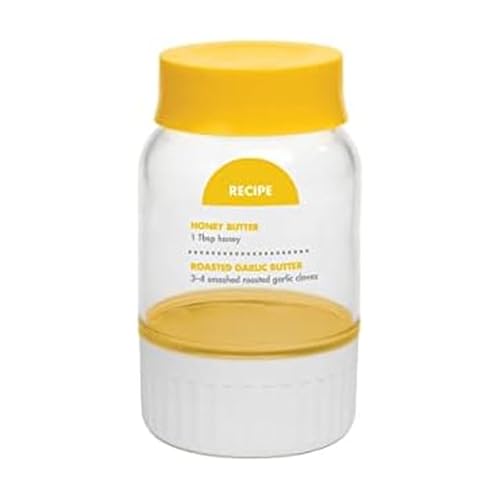
The Chef’n Buttercup is the small-batch outlier in this guide. Instead of a crank, it uses a shake-style method: cream goes into the container, you shake, and the butter collects in an included ramekin at the base. Roundups of the product put the yield at up to about a quarter cup of butter per batch, which is a serving or two rather than a weekly supply.
That tiny scale is the point. The Buttercup suits a single breakfast, a small compound butter with herbs or garlic, or a first experiment before committing to a full-size churn. It takes very little storage space and has no gears to wash, though it asks for shaking effort instead of cranking. The listing identifies the model as 102-567-017 in the Lemon and Meringue colorway. If your household goes through butter quickly, treat this as a complement to a jar churn rather than a replacement.
Specs
- Type: Shake-style butter maker
- Brand: Chef’n
- Model: 102-567-017
- Color: Lemon and Meringue, per the product name
- Collection: Butter collects in an included ramekin, per published roundups
- Batch yield: Confirm on the listing
- Power: None, hand operated
How to choose
Start with batch size, because it decides almost everything else. A shake-style maker or a small jar churn suits occasional small batches. A jar in the 1.2-liter range covers a family batch without taking over a cupboard, while the 51-ounce RDGDFONG jar and the Paderno maker, with its roughly 6.7-cup jar per roundups, suit bakers who use butter across several recipes each week. Remember that the cream fill is always less than the jar size, since the cream needs room to move.
Next, think about the mechanism. Hand cranks with metal gears work steadily and are easier on the arms over a full batch. A shake maker has fewer parts, but the effort is all yours.
Finally, check what is included. Some churns are the jar and crank alone, while kits elsewhere in this category add paddles, cloth, or molds, so read the box contents carefully. You will also need a strainer or cloth for rinsing the butter and a bowl of cold water for washing it, whichever churn you pick. Cream temperature matters more than gadget choice: cream that is cool but not fridge-cold generally churns more readily.
Who should skip
Skip this category if your household uses butter only occasionally and a store-bought block already covers your needs, because a churn earns its space only when it is used regularly. Also skip these manual tools if cranking or shaking for several minutes is not realistic for you; an electric countertop appliance or a stand mixer would be a better route to the same result.
Also skip the smallest option, the Chef’n Buttercup, if you bake in volume, since its per-batch yield is a small serving rather than a recipe quantity. And if you want cultured butters that need cultures and long resting times, a basic churn alone will not cover the whole process, so read up on the full method before buying any of these tools.
FAQ
How long does it take to churn butter by hand?
It depends on the churn, the amount of cream, and the cream temperature. Makers of jar churns in this size range commonly describe times in the region of 10 to 15 minutes of cranking, and the CAROD listing describes butter within about 15 minutes. Cooler cream and a steady pace generally work better than fast, uneven cranking.
How much butter does a batch make?
Yield depends on the fat content of the cream and how much you start with. As a general guide, finished butter is roughly half the volume of the cream, with the rest becoming buttermilk. The Chef’n Buttercup is the exception in scale, collecting up to about a quarter cup per batch per published roundups, so confirm yields on each listing.
What should I do with the buttermilk that is left over?
The liquid left after churning is a thin buttermilk that works in pancakes, biscuits, dressings, and marinades. Pour it into a clean jar, refrigerate it, and use it within a few days. Planning one baking or breakfast recipe around the same session means nothing from the batch goes to waste.
How do I clean and store a butter churn?
Wash the jar and paddle parts promptly in warm soapy water, rinse, and dry the crank mechanism thoroughly so no dairy residue remains in the gearing. Store crank heads fully dry. Always follow the care instructions on the specific listing, since dishwasher guidance varies between models.
Final verdict
For a first butter churn, the Kilner Small Manual Butter Churner is the simplest route: a glass jar, a crank, and a brand long associated with kitchen jars. Choose the RDGDFONG 51-ounce churn if batch size is your priority, the CAROD 1.2-liter churn if the sifting lid and mid-size jar appeal, or the Paderno maker if you prefer a rectangular jar and larger working capacity, after confirming its details on the listing. Keep the Chef’n Buttercup in mind for single servings and small flavored butters.
Product and ASIN Reference
| Product | ASIN |
|---|---|
| Kilner Small Manual Butter Churner | B07N8RNP1C |
| RDGDFONG Butter Churn, Wooden Handle, 51 oz Mason Jar | B0D7YY6Y1W |
| CAROD Traditional Manual Butter Churn Maker, 1.2 L | B0G3WC7MV6 |
| Paderno World Cuisine Fresh Butter Maker | B001HL0I9Y |
| Chef’n Buttercup Butter Maker | B00FC8U71W |
More from Amazon
Programs that pair well with the guide above. Offers and eligibility are set by Amazon and may change.
Set up recurring deliveries of everyday items on eligible products. Terms and savings are set by Amazon.
Explore Subscribe & SaveCollect the home and kitchen items you want in one registry that guests can shop from.
Create a wedding registryFree shipping on eligible items, Prime Video and more. Eligible new members can start with a free trial.
Start a Prime free trialAudiobooks and podcasts to listen to on the go. Eligible new members can start with a free trial.
Try Audible freeAs an Amazon Associate we earn from qualifying purchases.


Write Your Review
No reviews yet. Be the first to share your experience!