

Key takeaways
- Hard vegetables: Wide-chute vertical models are convenient, but alternating carrots with softer produce can reduce pressure buildup.
- Leafy greens: Roll leaves into compact bundles and feed them with celery or cucumber. Loose leaves can ride around the auger instead of reaching the screen.
- Celery: Cut stalks into short pieces, ideally around 1–2 inches, to reduce stringy fibers wrapping around the auger.
- Soft fruit: Alternate it with firm produce, or expect thicker juice and more pulp. Very soft ingredients alone can overwhelm some screens.
- Frozen ingredients: Use only the accessories and instructions intended for frozen desserts; do not assume a juicer is a blender.
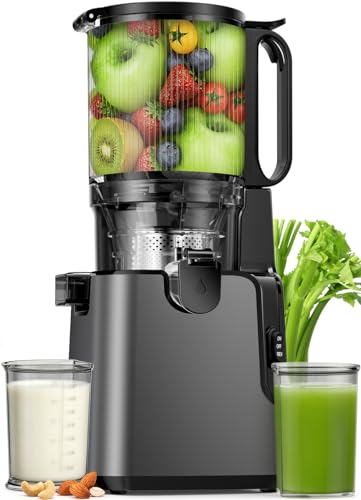
The best masticating juicer for most households is the Nama J2 for hands-off daily juicing, while the Kuvings EVO 820 is the stronger choice for larger batches, the Omega MM900HDC suits leafy greens and celery, and the Hurom H400 is the better compact, easy-clean option.
Our top picks


As an Amazon Associate we earn from qualifying purchases at no extra cost to you. Ratings are shown as listed on Amazon.
Best masticating juicers at a glance
Slow—or masticating—juicers crush and press produce through a fine screen rather than shredding it with a fast-spinning blade. That design usually means less foam, quieter operation, and good extraction, but it also requires smaller pieces unless the machine has a genuinely wide hopper.
| Juicer | Best for | Motor | Feed system | Approx. footprint | Noise and cleaning |
|---|---|---|---|---|---|
| Nama J2 | Frequent, low-effort family juicing | 150 W | Self-feeding hopper, about 5.4 in wide | About 10.6 × 9.5 in | Quiet; moderate cleaning |
| Kuvings EVO 820 | Large batches and whole-fruit convenience | 240 W | Wide-mouth hopper, about 3.2 in | About 11 × 8.5 in | Quiet; moderate cleaning |
| Hurom H400 | Easy cleanup and everyday juice | 150 W | Large self-feeding hopper | About 9.5 × 8.5 in | Quiet; relatively easy cleaning |
| Omega MM900HDC | Celery, leafy greens, and small servings | 150 W | Conventional narrow chute | About 15.5 × 6.5 in | Quiet; several parts to rinse |
| Tribest Greenstar Elite | Maximum extraction and heavy use | 200 W | Conventional chute | About 18.5 × 6.8 in | Quiet; most involved cleaning |
Dimensions and weights can vary slightly by production version and included accessories. Treat the figures as planning numbers, not a guarantee that every package will be identical.
Our picks by buying situation
| Your situation | Best fit | Why | Main compromise |
|---|---|---|---|
| You juice several times per week and dislike prep | Nama J2 | Its large hopper lets you load multiple pieces before the auger needs attention. | Tall and relatively expensive. |
| You make juice for several people | Kuvings EVO 820 | Powerful motor, wide chute, and good batch capacity. | Heavy and not especially easy to store. |
| You want the least complicated cleanup | Hurom H400 | The enclosed strainer design reduces the number of tiny mesh openings to scrub. | Pulp can be wetter than with a more aggressive twin-gear design. |
| You mainly juice celery or greens | Omega MM900HDC | A dedicated adjustable end cap helps tune pressure for fibrous produce. | Narrow chute means more cutting and feeding. |
| You prioritize extraction over convenience | Tribest Greenstar Elite | Twin gears handle fibrous greens and dense vegetables with very dry pulp. | Longest assembly, cleaning, and storage footprint. |
Head-to-head: what separates the leading designs?
Nama J2 versus Kuvings EVO 820
Both are strong choices for people who want to put produce in the machine without cutting every item into narrow strips. The Nama J2 goes further with a very large self-feeding hopper: load produce in stages, then allow the auger to draw it down. That makes it particularly convenient for mixed juices and routine morning use.
The EVO 820 has a more conventional wide chute and a stronger motor rating. It is the better choice when you regularly make larger quantities or process dense ingredients such as carrots and beets. Its taller, heavier body also feels more like a permanent countertop appliance. For one or two glasses at a time, the Nama’s reduced feeding effort is usually more valuable than the EVO’s extra power.
Hurom H400 versus an ordinary fine-mesh juicer
The H400’s main advantage is ownership effort. A traditional mesh strainer can extract excellent juice, but its small holes collect pulp and require careful brushing. The H400 uses a different strainer arrangement designed to make rinsing faster. That does not make it maintenance-free: fibrous celery and leafy greens still need prompt rinsing before residue dries.
Choose a conventional fine-mesh model if you want maximum control over pulp texture. Choose the H400 if you know that difficult cleanup will cause the machine to stay unused.
Omega MM900HDC versus Tribest Greenstar Elite
The Omega is a single-auger horizontal machine with a compact width and a particularly useful celery setting. It performs well with wheatgrass and leafy greens when the produce is fed slowly. Its limitation is preparation: long fibers must be cut into short lengths, and soft fruit can produce a thicker, more pulpy result.
The Greenstar Elite uses twin gears and is the more extraction-focused design. It can produce exceptionally dry pulp from fibrous ingredients and offers more control for hard produce, greens, and some food-processing tasks. The price is a longer assembly and more parts to wash. This is a specialist choice for frequent green-juice users, not necessarily the best first juicer.
Juice yield, pulp, and leafy-green performance
Juice yield depends more on produce freshness, variety, temperature, and feeding technique than on the motor number printed on the box. A useful comparison is pulp dryness: if the discarded pulp is visibly wet and can be squeezed to release a large amount of liquid, the produce may be fed too quickly, the screen may be clogged, or the pressure setting may be unsuitable.
- Hard vegetables: Wide-chute vertical models are convenient, but alternating carrots with softer produce can reduce pressure buildup.
- Leafy greens: Roll leaves into compact bundles and feed them with celery or cucumber. Loose leaves can ride around the auger instead of reaching the screen.
- Celery: Cut stalks into short pieces, ideally around 1–2 inches, to reduce stringy fibers wrapping around the auger.
- Soft fruit: Alternate it with firm produce, or expect thicker juice and more pulp. Very soft ingredients alone can overwhelm some screens.
- Frozen ingredients: Use only the accessories and instructions intended for frozen desserts; do not assume a juicer is a blender.
A twin-gear machine generally has the edge for greens, while a well-designed vertical single-auger machine is easier for mixed household juices. No model eliminates the need to prepare tough, stringy produce.
Cleaning effort and durability realities
Most failures blamed on the motor begin with maintenance: dried pulp hardens in the screen, fibers wind around the auger, and seals become difficult to seat. Rinse removable parts immediately after juicing, then use the supplied brush on the screen or strainer. Do not put the main motor base under running water.
The parts most likely to wear are silicone seals, scraper arms, screens, and augers. Their service life depends on frequency, hard seeds, frozen foods, and whether the machine is forced when jammed. Replacement parts matter more than a small difference in advertised wattage, so check that screens, seals, and augers are available before buying.
Reverse the motor briefly when produce jams; do not push harder with the plunger. Cut strings from celery and pineapple, remove pits and hard seeds, and leave clearance around the motor’s ventilation area. For regular use, a small drying rack or dedicated storage bin prevents the cleaned parts from being reassembled while damp.
Countertop space: a practical fit check
Measure more than the machine’s base. Leave room above a vertical juicer for its hopper lid and enough side clearance to remove the pulp container. A model that is 10 inches wide may need roughly 14–16 inches of usable working width once a container, cutting board, and produce bowl are included.
For a small kitchen, a horizontal Omega-style machine is easier to slide under a cabinet but occupies more front-to-back space. A vertical Nama, Hurom, or Kuvings design uses less depth during operation but may be too tall for a shelf. Weighing 18–22 pounds is common for these machines; twin-gear models can feel substantially heavier and are better left in one location.
Is a premium juicer worth it?
Use frequency is the simplest calculation. Suppose a premium machine costs $500 and you use it four times weekly for three years:
$500 ÷ (4 × 52 × 3) = about $0.80 per use
Add replacement parts, produce, and your time. If you will use the juicer only twice a month, a cheaper and easier-to-store model may deliver better value even if its extraction is slightly lower. Conversely, a wide hopper can save several minutes of cutting each session. At four sessions per week, saving five minutes amounts to more than 17 hours per year.
Final verdict
Choose the Nama J2 for the best balance of convenience and everyday performance. Choose the Kuvings EVO 820 for bigger batches and a powerful wide-feed design. Choose the Hurom H400 when cleanup is your deciding factor, the Omega MM900HDC for celery and greens in modest quantities, and the Tribest Greenstar Elite when maximum extraction and fibrous-produce performance justify the extra work.
Juice is only one part of a varied eating pattern. If you are changing your diet for a medical condition or taking medication affected by particular foods, discuss the change with a qualified healthcare professional.





Write Your Review
No reviews yet. Be the first to share your experience!