

Key takeaways
- Smoke: Enclosed drum machines generally contain smoke better than open fluid-bed machines, but every home roaster needs ventilation. Dark roasting produces much more smoke than light roasting.
- Cooling: Fast cooling stops the roast from continuing through residual heat. Dedicated cooling trays are particularly valuable for batches above 300 g; a machine that takes too long to cool can turn a well-timed roast into a darker one.
- Chaff: Fluid-bed roasters commonly separate chaff into a collector, but fine flakes can escape during emptying. Drum machines usually keep more chaff inside the drum, though the tray and exhaust path still require cleaning.
- Noise: Air roasters have a constant fan sound. Drum machines are usually less intrusive, but their motors and cooling fans remain audible.
The best coffee roaster for fresh beans at home is the FreshRoast SR800 for flexible small-batch roasting, the Behmor 2000AB Plus for quieter drum roasting with stronger smoke control, and the Aillio Bullet R2 for frequent, high-volume users who want detailed profile control.
Home roasters differ more in workflow than in headline capacity. A large batch is useful only if the machine can cool it quickly; a powerful profile editor is less helpful if you have little ventilation; and a compact roaster may still need substantial clearance because chaff and smoke exit above the chamber. The comparison below focuses on the factors that affect daily ownership: usable batch size, roast control, smoke, cooling, noise, chaff, and safe operating space.
Our top picks



As an Amazon Associate we earn from qualifying purchases at no extra cost to you. Ratings are shown as listed on Amazon.
Best coffee roasters by situation
| Situation | Best fit | Why it fits | Main compromise |
|---|---|---|---|
| First home roaster, 100–200 g batches | FreshRoast SR800 | Simple fluid-bed design, visible beans, adjustable fan and heat | Louder fan and more chaff in the surrounding area |
| Apartment or shared kitchen | Behmor 2000AB Plus | Enclosed drum and integrated smoke-suppression system | Longer roast-and-cool cycle; ventilation is still required |
| Compact, repeatable profile roasting | Kaffelogic Nano 7e | Small footprint and automated profile control | Small batches, typically around 100 g |
| Frequent roasting for several people | Aillio Bullet R2 | Large capacity, powerful heating, logging and detailed control | High purchase price, weight, heat and electrical demand |
| Traditional drum-roast workflow | Gene Cafe CBR-101 | Excellent visibility and straightforward temperature/time adjustment | Small batch size and less automation than newer profile-driven machines |
Head-to-head comparison
| Roaster | Advertised maximum batch | Practical starting batch | Roasting method | Cooling approach | Approximate machine weight |
|---|---|---|---|---|---|
| FreshRoast SR800 | 226 g | 100–200 g | Fluid bed | Fan-driven cooling in the roast chamber | About 2.7 kg |
| Behmor 2000AB Plus | 454 g | 225–340 g | Enclosed drum | Automatic cooling cycle | About 10 kg |
| Gene Cafe CBR-101 | 250 g | 150–200 g | Rotating glass drum | Separate cooling cycle with airflow | About 5 kg |
| Kaffelogic Nano 7e | 120 g | 70–100 g | Fluid bed | Integrated forced-air cooling | About 3 kg |
| Aillio Bullet R2 | 1,000 g | 400–800 g | Electric drum | Dedicated cooling tray | About 25 kg |
Maximum capacity is not the same as ideal capacity. A roaster usually produces more even results when it is not filled to its absolute limit, particularly with dense green coffee or light roast profiles. A useful planning assumption is that roasted coffee weighs about 12–18% less than green coffee because moisture leaves during roasting. A 225 g green batch therefore yields roughly 185–200 g roasted coffee.
FreshRoast SR800: best for learning and small, adjustable batches
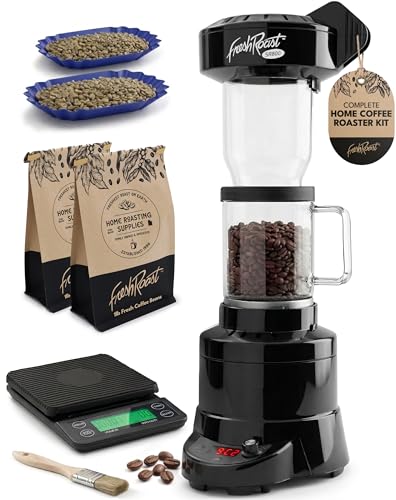
The SR800 uses a glass roasting chamber and moving hot air. Its transparent design makes it easy to observe bean movement, color changes and the approach of first crack. Fan speed and heat can be adjusted during the roast, so it is suitable for experimenting with light, medium and darker profiles.
Its main advantage is responsiveness. Small batches change quickly, which lets an experienced user correct a roast without waiting for a heavy drum to react. The trade-off is noise: the high-speed fan is clearly audible, and the machine produces more visible chaff than an enclosed drum roaster. Place the chaff collector beneath a hood or near an exhaust fan, not directly beneath an overhead cabinet.
For an initial 100 g batch, allow approximately 30 cm of clear space above the chamber and at least 15 cm on the sides. The actual exhaust must remain unobstructed. An extension tube or aftermarket chaff solution may improve ventilation, but it should not restrict airflow or expose plastic parts to heat.
Behmor 2000AB Plus: best enclosed option for smoke-conscious kitchens
The Behmor’s rotating steel drum and enclosed roasting chamber make it substantially tidier than an open fluid-bed design. Its smoke-suppression system reduces smoke during normal roasting, particularly compared with an open chamber approaching second crack. It also offers preset programs and manual control, making it approachable for beginners while leaving room to adjust time and roast level.
This is the strongest choice when noise and loose chaff matter. The drum is quieter than a high-speed air roaster, and most chaff remains inside the drum or chaff tray. It is not smoke-free, however. Coffee produces smoke as the roast darkens, and the internal suppression system does not replace external ventilation. A window, range hood that actually vents outdoors, or suitable local exhaust is still advisable.
The Behmor’s disadvantages are slower response and a long cooling cycle. Its large nominal capacity can also encourage overloading. For more even results, begin with 225–340 g rather than a full 454 g, especially while learning how a particular bean behaves.
Kaffelogic Nano 7e: best for small spaces and repeatability
The Nano 7e is a compact, automated fluid-bed roaster designed around stored roast profiles. It is appealing when consistency and counter space matter more than batch size. A typical 100 g roast is enough for a few days of coffee, but households that consume several cups daily may need multiple cycles.
Automation reduces the need to stand beside the roaster, but it does not eliminate ventilation requirements. The small chamber still releases smoke and chaff, and its light construction means the surrounding surface should be heat-resistant and stable. Its software-oriented workflow is a better match for someone who wants to repeat a profile than for someone who prefers to make every adjustment manually.
Gene Cafe CBR-101: best for visibility without a large machine
The Gene Cafe uses a rotating glass roasting chamber, allowing an unobstructed view of the beans. Its temperature and time controls are accessible, and the drum action is gentler than the vigorous bean movement of a fluid-bed roaster. It is a practical middle ground for users who want visual feedback and a traditional drum-style result.
The relatively small batch makes it less suitable for a large household, and cooling deserves attention. Do not leave beans sitting hot after the roast ends; complete the cooling cycle before transferring them to a metal tray if additional cooling is needed. The glass chamber also needs careful handling after repeated heating and cooling cycles.
Aillio Bullet R2: best for serious volume and profile control
The Bullet R2 is aimed at users who roast frequently or want to develop repeatable profiles with detailed logging. Its one-kilogram nominal capacity is in a different class from countertop fluid-bed machines, and its dedicated cooling tray makes larger batches practical.
This capacity comes with ownership demands. The machine is heavy, generates considerable heat, and needs a sturdy, level surface with generous clearance. A safe installation should leave roughly 30 cm or more above the exhaust path, keep combustible items well away from the body, and provide effective external ventilation. A small kitchen island or enclosed cabinet is not an appropriate location simply because the machine fits physically.
Smoke control, cooling and chaff: the differences that affect daily use
- Smoke: Enclosed drum machines generally contain smoke better than open fluid-bed machines, but every home roaster needs ventilation. Dark roasting produces much more smoke than light roasting.
- Cooling: Fast cooling stops the roast from continuing through residual heat. Dedicated cooling trays are particularly valuable for batches above 300 g; a machine that takes too long to cool can turn a well-timed roast into a darker one.
- Chaff: Fluid-bed roasters commonly separate chaff into a collector, but fine flakes can escape during emptying. Drum machines usually keep more chaff inside the drum, though the tray and exhaust path still require cleaning.
- Noise: Air roasters have a constant fan sound. Drum machines are usually less intrusive, but their motors and cooling fans remain audible.
How much space do you really need?
Measure more than the appliance’s footprint. Add room to load green beans, remove a hot chamber, empty chaff and access the controls. As a practical minimum, reserve a work area about 60 cm wide and 50 cm deep for a small roaster, with 30 cm of unobstructed vertical space above the exhaust. A large drum roaster may need at least 80 cm of width and 60 cm of depth, plus open space around the cooling tray.
Never roast beneath a low cabinet, beside paper towels, or on a surface that can soften or discolor from heat. Do not operate a roaster unattended, and follow its electrical requirements rather than sharing a marginal extension lead with another high-wattage appliance.
Ownership costs and maintenance
Green coffee often costs roughly $8–$18 per kilogram depending on origin and grade. If a roaster uses 225 g of green coffee and yields about 190 g roasted coffee, the beans cost approximately $1.80–$4.05 per batch before electricity and shipping. At three batches per week, a 1 kg bag lasts about 4.4 batches, not five, because of roasting loss.
Chaff collectors, screens, cooling trays and exhaust paths need regular cleaning. Coffee oils gradually accumulate, especially after dark roasts. The most common avoidable mistakes are overfilling the chamber, blocking airflow, stopping before the beans cool, and storing freshly roasted coffee immediately in a sealed container while it is still releasing carbon dioxide. Let the beans rest in a suitable vented container for several hours, then seal them once the initial degassing has eased.
Final choice
Choose the FreshRoast SR800 if you value visibility, experimentation and modest batches. Choose the Behmor 2000AB Plus if enclosed roasting, lower chaff and a quieter workflow matter most. Choose the Kaffelogic Nano 7e for a compact, repeatable routine, the Gene Cafe for a visible drum roast, and the Aillio Bullet R2 only when your volume, ventilation and workspace justify a much larger machine. The best match is the roaster whose cooling, exhaust and batch size fit your kitchen—not simply the model with the largest capacity.





Write Your Review
No reviews yet. Be the first to share your experience!