

Key takeaways
- Empty the used grounds after every brew; leaving a wet filter in place encourages odors and mold.
- Rinse the filter basket and carafe daily, then wash them with unscented dish soap regularly.
- Wipe the showerhead and the area around the basket because stray grounds can block water distribution.
- Run the manufacturer-approved descaling cycle when the machine signals it or when flow becomes slower.
- Do not assume a “self-clean” button removes coffee oil from the carafe lid; removable parts still need hand washing.
- Do not put a thermal carafe on a hot plate unless its instructions specifically allow it.
The best 12 cup coffee makers for daily brewing are the OXO Brew 12-Cup Coffee Maker for the most balanced design, the Breville Precision Brewer Thermal for control, the Ninja 12-Cup Programmable Brewer for flexible household use, and the Cuisinart DCC-3400P1 for an affordable thermal-carafe option.
Our top picks


As an Amazon Associate we earn from qualifying purchases at no extra cost to you. Ratings are shown as listed on Amazon.
Best 12 cup coffee makers at a glance
| Coffee maker | Best for | Brewing temperature | Carafe and batch size | Typical price range |
|---|---|---|---|---|
| OXO Brew 12-Cup Coffee Maker | Most households | Approximately 197.6–204.8°F | 12 cups; double-wall thermal carafe | $250–$330 |
| Breville Precision Brewer Thermal | Recipe control and specialty coffee | Adjustable, up to approximately 200°F | 12 cups; thermal carafe | $280–$330 |
| Ninja 12-Cup Programmable Brewer | Families wanting flexibility | Hot-brewing range varies by mode | 12 cups; glass or thermal configuration depending on model | $90–$180 |
| Cuisinart DCC-3400P1 | Budget-conscious daily brewing | Selectable temperature settings | 12 cups; thermal carafe | $100–$170 |
| Black+Decker 12-Cup Programmable Coffee Maker | Lowest-cost basic brewing | Standard automatic-drip range | 12 cups; usually glass carafe and hot plate | $35–$70 |
Coffee-machine “cups” are typically 5 fluid ounces, not the 8-ounce measure used for a mug. A 12-cup machine therefore makes about 60 fluid ounces, or roughly seven to eight ordinary 8-ounce servings. If your household fills large travel mugs, a 12-cup brewer may provide only four or five drinks.
1. OXO Brew 12-Cup Coffee Maker: best overall for busy households
The OXO Brew 12-Cup Coffee Maker is the strongest all-round choice when several people want dependable coffee without adjusting many settings. Its brew temperature is designed to stay within the Specialty Coffee Association’s commonly cited 197.6–204.8°F range, and its showerhead distributes water over the grounds more evenly than a single-point drip outlet.
The double-wall thermal carafe avoids the burnt flavor that can develop when coffee sits on a hot plate. A small mixing tube in the carafe helps keep strength more consistent from the first pour to the last. The machine also includes a programmable clock, automatic start, a freshness timer, a pause-and-pour function, and a removable water reservoir.
Choose it if your household usually brews one full pot each morning and values simple controls. Its main disadvantages are a relatively tall footprint and a price well above basic programmable brewers. The thermal carafe also requires careful pouring because its lid must be positioned correctly for a full flow rate.
2. Breville Precision Brewer Thermal: best for control over the recipe
The Breville Precision Brewer Thermal is the better choice for coffee drinkers who switch between regular drip coffee, lighter roasts, iced coffee, and smaller batches. It supports several brewing modes, including Gold, Fast, Strong, Iced, Cold Brew, and My Brew, with adjustable temperature and contact-time settings in the more customized modes.
Its 60-ounce capacity is equivalent to a conventional 12-cup brewer, and it can brew into a thermal carafe or a compatible flat-bottom basket accessory. The machine is also designed to recognize certain filter-basket configurations and regulate its flow accordingly. That can be useful when you want to make a half batch without treating the coffee like a reduced version of a full pot.
This model makes the most sense for experienced brewers who will actually use the controls. For someone who only wants to press a button at 6:30 a.m., the extra settings add cost and cleaning surfaces without much benefit. It is also larger and more visually prominent than a basic drip machine.
3. Ninja 12-Cup Programmable Brewer: best for flexible family use
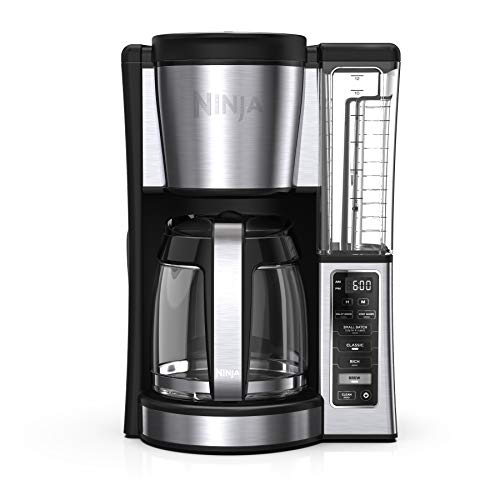
The Ninja 12-Cup Programmable Brewer is a practical middle-ground option for households that want multiple brew strengths, a small-batch setting, and a more convenient water reservoir without moving into specialty-coffee pricing. Depending on the exact version, it is available with a glass carafe and warming plate or a thermal-carafe arrangement, so check the model name before buying.
Its small-batch function is important: brewing four cups in a full-size machine without changing the water-to-coffee ratio can produce weak coffee. The Ninja’s dedicated setting adjusts the process for a smaller volume. Programmable start time, a delay-brew function, and a removable filter holder also suit a household with different morning schedules.
Temperature performance is less precisely specified than on the OXO or Breville machines, so this is primarily a convenience pick rather than a temperature-control pick. If you choose the glass-carafe version, coffee stays hot on the plate but can develop a cooked taste after extended holding. Transfer leftovers to an insulated flask if they will not be consumed soon.
4. Cuisinart DCC-3400P1: best value with a thermal carafe
The Cuisinart DCC-3400P1 provides the familiar programmable-drip format at a lower price than premium brewers. It makes a 12-cup batch, offers selectable regular or bold strength, includes a thermal carafe, and typically lets users adjust the brew temperature across low, medium, and high settings.
The thermal carafe is useful when coffee will be served gradually because it removes the need to keep a heating element running. The machine also includes a self-cleaning cycle and a brew-pause feature. Its controls are more conventional than the Breville’s, which makes it easier for several family members to use without learning a new brewing system.
The trade-off is refinement. The carafe may pour more slowly than premium designs, the display and buttons are less elegant, and the thermal performance depends heavily on preheating the carafe. Run a short rinse of hot water through it before brewing if you want the coffee to remain warmer for longer.
5. Black+Decker 12-Cup Programmable Coffee Maker: best basic budget choice
A Black+Decker 12-Cup Programmable Coffee Maker is appropriate when the priority is a low purchase price and uncomplicated operation. Common versions provide a programmable clock, automatic shutoff, a brew-pause feature, and a glass carafe on a warming plate.
It is less suitable for people who leave coffee sitting for hours. The hot plate can maintain serving temperature, but prolonged heating gradually changes flavor. The brew-temperature specifications are also less detailed than those provided for specialty-oriented machines.
Choose this type when the machine will be emptied soon after brewing, replacement cost matters, or the brewer is used in an office, guest area, or second kitchen. A separate vacuum flask is a useful low-cost improvement for keeping a portion of the batch hot without continued cooking.
How to choose by household situation
| Your situation | Best fit | Why | What to compromise on |
|---|---|---|---|
| One full batch almost every morning | OXO Brew 12-Cup | Consistent temperature, thermal storage, simple programming | Higher price and larger footprint |
| Different roasts and brewing preferences | Breville Precision Brewer Thermal | Adjustable temperature, strength, and brew modes | More setup and a steeper learning curve |
| Two to four people with mixed schedules | Ninja 12-Cup Programmable | Small-batch mode and flexible programming | Less precise temperature documentation |
| Thermal carafe on a moderate budget | Cuisinart DCC-3400P1 | 12-cup capacity and familiar controls | Less polished pouring and interface design |
| Lowest upfront cost | Black+Decker 12-Cup | Basic programmable brewing at a low price | Glass carafe and hot-plate flavor changes |
| Limited counter space | A compact 10- to 12-cup glass-carafe model | Usually shorter than thermal-reservoir designs | More exposure to heat and less convenient storage |
Batch size: calculate what you will really drink
Suppose four people each drink two 10-ounce mugs. That is 80 fluid ounces, or about 16 coffee-maker cups. A 12-cup machine cannot produce that amount in one cycle. You would need either a second brew, a larger commercial-style brewer, or smaller servings.
For a household drinking six 8-ounce mugs, the calculation is different: 6 × 8 = 48 fluid ounces. That fits comfortably within a 12-cup machine’s approximately 60-fluid-ounce capacity, leaving room for absorption in the grounds and minor measuring differences. This is why capacity should be judged by mug size, not the number printed on the front of the machine.
Cleaning and ownership realities
The parts most likely to cause trouble are the carafe lid, filter basket, water reservoir, and the internal water path. Coffee oils accumulate in the basket and carafe lid before they are visibly obvious, while mineral scale gradually restricts water flow and can reduce heating performance.
- Empty the used grounds after every brew; leaving a wet filter in place encourages odors and mold.
- Rinse the filter basket and carafe daily, then wash them with unscented dish soap regularly.
- Wipe the showerhead and the area around the basket because stray grounds can block water distribution.
- Run the manufacturer-approved descaling cycle when the machine signals it or when flow becomes slower.
- Do not assume a “self-clean” button removes coffee oil from the carafe lid; removable parts still need hand washing.
- Do not put a thermal carafe on a hot plate unless its instructions specifically allow it.
Water hardness determines how often descaling is needed. In a hard-water home, monthly maintenance may be reasonable with daily use; in a softer-water area, the interval can be longer. Use the manufacturer’s descaling instructions rather than substituting vinegar if the manual warns against it.
Final recommendation
For most busy households, the OXO Brew 12-Cup Coffee Maker offers the best balance of brewing temperature, carafe design, programming, and cleaning convenience. Select the Breville Precision Brewer Thermal if recipe control matters more than simplicity. Choose the Ninja for mixed batch sizes and family flexibility, the Cuisinart DCC-3400P1 for a practical thermal-carafe value, and a Black+Decker 12-cup model when the lowest initial cost is the deciding factor.






Write Your Review
No reviews yet. Be the first to share your experience!