

Key takeaways
- Compare the best RO/DI filter systems for aquariums by daily output, stage layout and cartridge format, from a compact 50 GPD unit to 100 GPD.
The real decision is not whether to filter your tap water, but what your water actually needs before it touches the tank. Municipal supplies carry chlorine or chloramine, phosphate, silicate and a shifting load of dissolved solids that feed algae and stress sensitive livestock. A reverse osmosis membrane strips out most of that, yet it still leaves a measurable residue behind. The deionization stage is what takes the output the rest of the way to zero TDS, and choosing between systems means matching daily output, stage layout and cartridge format to your water and your routine.
This guide serves nano and small-tank keepers making their first purified water, reef keepers mixing saltwater every week, and freshwater breeders who need a blank slate they can remineralize. The picks were chosen from the stage configurations, gallons-per-day ratings and cartridge styles stated on their Amazon pages: a compact cartridge unit, a tool-free twist-in model, a full canister system with chloramine-rated carbon, and a five-stage unit built around standard housings.
Quick Picks
Disclosure: As an Amazon Associate we earn from qualifying purchases.
| Product | Best for | Key spec from title |
|---|---|---|
| Aquatic Life RO Buddie 4-Stage | A small tank making its first RO/DI water | 50 GPD four-stage with DI resin |
| Aquatic Life Twist-In 4-Stage | Keepers who want tool-free cartridge changes | 75 GPD twist-in cartridges |
| Aquatic Life Classic 4-Stage Carbon Plus | Chloramine-treated city water | 100 GPD with Carbon Plus cartridge |
| LiquaGen 5-Stage RO/DI | A portable five-stage setup with dual carbon | 75 GPD five-stage RO/DI |
How to Choose
Daily output in gallons per day
Size the unit by your weekly water-change volume, not by the tank’s sticker size. A 50 GPD unit suits a nano or small tank whose keeper changes a few gallons a week, while a 100 GPD system earns its footprint when a larger reef tank needs twenty gallons of mixing water on a schedule. Remember that the rating assumes the maker’s stated conditions, such as 65 PSI supply pressure and 77-degree water. A cold supply line or weak household pressure stretches every fill, so a keeper on low pressure should step up one output class rather than plan around the headline figure.
Stage layout and the DI stage
Every system here starts with sediment and carbon stages that protect the membrane, and the membrane does the heavy lifting by removing the great majority of dissolved solids. What separates an RO unit from an RO/DI system is the final deionization resin stage, which polishes off the remainder and delivers zero TDS water. Color-changing resin earns its keep because the shift in color warns you the stage is exhausting before output quality slips. If a listing stops at three stages with no resin, expect low TDS rather than zero, and plan your livestock choices around that difference.
Chlorine versus chloramine handling
Chlorine and chloramine are not interchangeable problems, and carbon stages are not all rated for both. Several aquarium listings state plainly that their carbon block removes chlorine but not chloramines, which matters in the many cities that disinfect with chloramine. Check your municipal water report before ordering, then match the carbon stage to what it says. A cartridge rated for chloramine reduction, with a stated capacity in gallons, gives you a maintenance target as well as protection for the membrane. Guessing here is expensive: chloramine that slips past the carbon shortens membrane life and reaches the tank.
Cartridge format and ongoing upkeep
The format decides how maintenance feels for years. Sealed inline cartridges swap quickly but lock you into one maker’s replacements. Twist-in cartridges change by hand with no housing wrench and no spills. Standard ten-inch canisters accept widely available media, and a refillable DI canister lets you pack fresh resin instead of replacing a sealed cartridge. Look at what the box includes, such as press-fit connectors and color-coded tubing, and decide where the unit will live: a faucet-side hookup you store between uses, or a mounted system plumbed in beside the tank.
The 4 Best Options
Aquatic Life RO Buddie 4-Stage RO/DI System, 50 GPD
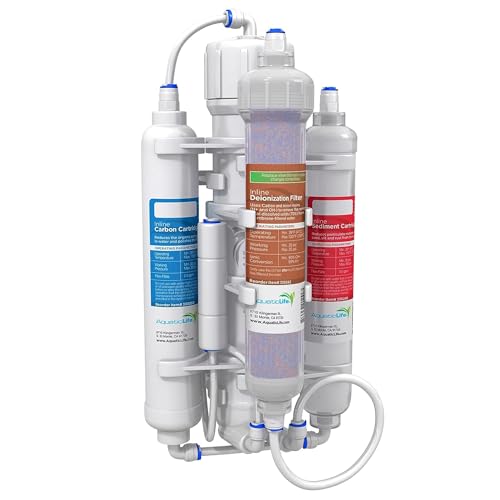
This is the entry point for a keeper whose tank is small and whose storage space is smaller. The RO Buddie hangs by a utility sink or sits on a shelf, runs entirely off tap pressure with nothing to plug in, and still runs the full four-stage path ending in deionization resin, so a nano reef or a shrimp tank gets genuine zero TDS water. Its modest output asks you to start a fill hours before a water change rather than minutes, which suits planned maintenance on small volumes far better than emergency top-offs on a big system.
Specs
- Stages: sediment, carbon, RO membrane and DI resin cartridges
- Output: up to 50 gallons per day, about 2 gallons per hour at 65 PSI and 77 degrees Fahrenheit
- Membrane removes up to 98 percent of TDS, with the DI resin removing the remaining TDS
- Model number: 540019
- Item weight: 3.9 pounds
- Maximum flow rate: 180 liters per day
Best for: a first RO/DI unit for nano and small tanks with modest weekly water changes.
Watch out for: the listing states the carbon stage does not remove chloramines, so check your water report before relying on it for treated city water.
ASIN: B00204CQF6
Aquatic Life Twist-In 4-Stage RO/DI System, 75 GPD
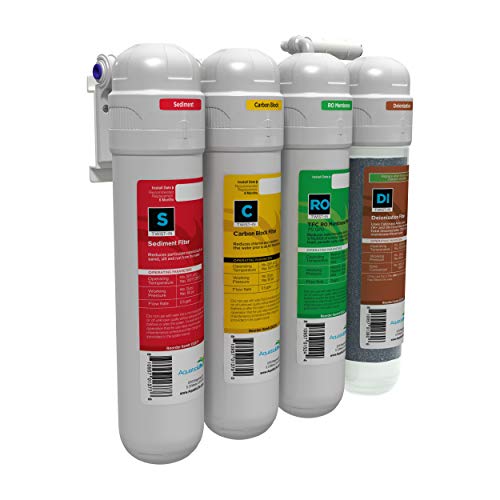
Choose this one if the thought of a housing wrench, dripping canisters and O-ring grease is what has kept you buying water from the fish store. Every stage, from sediment through the color-changing DI resin, twists into the manifold by hand, so a full cartridge change takes minutes and stays dry. Output sits halfway between the compact units and the big canister systems, enough for a mid-size tank’s weekly change in a single morning, and the slim manifold mounts neatly where a bulky housing bank would not fit.
Specs
- Stages: sediment, carbon, RO membrane and DI resin, all in twist-in cartridges
- Output: up to 75 gallons per day
- DI resin is color-changing, shifting from blue toward tan as it exhausts
- Membrane TDS reduction ratio stated as 1 to 10,000
- Dimensions: 12 by 4 by 13 inches
- Suggested supply pressure: 65 PSI, with a stated maximum of 80 PSI
Best for: keepers who want cartridge changes with no tools and no spills.
Watch out for: the listing states this system does not remove chloramines, and its cartridges are a proprietary twist-in format, so replacements must come from the same line.
ASIN: B083P4HZPD
Aquatic Life Classic 4-Stage RO/DI System with Carbon Plus, 100 GPD
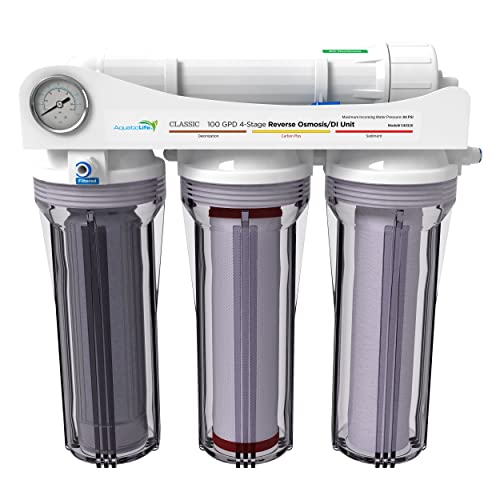
This is the pick for a keeper whose city disinfects with chloramine and whose tank drinks water by the bucket. Its Carbon Plus cartridge is rated for chloramine reduction with a stated gallon capacity, which the smaller cartridge units do not claim, and the refillable ten-inch DI canister takes bulk resin when the color change says the stage is spent. A built-in pressure gauge and automatic shutoff suit a system that stays plumbed in and fills a storage container unattended, rather than one hooked to a faucet for an afternoon.
Specs
- Model number: 540706
- Stages: 5-micron sediment cartridge, Carbon Plus cartridge, 100 GPD RO membrane and a refillable 10-inch color-changing DI resin cartridge
- Chloramine reduction: 3,000 gallons at 0.5 GPM, with more than 98 percent reduction at 3 ppm chloramine
- Included: quarter-inch Buddy-Fit press-fit connectors and 10 feet each of blue, yellow and red quarter-inch tubing
- Item weight: 15.9 pounds
- Dimensions: 18.5 by 7 by 19 inches
- Maximum operating pressure: 80 PSI
Best for: chloramine-treated municipal water and mid-size tanks that need 100 GPD on tap.
Watch out for: it is a full canister system that wants mounting space and a semi-permanent hookup, and it is built for aquarium water, not drinking water.
ASIN: B09MTS1BCM
LiquaGen 5-Stage RO/DI Aquarium Reef Water Filter System, 75 GPD

LiquaGen builds this unit for aquarium keepers who want the conventional canister layout with an extra carbon stage in front of the membrane. Two carbon stages, a UDF carbon and a carbon block, give chlorine more contact time before the water reaches the membrane, and the inline DI cartridge finishes the output for reef mixing. It arrives with its filters included and needs no drilling or permanent modification, so it works as a portable system you connect when it is time to make water and put away when the buckets are full.
Specs
- Model: LG-1OT
- Stages: sediment, UDF carbon, carbon block, RO membrane and inline DI
- Output: 75 gallons per day
- Filters included with the system
- Designed for aquarium and reef use, with no permanent installation or drilling required
Best for: reef and freshwater keepers who want a five-stage layout in a portable, hook-up-and-run system.
Watch out for: the maker positions it for city water supplies, so confirm your incoming TDS suits it, and note the DI stage is a sealed inline cartridge rather than a refillable canister.
ASIN: B01FNAPGPA
Which One Fits Your Situation
A nano tank and a keeper with no spare cupboard space
Pick the RO Buddie 4-Stage. It is the smallest and lightest system here, it runs off tap pressure alone, and its 50 GPD output covers the few gallons a nano or small freshwater tank needs each week. Start the fill in the morning and your water-change water is ready by the afternoon.
City water treated with chloramine
Pick the Aquatic Life Classic 4-Stage with Carbon Plus. It is the only system in this group whose carbon stage carries a stated chloramine reduction rating with a gallon capacity, and its 100 GPD membrane plus refillable DI canister suit a keeper making mixing water every week for a mid-size reef.
You keep putting off filter changes
Pick the Twist-In 4-Stage. Sediment, carbon, membrane and DI all swap by hand with no wrench and no dripping housings, and the DI resin changes color as it exhausts, so the unit itself tells you when its turn has come. Removing the friction from maintenance is what keeps output at zero TDS.
A reef setup that cannot take a permanent installation
Pick the LiquaGen 5-Stage. It needs no drilling and connects when you need water, its dual carbon stages give the membrane an easier job on city supplies, and the five-stage path ends in deionization for salt mixing. It stores away between sessions, which suits a rented home or a shared utility room.
Common Mistakes
- Buying an RO-only unit and expecting zero TDS water, when only a deionization stage removes the last dissolved solids.
- Assuming every carbon stage handles chloramine, when several listings state theirs removes chlorine only.
- Sizing a system by the tank’s gallons instead of the weekly water-change volume and the fill time you can tolerate.
- Ignoring the rating conditions: output figures assume the maker’s stated pressure and temperature, and a cold, low-pressure supply runs slower.
- Letting DI resin exhaust unnoticed because there is no TDS meter in the routine and the resin’s color change went unchecked.
Frequently Asked Questions
Do I need the DI stage, or is reverse osmosis enough on its own?
For most aquarium use, the DI stage is the point of the system. The membrane removes up to about 98 percent of dissolved solids, which still leaves phosphate, silicate and other residue that algae happily use. The resin stage removes that remainder and delivers zero TDS water you can remineralize or mix with salt on your own terms.
How long does a 50 GPD unit take to fill a water-change bucket?
At its rated conditions, the 50 GPD class produces about 2 gallons per hour, so a five-gallon bucket takes roughly two and a half hours. Real fills run slower on cold water or low household pressure. Most keepers start the unit in the morning, or fill a lidded storage container the day before a scheduled water change.
Will these systems remove chloramine from my city water?
Only if the carbon stage is rated for it. In this group, the Carbon Plus cartridge in the Aquatic Life Classic carries a stated chloramine reduction capacity, while the RO Buddie and Twist-In listings say their carbon does not remove chloramines. Read your municipal water report first, then choose the carbon stage that matches what your city actually uses.
How do I know when the DI resin is spent?
Color-changing resin gives the first warning as it shifts shade, and a handheld TDS meter confirms it: once output readings climb above zero, the resin is exhausting. Check the product water every few fills rather than on a calendar, because resin life depends on how much dissolved solid your membrane passes, which varies with your source water.
More from Amazon
Programs that pair well with the guide above. Offers and eligibility are set by Amazon and may change.
Set up recurring deliveries of everyday items on eligible products. Terms and savings are set by Amazon.
Explore Subscribe & SaveCollect the home and kitchen items you want in one registry that guests can shop from.
Create a wedding registryFree shipping on eligible items, Prime Video and more. Eligible new members can start with a free trial.
Start a Prime free trialAudiobooks and podcasts to listen to on the go. Eligible new members can start with a free trial.
Try Audible freeAs an Amazon Associate we earn from qualifying purchases.





Write Your Review
No reviews yet. Be the first to share your experience!