

Key takeaways
- 0.5–0.75 inch: Light and inexpensive, but more prone to sliding, flexing, and developing a slight dish if repeatedly exposed to uneven moisture.
- 1–1.25 inches: The best general-purpose range for most home kitchens. It offers useful mass without becoming difficult to wash or store.
- 1.5–2 inches: Very stable and satisfying for heavy chopping or carving, but substantially heavier and more demanding to maintain.
The best teak cutting boards for everyday prep are thick, edge-grain boards around 1 to 1.5 inches thick, with a stable footprint, a comfortable working size, and a shallow juice groove only if you regularly cut wet foods.
Teak is a practical middle ground between very hard, heavy hardwoods and softer, lighter woods. Its naturally oily fibers help it resist rapid moisture exchange, while its moderate hardness gives knives a less harsh feel than many dense exotic woods. The trade-off is that teak can dull a blade faster than softer maple or walnut, and its surface may feel slightly waxy until it is properly cleaned and conditioned.
Our top picks

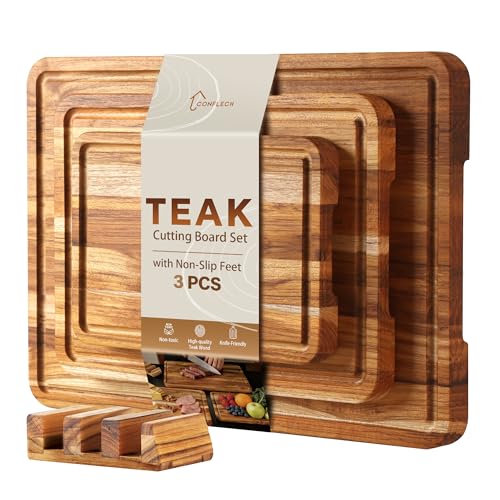


As an Amazon Associate we earn from qualifying purchases at no extra cost to you. Ratings are shown as listed on Amazon.
Best teak cutting board choices by situation
| Kitchen situation | Recommended board | Useful target specifications | Why it fits |
|---|---|---|---|
| Small kitchen or occasional prep | Compact edge-grain board | 12 x 16 inches; 0.75–1 inch thick; 3–5 lb | Easy to store and lift, while still large enough for vegetables and sandwiches |
| Daily cooking for one or two people | Medium edge-grain board | 15 x 20 inches; 1–1.25 inches thick; 6–10 lb | Balances usable work area, stability, and manageable cleaning |
| Frequent family meal preparation | Large thick edge-grain board | 18 x 24 inches; 1.25–1.5 inches thick; 11–16 lb | Provides room for separating ingredients without crowding the counter |
| Carving roasts or serving at the table | End-grain board with groove | 16 x 20 inches; 1.5–2 inches thick; 14–22 lb | Extra mass reduces movement, and the groove catches juices during carving |
| Lowest-cost teak option | Thin edge-grain board | 10 x 14 inches; 0.5–0.75 inch thick; 2–4 lb | Costs less and stores easily, though it is more likely to slide or warp |
Teak grain: edge-grain versus end-grain
Edge-grain teak
Edge-grain boards are made by arranging long strips of wood so the knife meets the sides of the grain. This is the most useful construction for everyday prep because it is usually thinner, lighter, less expensive, and easier to wash at the sink.
A good edge-grain board should have evenly matched strips, tight glue joints, a flat working surface, and no open cracks near the edges. The grain pattern is typically long and linear. Because the board has less thickness than most end-grain models, it can transmit more chopping vibration to the counter, particularly when it is under 0.75 inch thick.
End-grain teak
End-grain boards expose the cut ends of the wood fibers at the surface. Knife edges enter between fibers rather than striking across their length, which can produce a softer, quieter chopping feel. End grain is also typically thicker and heavier, making it attractive for cooks who want a board that stays fixed while mincing or carving.
End grain is not automatically more durable. The exposed fiber ends can absorb water if the board is neglected, and glue lines can open after repeated soaking or drying. End-grain teak also takes longer to dry and may be awkward to lift with one hand. Choose it for stability and chopping comfort, not simply because the construction sounds premium.
How thickness changes knife feel and stability
- 0.5–0.75 inch: Light and inexpensive, but more prone to sliding, flexing, and developing a slight dish if repeatedly exposed to uneven moisture.
- 1–1.25 inches: The best general-purpose range for most home kitchens. It offers useful mass without becoming difficult to wash or store.
- 1.5–2 inches: Very stable and satisfying for heavy chopping or carving, but substantially heavier and more demanding to maintain.
Board dimensions matter as much as thickness. A 12 x 16-inch board has 192 square inches of working area. A 15 x 20-inch board has 300 square inches—about 56 percent more space—without being dramatically wider in either direction. That extra area is valuable when chopped ingredients need to remain on the board while a second batch is prepared.
Before buying, measure the counter section where the board will sit. Leave several inches around it for hand movement, and check that the board can fit into your sink or be rinsed with a spray nozzle. A board that is technically spacious but impossible to clean comfortably often gets used less.
Do you need a juice groove?
A juice groove is useful for carving chicken, turkey, roasts, citrus, and very ripe tomatoes. It is less helpful for ordinary vegetable prep because it reduces the flat working area and can trap small pieces of onion, herbs, or garlic.
Look for a groove roughly 0.2 to 0.35 inch wide and at least 0.1 inch deep, positioned far enough from the edge that it does not weaken the perimeter. A groove that is too shallow overflows easily; one that is too deep is harder to scrub and can leave food residue behind.
If you mostly mince, slice, and dice, a reversible flat board is usually the better choice. If you want one board for carving, select a model with a groove on only one face. The flat side remains available for routine prep, and the grooved side can be reserved for juicy foods.
Knife feel, weight, and everyday handling
Teak generally feels firm but not glass-hard under a knife. It is more forgiving than very dense woods, although the silica and natural oils in some teak can increase edge wear compared with softer cutting-board woods. Keep knives sharp rather than forcing a dull blade through food; excessive force is more likely to cause slipping than a moderately firm board surface.
Weight is a practical safety feature. A board weighing 6 to 10 pounds is usually stable enough for daily chopping while remaining liftable for cleaning. Boards above roughly 15 pounds stay planted exceptionally well, but moving them with wet hands can be inconvenient. Rubber feet improve stability, though they make the board nonreversible and can hide moisture underneath. If a board has no feet, place a damp—not soaking—kitchen towel beneath it when needed.
Maintenance requirements and common mistakes
- Clear the surface promptly. Scrape away food, then wash both faces with warm water, a small amount of dish soap, and a soft brush or sponge.
- Dry it upright or on its edge. Air circulation helps both faces dry at a similar rate. Do not leave it flat in a puddle or standing in a wet sink.
- Condition only when the surface looks dry. Apply a thin coat of food-grade mineral oil, allow it to soak in for several hours, and wipe away excess. A board cream containing mineral oil and beeswax can add a more water-resistant finish.
- Maintain the whole board. Oil the top, underside, edges, and any juice groove. Treating only the cutting face encourages uneven moisture movement.
- Sand raised fibers carefully. If the surface feels rough after repeated washing, use fine abrasive paper—around 220 grit—on a clean, dry board, then remove dust and recondition it.
Do not put a teak cutting board in the dishwasher, soak it, or leave it beside a radiator or hot cooktop. Heat and rapid drying can cause cupping, splits, and separated joints. Avoid olive, vegetable, and other cooking oils for conditioning because they can oxidize and become sticky or rancid. Strong bleach solutions, abrasive scouring powders, and prolonged exposure to acidic cleaners can also damage the finish.
What wears first, and when to replace the board
On a frequently used board, the first signs of wear are usually shallow knife tracks, a roughened surface, darkened areas in a groove, or slight movement on the counter. Knife marks alone do not mean the board must be discarded. If the surface remains solid, it can often be cleaned, lightly sanded, and reconditioned.
Replace a board when it has deep grooves that cannot be smoothed, persistent cracks, loose laminated sections, mold-like growth that remains after cleaning, or a pronounced wobble. A split that runs through the board is especially concerning because food and moisture can collect inside it.
Bottom line: which teak board should you buy?
For most households, choose a flat edge-grain teak board about 15 x 20 inches and 1 to 1.25 inches thick. It offers the most useful balance of knife comfort, working space, weight, price, and maintenance. Choose a 12 x 16-inch board if storage and lifting matter most, or move to a 16 x 20-inch end-grain board with a juice groove if carving and heavy chopping are regular tasks. Whichever style you choose, construction quality, a flat surface, responsible drying, and periodic conditioning matter more than decorative grain or maximum thickness.








Write Your Review
No reviews yet. Be the first to share your experience!