

Key takeaways
- 10–12 inches: about 3–4 quarts; suitable for two to four people.
- 12–14 inches: about 4–6 quarts; the most versatile range for family meals.
- 14–16 inches: about 6–9 quarts; better for parties, large pasta salads, or buffet service.
- 16 inches and larger: often more difficult to lift, wash, and store than expected.
Best Large Wooden Salad Bowl Set
The best large wooden salad bowl set for most kitchens is a 12- to 14-inch acacia or rubberwood bowl with a food-safe finish, four matching serving utensils, and a practical capacity of about 4 to 6 quarts.
That size is large enough for a family salad, pasta salad, fruit, or a side dish for a small gathering without becoming difficult to store. The right choice depends less on appearance than on diameter, usable capacity, wood construction, finish quality, and how much hand-washing you are willing to do.
Our top picks

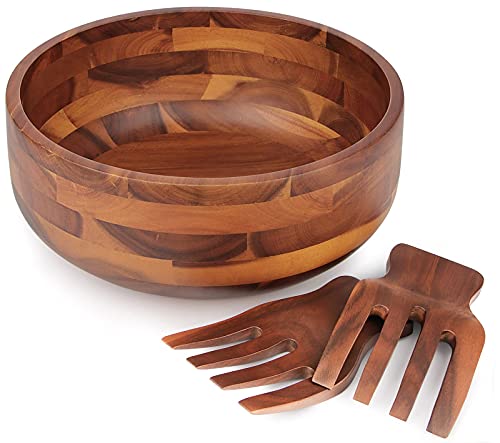
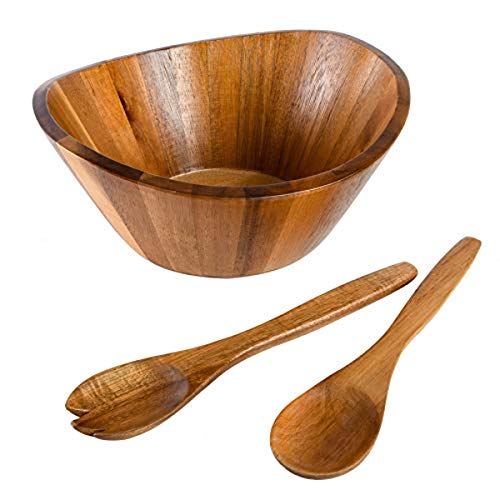

As an Amazon Associate we earn from qualifying purchases at no extra cost to you. Ratings are shown as listed on Amazon.
Best choices by situation
| Kitchen situation | Best bowl specification | Why it fits | Typical 2026 market range |
|---|---|---|---|
| Everyday family meals | 12–14 inches, 4–6 quarts, acacia or rubberwood, four utensils | Good balance of capacity, stability, and storage | $35–$80 |
| Frequent entertaining | 14–16 inches, 6–9 quarts, thick-wall hardwood construction | Holds a large salad without crowding; heavier and more stable | $70–$160 |
| Limited cabinet space | 11–12 inches, 3–4 quarts, nesting design | Uses less shelf space and is easier to lift | $25–$65 |
| Lowest initial cost | 12 inches, rubberwood or engineered wood, simple utensil pair | Usually lighter and less expensive than premium hardwood | $20–$45 |
| Decorative serving and occasional use | 14–16 inches, acacia or olive wood, pronounced grain | Strong visual appeal, but requires careful maintenance | $60–$180 |
How much bowl do you really need?
Manufacturers often describe a bowl as “large” without using a consistent standard. Diameter is useful, but depth and shape affect actual serving capacity. A wide, shallow bowl may look substantial while holding less food than a narrower, deeper model.
For a practical estimate, allow approximately 1 to 1.5 quarts of bowl capacity per four generous side-salad servings. This is not a recipe measurement; it leaves room for tossing without spilling.
- 10–12 inches: about 3–4 quarts; suitable for two to four people.
- 12–14 inches: about 4–6 quarts; the most versatile range for family meals.
- 14–16 inches: about 6–9 quarts; better for parties, large pasta salads, or buffet service.
- 16 inches and larger: often more difficult to lift, wash, and store than expected.
A useful fit calculation is to reserve at least 2 inches of counter or table space beyond the bowl’s diameter on each side. A 14-inch bowl therefore needs roughly an 18-inch square of clear surface for comfortable tossing and serving. Also check the cabinet opening: a bowl that fits on a shelf may not fit through the door at an angle.
Wood types compared head-to-head
Acacia
Acacia is a popular choice for large bowls because it is relatively hard, visually distinctive, and generally more resistant to everyday dents than softer woods. Its varied grain can hide small knife or utensil marks. The trade-off is variation: color and grain can differ substantially between pieces, and neglected finishes may become dry or uneven.
Rubberwood
Rubberwood is commonly used in affordable wooden kitchenware. It usually has a lighter, more uniform appearance and can provide good value when properly sealed. It may show scratches and dents sooner than a dense hardwood, so it is best for normal serving rather than rough mixing with metal tools.
Olive wood
Olive wood has striking grain and a dense feel, making it attractive for presentation. Large olive-wood bowls are often expensive because sizable, clear pieces are less common. They can also be heavier than expected. Choose one for appearance and occasional serving, not because it eliminates maintenance.
Bamboo and laminated wood
Bamboo is technically a grass, but it is widely sold as wooden kitchenware. Laminated bamboo or wood can be light, affordable, and dimensionally consistent. Inspect the edges and seams carefully: repeated soaking, heat, or dishwasher exposure can weaken adhesive joints over time.
What should be included in the set?
A full set normally includes a bowl and a serving fork and spoon. Four-piece sets may add salad servers with a wider head, a pair of smaller utensils, or individual serving bowls. Count the pieces rather than assuming “set” means a complete place setting.
- Two utensils: enough for basic serving and easier to store.
- Four utensils: useful if the set includes small serving bowls or if two people serve at once.
- Deep, broad-ended servers: better for leafy greens and pasta than narrow, decorative handles.
- Built-in utensil rests or slots: convenient, but they add places where dressing and moisture can collect.
Prefer utensils with smooth, rounded edges and no unfinished end grain. Rough handles are not only uncomfortable; they can absorb moisture and develop discoloration faster.
Finish durability matters more than shine
A glossy surface is not proof of a durable finish. Look for a smooth, even interior and clear care instructions identifying the coating as food-safe after curing. Common finishes include mineral oil and wax blends, plant-based oils, and harder film-forming finishes. Each can be suitable when correctly applied, but the finish must remain intact.
The interior bottom usually wears first because it receives repeated tossing and scraping. The rim is also vulnerable to chips, especially on thin-walled bowls. Darkening, a rough feel, white dry patches, or small raised fibers indicate that the surface needs conditioning or closer inspection.
A thick wall of approximately 8–15 millimeters generally offers better stability and impact resistance than an unusually thin decorative bowl. It also adds weight. For a 14-inch bowl, a finished weight of roughly 2.5–5 pounds is common; heavier models are stable but less convenient to carry when full.
Care requirements and common mistakes
Wooden bowls are durable serving pieces, but they are not maintenance-free. The main enemy is repeated exposure to water followed by uneven drying.
- Remove food soon after serving. Acidic dressings, salt, and oily sauces can gradually mark the finish if left overnight.
- Wash by hand with lukewarm water. Use a soft sponge and a small amount of mild dish soap. Avoid abrasive pads.
- Do not soak the bowl. Water can enter the grain and cause swelling, raised fibers, or loosening at laminated seams.
- Dry immediately. Wipe all surfaces, then allow the bowl to air-dry completely before stacking or storing.
- Condition when the surface looks dry. Apply a thin coat of a food-contact-appropriate conditioner according to its label, then remove excess oil so the bowl is not sticky.
Do not put a wooden bowl in the dishwasher, microwave, or conventional oven unless the manufacturer specifically permits it. Dishwasher heat and prolonged detergent exposure can split, warp, fade, or strip the finish. Avoid cutting directly in the bowl as well; knife marks create grooves that are difficult to clean and can shorten the useful life of the finish.
Durability and ownership costs
The purchase price is only part of the decision. A cheaper bowl that requires replacement after splitting may cost more than a moderately priced hardwood bowl used for years. As a simple illustration, a $50 set used twice a week for three years provides about 312 uses, or approximately $0.16 per use before the cost of conditioner. A $100 set used weekly for five years provides about 260 uses, or approximately $0.38 per use. The second set is not automatically better; frequency and care determine the result.
Conditioner is usually inexpensive, but it is a consumable. Depending on bowl size and frequency of use, a small bottle may provide several applications over one to two years. Replacement utensils are harder to match, so a set with standard-shaped servers may be more practical than one with unusually shaped, proprietary pieces.
Final buying checklist
- Choose 12–14 inches and 4–6 quarts for the most flexible everyday size.
- Confirm the listed capacity, not just the diameter.
- Check that the bowl fits both the cabinet opening and dishwasher-free washing area.
- Favor smooth, sealed interior surfaces and rounded, chip-resistant rims.
- Choose acacia for a hardwearing, varied-grain appearance; rubberwood for value; olive wood for premium presentation; laminated bamboo or wood for lighter weight and lower cost.
- Verify exactly how many utensils are included.
- Plan on hand-washing, immediate drying, and occasional conditioning.
For most households, a 12- to 14-inch acacia or well-finished rubberwood set with four practical utensils is the strongest all-purpose choice. Move to a 14- to 16-inch thick-wall hardwood bowl only when you regularly serve crowds and have the storage space to accommodate its size and weight.






Write Your Review
No reviews yet. Be the first to share your experience!