

Key takeaways
- Fan motors are the part most likely to fail, so keep vents clear and wipe dust from them regularly.
- Wash trays after every use to avoid sugar residue and mold.
- Plastic trays warp if placed in a hot dishwasher; check the manual.
- Mesh sheets and fruit-leather trays are consumables you may need to replace.
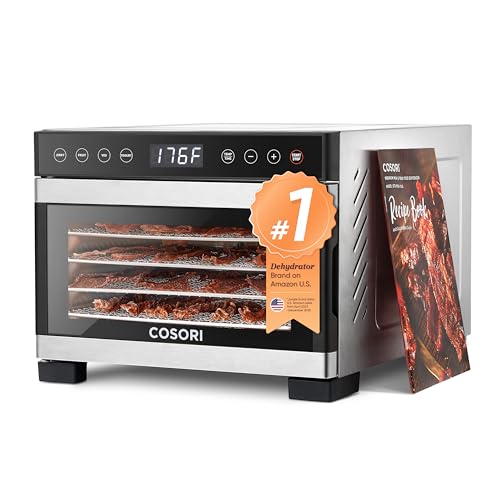
For most home cooks the COSORI Premium 6-tray is the best food dehydrator: it has a quiet fan, a digital thermostat and timer, and dishwasher-safe stainless steel trays. If you dry large batches of jerky or garden harvests, the Excalibur 3926TB 9-tray is the better long-term machine, and the Nesco Snackmaster Pro FD-75A is the budget pick for occasional fruit and herbs.
Our top picks



As an Amazon Associate we earn from qualifying purchases at no extra cost to you.
Quick Comparison of the Best Food Dehydrators
| Pick | Best for | Trays and drying area | Temperature range | Controls | Price range |
|---|---|---|---|---|---|
| COSORI Premium 6-tray | Best overall | 6 stainless steel trays | 95-165 F | Digital, timer up to 48 hours | Mid |
| Excalibur 3926TB | Best for big batches and jerky | 9 trays, about 15 sq ft | 105-165 F | Adjustable thermostat, timer | Premium |
| Nesco Snackmaster Pro FD-75A | Best budget | 5 trays, expandable to 12 | 95-160 F | Thermostat, no timer | Budget |
| Magic Mill Pro (7-tray) | Best stainless steel value | 7 stainless steel trays | 95-176 F | Digital, timer | Mid |
| Nesco Gardenmaster FD-1040 | Best expandable harvest machine | 4 trays, expandable to 20 | 95-160 F | Digital, 48-hour timer | Mid to upper-mid |
Specs follow each manufacturer’s published listing; confirm tray counts and temperature range on the current model page before buying, because brands revise models. Prices are general market bands, so use Check price to see today’s number.
Best Overall: COSORI Premium 6-Tray
The COSORI Premium has a rear-mounted fan that pushes air across the trays, a temperature range from 95 to 165 F, and a timer that can run up to 48 hours. Its stainless steel trays are easy to clean and do not hold odors like plastic trays can. The unit is quiet enough to run in a kitchen overnight, which matters because most dehydrating takes 6 to 12 hours.
Who it suits: households that dry fruit, herbs, jerky and fruit leather a few times a month. Main trade-off: with a rear fan you usually need to rotate trays once or twice for the most even results, and owner reports suggest a shorter lifespan than heavy-duty Excalibur machines.
Best for Large Batches and Jerky: Excalibur 3926TB
Excalibur machines use horizontal airflow, with the fan and heater at the back, so every tray gets air from the same direction and you rarely need to rotate trays. The 3926TB has nine trays with about 15 square feet of drying area, an adjustable thermostat and a timer. Per Excalibur’s spec sheet, the 600-watt unit runs at a range suited to jerky, herbs and fruit.
Who it suits: gardeners, hunters, and anyone who dries food weekly. Main trade-off: it is large, takes serious counter or shelf space, and costs more. The trays are plastic polycarbonate with a flexible mesh insert, so you will want a few extra mesh sheets for sticky foods.
Best Budget: Nesco Snackmaster Pro FD-75A
The Snackmaster Pro is the classic starter dehydrator. It has a top-mounted fan, five trays that can expand to twelve, and a temperature dial from 95 to 160 F. It is made in the USA and is easy to find replacement trays for.
Who it suits: beginners who want to try apple chips, dried herbs or small jerky batches. Main trade-off: there is no timer, so you have to stop it manually, and the top fan design means trays near the bottom may dry slightly slower. Rotating trays halfway through is a good habit.
Best Stainless Steel Value: Magic Mill Pro
The Magic Mill Pro offers seven stainless steel trays, a 600-watt rear fan, digital controls, and a temperature range up to 176 F. That higher ceiling is useful if you follow guidance that jerky should reach a safe internal temperature during drying. It is often compared with the COSORI 6-tray as a lower-cost alternative with extra tray capacity.
Who it suits: shoppers who want stainless trays without paying COSORI prices. Main trade-off: it is a newer brand with a shorter track record, so check the warranty terms and customer service reputation.
Best Expandable Harvest Machine: Nesco Gardenmaster FD-1040
The Gardenmaster is Nesco’s step-up model. It ships with four trays but expands to twenty, has a 1,000-watt heater and a 48-hour digital timer, and runs from 95 to 160 F. That makes it good for gardeners who dry large tomato, apple or pepper harvests in one go.
Who it suits: homesteaders and people who process produce in seasonal batches. Main trade-off: it is bulky when fully loaded, and with the top fan design some rotation is still helpful.
How to Choose a Food Dehydrator
Airflow design: horizontal or vertical
Horizontal airflow (fan at the back, like Excalibur and COSORI) sends air across each tray evenly. Vertical stack models (fan at the top or bottom, like most Nesco units) cost less but dry unevenly, which is why rotating trays is recommended. If you will dry often, pay for horizontal airflow.
Wattage and temperature range
Most home dehydrators run between 400 and 1,000 watts. A range of about 95 to 165 F covers herbs (95-115 F), fruit and vegetables (125-135 F), and jerky (160 F as a final target or higher in the machine). Adjustable thermostats matter more than the number of trays, because drying at the wrong temperature leads to case hardening or unsafe jerky.
Tray material and drying area
Stainless steel trays are durable, easy to clean and do not stain. Plastic trays are lighter and cheaper but can crack, stain from tomatoes and hold odors. Count the drying area, not just trays, because a 9-tray machine with 15 square feet dries nearly twice what a 6-tray machine can.
Timer and auto shutoff
A timer lets you start a batch before bed or leave the house safely. Without a timer you risk over-drying, which makes fruit brittle and wastes electricity.
Noise and footprint
Dehydrators run for many hours, so noise matters in open-plan homes. Rear-fan units tend to run quieter and are easier to store flat, while stackable units need vertical room.
Worked Example: Energy Cost of a Jerky Batch
A 600-watt dehydrator running for 8 hours uses 4.8 kWh of electricity (0.6 kW x 8 h). That is about the same as running a 1,500-watt space heater for just over 3 hours, so a batch is a modest but real cost. Multiply 4.8 kWh by your local rate per kWh to see your cost, and compare it against store-bought jerky, which is often priced per ounce at a large premium. Loading a full machine rather than half-loading it is the best way to lower your cost per ounce.
Safe Drying Basics
- Wash produce and trim fat from meat, because fat can turn rancid when stored.
- Slice evenly, about 1/4 inch thick for jerky and fruit, so pieces finish at the same time.
- For jerky, USDA guidance recommends heating meat to 160 F (165 F for poultry) at some point, either by pre-heating or in the dehydrator if it reaches that temperature.
- Dry until the food bends without breaking for jerky, or feels leathery with no moist spots for fruit.
- Let pieces cool, then store in airtight containers. Condition fruit by shaking it in a jar for a few days to check for moisture.
Decision Matrix
| Your situation | Choose |
|---|---|
| Occasional fruit and herbs, tight budget | Nesco Snackmaster Pro FD-75A |
| Regular home use, quiet kitchen, easy cleaning | COSORI Premium 6-tray |
| Weekly jerky or big garden harvests | Excalibur 3926TB |
| Want stainless trays at a lower price | Magic Mill Pro |
| Seasonal bulk processing, expandable | Nesco Gardenmaster FD-1040 |
Ownership Realities
- Fan motors are the part most likely to fail, so keep vents clear and wipe dust from them regularly.
- Wash trays after every use to avoid sugar residue and mold.
- Plastic trays warp if placed in a hot dishwasher; check the manual.
- Mesh sheets and fruit-leather trays are consumables you may need to replace.
Frequently Asked Questions
Is a food dehydrator worth buying?
If you regularly dry herbs, make jerky, or preserve garden produce, yes. It gives you control over ingredients and saves money on store-bought dried snacks. If you only dry food once or twice a year, an oven on a low setting may be enough.
What is the best temperature for jerky?
Many recipes dry jerky between 145 and 160 F. USDA guidance says meat should reach 160 F (165 F for poultry), so check your dehydrator’s maximum temperature and consider a pre-heat or post-heat step in the oven.
How long does it take to dehydrate fruit?
Thin apple slices often take 6 to 10 hours at around 135 F, while berries and bananas can take longer. Humidity, slice thickness and load size all change the time, so check pieces periodically.
Do I need to rotate trays?
On horizontal airflow machines like Excalibur, usually not. On vertical stack models with a top or bottom fan, rotating trays once or twice improves evenness.
Can I use a dehydrator for yogurt or bread proofing?
Some models with low temperature settings can, but check the manufacturer’s guidance, because many start at 95 F, which is too high for some cultures.
How should I store dehydrated food?
Use airtight jars or vacuum bags and keep them in a cool, dark place. Jerky and fruit with any remaining moisture should be refrigerated or frozen for longer storage.




Write Your Review
No reviews yet. Be the first to share your experience!