

Our Top Picks
 Magic Mill Pro Food Dehydrator Machine7 Full-Size Trays15.5 x 11.3 x 10.8 inches16 PoundsCheck on Amazon
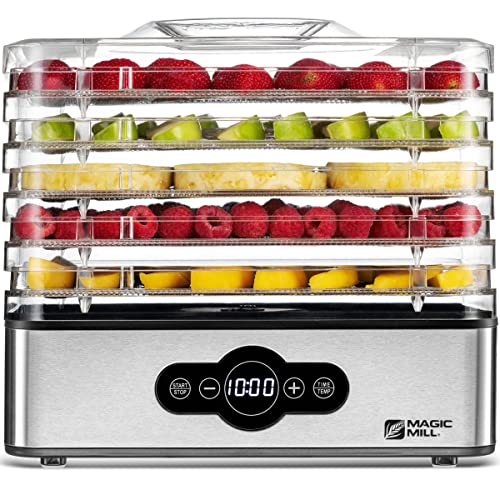
The LEM BigBite 10-Tray Stainless Steel Dehydrator is our best overall pick for people who want serious drying capacity: ten stainless trays, an 800W heater with a rear fan, a temperature range of 95 to 176 degrees Fahrenheit and a long digital timer. Stainless steel trays matter because they do not warp, stain or hold odors the way plastic trays can, and they handle meat, fruit and herbs equally well. The other five picks are mostly Magic Mill models in 5, 7 and 10-tray sizes, plus a high-wattage VEVOR for big batches.
Quick List
- LEM BigBite 10-Tray – best overall for big batches of jerky and fruit
- Magic Mill Premium 10 Extra-Large Trays – best for the most drying surface per tray
- Magic Mill Pro 10-Tray – best for a keep-warm function and wide food variety
- VEVOR 10-Tray 1000W – best for high power and fast loading
- Magic Mill Pro 7-Tray – best mid-size with a 600W rear fan
- Magic Mill 5-Tray – best compact choice for small households
Which One Is Right for You?
| If you… | Choose |
|---|---|
| make several pounds of jerky at a time | LEM BigBite 10-Tray |
| dry large fruit slices, herbs and big batches of treats | Magic Mill Premium 10 Extra-Large Trays |
| want to hold food warm after drying finishes | Magic Mill Pro 10-Tray |
| want maximum stated wattage and plenty of trays | VEVOR 10-Tray |
| dry for a family but lack space for a 10-tray | Magic Mill Pro 7-Tray |
| dry herbs, apple chips or snacks occasionally in a small kitchen | Magic Mill 5-Tray |
Tray count is the most important decision. Five trays handle a garden’s worth of herbs or a single batch of apple chips. Seven suit a family that dries weekly, and ten or more suit anyone who makes jerky in bulk or preserves seasonal harvests. Higher wattage helps hold temperature with a full load, but airflow and tray design matter at least as much.
All 6 Picks in Detail
1. Magic Mill Pro Food Dehydrator (7 Stainless Steel Trays) – Best mid-size model
As an Amazon Associate we earn from qualifying purchases at no extra cost to you.

The 7-tray Magic Mill Pro is the middle of the road, with a 600W rear fan, an even-drying system and full-size stainless trays. The listing gives a temperature range starting at 95 degrees, matching the low end that herbs and delicate fruit need. A rear fan pushes air across every tray from back to front, so you do not have to rotate trays as often as with a bottom-heated stack.
It suits families that dry weekly and want more than five trays without stepping up to a ten-tray unit. It is a good compromise between footprint and capacity.
Seven trays is about the sweet spot for a household that dries once a week: enough room for a full batch of banana chips or a few pounds of jerky, yet small enough to live on a pantry shelf between uses.
- 7 full-size stainless steel trays
- 600W rear fan, even-drying system
- Temperature range starting at 95 degrees, per the listing
- Upper temperature, timer: confirm on listing
- Digital controls
Pros
- Rear airflow supports even drying
- More manageable size than a 10-tray
Cons
- Less capacity for large jerky batches
- Fewer details visible in the listing title
It sits between the 5-tray and 10-tray Magic Mills, offering a sensible middle path.
2. Magic Mill Pro Food Dehydrator Machine (10 Stainless Steel Trays) – Best with a keep-warm function

The Magic Mill Pro with ten stainless steel trays is described as a dryer for jerky, dog treats, herbs, meat, beef and fruit, and it includes a keep-warm function. Keep-warm is helpful when you cannot be present at the exact moment drying ends, since the unit can hold food at a gentle temperature instead of letting it sit and reabsorb moisture.
It suits people with varied projects, from herb bundles to treats for pets, who want one machine with plenty of trays. The wattage and temperature range are not stated in the visible listing text, so confirm them before buying if they matter to you.
Because the listing does not name a temperature range, run a small first batch of something forgiving, such as apple slices, while you learn how the thermostat behaves. Keep notes on settings and times so the next batch comes out the same.
- 10 stainless steel trays
- Keep warm function
- Intended for jerky, dog treats, herbs, meat and fruit
- Digital controls: confirm on listing
- Wattage and temperature range: confirm on listing
Pros
- Keep-warm provides flexibility
- Many trays for multiple foods at once
Cons
- Specifications beyond tray count and keep-warm are not clear in the title
- Large footprint
Next to the 7-tray Pro, it adds three trays and a keep-warm mode, while the 7-tray model states its 600W fan and temperature range up front.
3. LEM BigBite 10-Tray Stainless Steel Dehydrator – Best overall for big batches

The BigBite is aimed squarely at jerky makers and hunters, yet it works equally well for fruit, vegetables and herbs. The manufacturer lists an 800W heating element, a rear-mounted fan, a temperature range of 95 to 176 degrees Fahrenheit and a 24-hour timer that adjusts in 30-minute steps. Each stainless tray measures roughly 12 by 12 inches, giving about 10 square feet of drying space in total, according to the maker.
It suits households that process a lot of food at once, such as after a hunting season or a farmers’ market haul. The listing also mentions it includes drying accessories for jerky, so confirm exactly what comes in the box.
For jerky, a practical workflow is to slice meat evenly, marinate overnight, heat it to the safe temperature first, then lay strips in a single layer with small gaps between them. Drying time varies with thickness, so check a strip every hour once you pass the four-hour mark.
- 10 stainless steel trays
- 800W element with rear fan, per the maker
- Temperature range 95 to 176 degrees Fahrenheit
- Digital timer up to 24 hours
- Stainless steel housing with a viewing door; confirm included accessories on the listing
Pros
- Large, evenly sized trays for big loads
- Wide temperature range covers herbs to jerky
Cons
- Heavy and bulky for storage
- Overkill for occasional small batches
Compared with the VEVOR, it lists a lower wattage but a well-documented temperature range and timer.
4. Magic Mill Food Dehydrator (5 Stackable Stainless Steel Trays) – Best compact choice

The 5-tray Magic Mill has stackable stainless steel trays, a 48-hour digital timer and temperature control up to 167 degrees Fahrenheit. A 48-hour timer is unusually long for a small unit, and useful for slow drying of herbs, fruit leather or very thick slices. The smaller size makes it easier to store, and fewer trays also mean it heats up quickly.
It suits single cooks, couples and anyone trying dehydration for the first time. If you plan to make large jerky batches regularly, you will outgrow it quickly.
Many beginners start with a unit this size because the cost of learning is low: a batch of herbs, a tray of fruit leather and a tray of dried mushrooms all fit at once. If you outgrow it, the stainless trays are the sort of accessory that makes a later upgrade less painful.
- 5 stackable stainless steel trays
- 48-hour digital timer
- Temperature control up to 167 degrees Fahrenheit
- Compact stackable design
- Wattage: confirm on listing
Pros
- Small footprint and long timer
- Stainless trays at a manageable size
Cons
- Limited capacity for bulk drying
- Upper temperature stops at 167 degrees
Compared with the 7-tray Pro, it is smaller and simpler, and it has a lower top temperature.
5. VEVOR 10-Tray Stainless Steel Food Dehydrator (1000W) – Best for high power

The VEVOR lists ten stainless steel trays, 1000W power and a digital adjustable timer and temperature control. A 1000W element recovers heat quickly when you open the door and load more trays, which helps in humid weather or when drying wet foods such as tomato slices and mango.
It suits those who prioritize heating power and a full set of digital controls. Higher wattage is not automatically better, though: a dehydrator that runs too hot can case-harden the outside of food while the inside stays moist. Use the temperature dial rather than relying on power alone, and confirm the exact temperature range on the product page.
With a full 10-tray load, the extra power helps the air temperature recover after you open the door to check progress. Open it as seldom as you can anyway, because every opening lets humid air in and slows drying.
- 10 stainless steel trays
- 1000W power
- Digital adjustable timer
- Digital temperature control
- Temperature range and timer length: confirm on listing
Pros
- High wattage for fast recovery with a full load
- Digital timer and temperature controls
Cons
- Draws more power than lower-wattage models
- Range and tray size are not given in the title
Against the LEM, it states more power, while the LEM documents its temperature range and timer more fully.
6. Magic Mill Premium Food Dehydrator (10 Extra-Large Stainless Steel Trays) – Best for large trays

This Magic Mill Premium model leads with ten extra-large stainless steel trays and 700W of power. Extra-large trays give you more surface area per layer, which is ideal for long strips of jerky, wide fruit slices and whole herb sprigs. The listing positions it for beef jerky, fruits, vegetables and dog treats.
It is a strong match for anyone who values capacity over compactness. Because the title does not give the temperature range or the timer length, confirm those on the product page, especially if you plan to dry meat and need a controllable thermostat.
Extra-large trays can make loading and unloading easier because you handle fewer, bigger surfaces. Check that the tray size fits your sink and dishwasher before you buy, since oversized trays do not always fit standard racks.
- 10 extra-large stainless steel trays
- 700W power
- Suited to jerky, fruit, vegetables and pet treats
- Tray dimensions: confirm on listing
- Timer and temperature range: confirm on listing
Pros
- Large trays suit long cuts and wide produce
- Stainless trays are durable and easy to wash
Cons
- Takes up considerable counter or shelf space
- Key control details are not in the title
The Magic Mill Pro 10-Tray is the nearest alternative, with a keep-warm feature and a different tray configuration.
Specs Compared
| Dehydrator | Trays | Power | Temperature range | Timer | Extras |
|---|---|---|---|---|---|
| LEM BigBite 10-Tray | 10 stainless | 800W (maker) | 95 to 176 degrees F (maker) | Up to 24 hours (maker) | Viewing door |
| Magic Mill Premium 10 XL | 10 extra-large stainless | 700W | Confirm on listing | Confirm on listing | Jerky, fruit, pet treats |
| Magic Mill Pro 10-Tray | 10 stainless | Confirm on listing | Confirm on listing | Confirm on listing | Keep warm |
| VEVOR 10-Tray | 10 stainless | 1000W | Confirm on listing | Digital adjustable | Digital temperature |
| Magic Mill Pro 7-Tray | 7 full-size stainless | 600W rear fan | Starts at 95 degrees F; upper limit: confirm | Confirm on listing | Even-drying system |
| Magic Mill 5-Tray | 5 stackable stainless | Confirm on listing | Up to 167 degrees F | 48 hours | Digital control |
How We Chose These
We started from the six stainless-tray dehydrators in the current product set and compared listing titles, specification fields and the manufacturer information available for the LEM BigBite. The criteria were tray count and material, stated power, temperature and timer range, airflow design, extra features such as keep-warm, and how clearly each listing describes what the machine does. Where a value was not stated, we marked it for confirmation instead of guessing. This is a research-based guide built from published information, and it does not claim that we dried food in any of these machines or measured their performance.
What to Look For
Why stainless steel trays?
Plastic trays are common on cheaper dehydrators, but they can warp with repeated heat, absorb odors from garlic or jerky marinades and stain from tomato or turmeric. Stainless steel resists all three, wipes clean and is usually dishwasher safe. Stainless is also better at supporting heavy loads such as thick meat strips. Check that trays have a mesh or perforated surface for airflow, and that edges are smooth so they slide in and out without catching.
Airflow design: rear fan or bottom fan
Rear-mounted fans with horizontal airflow, like those on the LEM and the 7-tray Magic Mill Pro, send air across each tray evenly, so you do not need to rotate trays during drying. Stacking dehydrators with a bottom or top fan push air up through a chimney, and the trays nearest the heat dry first. If you plan to dry mixed foods, horizontal airflow is more forgiving. If you plan to dry only herbs on a few trays, either design works.
Temperature range and safe jerky drying
A good range runs from about 95 degrees Fahrenheit for herbs and delicate foods up to 160 or higher for meat. Typical targets are 95 to 115 degrees for herbs, around 125 to 135 for vegetables and 135 for fruit. For jerky, USDA food safety guidance says to heat meat to 160 degrees (165 for poultry) before drying, because a typical dehydrator at 130 to 140 degrees may not kill bacteria on its own, then hold a steady 130 to 140 degrees until dry. Use a dehydrator with an adjustable thermostat that can hold that range, and do not raise the temperature to rush the process.
Capacity, timer and wattage
Count usable surface area, not just trays. As a rule of thumb, one pound of sliced apples fills roughly two 12-inch square trays, and a pound of jerky meat strips fills about two to three. Using that rule, a 10-tray unit handles four to five pounds of fruit or jerky at once, while a 5-tray unit handles about two pounds. Longer timers help with overnight drying, and an auto shut-off prevents over-drying. Wattage affects heat recovery; 600W to 1000W is typical for large units.
Worked example: if you slice five pounds of apples for chips, you would need about ten trays in one session, or two batches in a 5-tray unit. Dry time is usually 6 to 10 hours for apples, so a single large load saves a full day of work.
Preparing food for even drying
Uniform pieces dry uniformly. Slice fruit and vegetables to a consistent thickness, about one-quarter inch for most fruit and slightly thinner for vegetables, and cut jerky strips with or against the grain depending on whether you want a chewier or tenderer texture. Pre-treating light fruit such as apples and pears with a lemon juice dip slows browning. Blanch dense vegetables like carrots and green beans briefly before drying so they rehydrate better later.
Arrange pieces in a single layer without overlap. Crowded trays block airflow and leave wet spots, which can later mold in storage. If pieces are different sizes, group them on separate trays so you can pull the smaller ones early.
Warranty, parts and pet treats
A dehydrator may run for a thousand hours over its life, so look at how the maker handles replacement parts. Fans and thermostats are the pieces that most often wear out; a longer warranty, such as the five years LEM lists for the BigBite, signals confidence. Check whether spare trays are sold separately, because adding trays later can stretch a smaller unit.
Several listings mention dog treats. Use plain, unseasoned meat or vegetables, avoid onion, garlic and other ingredients that are unsafe for dogs, and follow the same meat-handling steps you would use for human jerky. Store treats in the refrigerator or freezer if they are not fully dry.
Noise, placement and cleaning
Dehydrators run for hours, so fan noise matters if the machine sits in a living area. Place it in a ventilated spot away from walls, since it vents humid air, and keep the cord clear of heat. Clean trays after each use, wiping or soaking away fats from jerky so they do not turn rancid in storage.
Questions
How long does it take to dehydrate food?
Herbs may need only 2 to 4 hours, fruit slices 6 to 12 hours, and jerky 4 to 8 hours depending on thickness and humidity. Check by feel: fruit should be leathery, jerky should bend and crack without snapping, and herbs should crumble.
Is it safe to make jerky in a home dehydrator?
Yes, if you follow USDA guidance: heat meat to 160 degrees Fahrenheit, or poultry to 165, before drying, then dry at a steady 130 to 140 degrees. Use a dehydrator with an adjustable thermostat, keep raw meat separate from other foods and store finished jerky properly.
Do I need to rotate the trays?
With rear-fan horizontal airflow, rotation is usually unnecessary. With bottom-fan stacking designs, swap trays top to bottom partway through for even drying.
Can I dehydrate different foods at the same time?
You can, but flavors can transfer, so avoid drying strong foods like onion or garlic with fruit. Also, foods dry at different rates, so remove each tray when its contents are done instead of waiting for the whole load.
What is the best temperature for fruit?
Around 135 degrees Fahrenheit is a common starting point for fruit slices, with herbs lower at about 95 to 115. A lower temperature takes longer but protects color and flavor.
How should I store dehydrated food?
Let it cool fully, then pack it in airtight containers or vacuum bags and keep it in a cool, dark place. Check in the first few days for condensation; if you see moisture, return the food to the dehydrator for more drying.
Update History
- October 20, 2026 – Initial publication; product set drawn from current catalog listings.
- Check the product page for current specifications and availability before buying.
Sources
- Manufacturer product and specification pages for LEM Products
- Retailer listing titles and specification fields for all six dehydrators
- USDA Food Safety and Inspection Service guidance on jerky and food safety





Write Your Review
No reviews yet. Be the first to share your experience!