

Our Top Picks
 Small Dehumidifier for Home 44OZ Quiet with AutoSmall6.56 x 4.94 x 9.29 inches3.14 PoundsCheck on Amazon
 GoGuess 1600 Sq.Ft Compressor Dehumidifier for Basement1600 Sq. Ft7.2 x 13.2 x 17.1 inchesCheck on Amazon
 Dehumidifier 1657ML 58OZ Small Dehumidifier for Home 230medium4.96 x 5.89 x 9.53 Inches2.32 poundsCheck on Amazon
The best dehumidifier for a kitchen is a compact, quiet unit that you park well away from the stove and run until the room settles under roughly 50 percent relative humidity, and for a typical closed kitchen the 44-ounce Newo is our pick on paper because its listing pairs a defrost function with five timers and a 260 square foot rating. Open-plan kitchens that flow into a dining area need more muscle, and there the GoGuess 21-pint compressor unit with a drain hose is the one we would shortlist first. Both calls come from reading listings, not from running the machines: nobody on the team has cooked next to any of these.
A kitchen is a strange place to dehumidify. The moisture arrives in bursts, a rolling boil here, a dishwasher vent there, and then the air goes back to normal. This guide treats that pattern as the main design constraint, so you will find a steam budget, a sizing example, and a placement checklist before the product notes.
The eight listings side by side

ToLife Dehumidifier, 1000 Sq Ft 95 oz Tank with Sleep Mode, Auto Shutoff | Portable for Home, Bedroom, Bathroom and Basement with 7-Color LED Light, Grey


As an Amazon Associate we earn from qualifying purchases. Product prices and availability are accurate as of the date/time indicated.
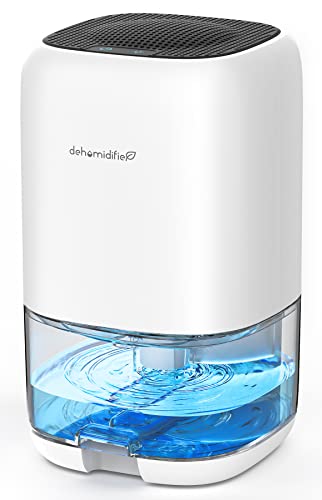
TABYIK 35 OZ Dehumidifier for Bedroom RV, Quiet with Auto Shut Off, White | 280 Sq.Ft Small Dehumidifiers for Home Bathroom Closet, 7 Color Light, 28dB Ultra Quiet, 35OZ Water Tank


As an Amazon Associate we earn from qualifying purchases. Product prices and availability are accurate as of the date/time indicated.
Small Dehumidifier for Home 44OZ Quiet with Auto Off & Defrost 5 Timers 3 modes 10 Color Lights 3 Brightness 260 Sq.ft Portable Dehumidifiers for Basement Bedroom Bathroom RV Closet




As an Amazon Associate we earn from qualifying purchases. Product prices and availability are accurate as of the date/time indicated.

Dehumidifiers for Home, 1000 Sq Ft Dehumidifier with 95oz Tank Auto Shutoff | Quiet for Bedroom, Bathroom and Basement with Sleep Mode 7-Color LED Light, Grey


As an Amazon Associate we earn from qualifying purchases. Product prices and availability are accurate as of the date/time indicated.
GoGuess 1600 Sq.Ft Compressor Dehumidifier for Basement, Max 21 Pint/Day | Dehumidifier with Drain Hose for Home RV Garage Large Room, Timer Humidity Control


As an Amazon Associate we earn from qualifying purchases. Product prices and availability are accurate as of the date/time indicated.
Dehumidifier 1657ML 58OZ Small Dehumidifier for Home 230 Ft² Safety Dehumidifiers Adjustable 10 Color Lights 5 Timers 3 Setting Modes Auto Shut Off Protection Low Noise For Bedroom Bathroom


As an Amazon Associate we earn from qualifying purchases. Product prices and availability are accurate as of the date/time indicated.

BEDRED Dehumidifier, 95Oz Dehumidifier for Home 1000 Sq.Ft | Quiet, Auto Shutoff, Sleep Mode, 7 Color Ambient Light for Bedroom, Bathroom, Basement (Deep Black)
As an Amazon Associate we earn from qualifying purchases. Product prices and availability are accurate as of the date/time indicated.

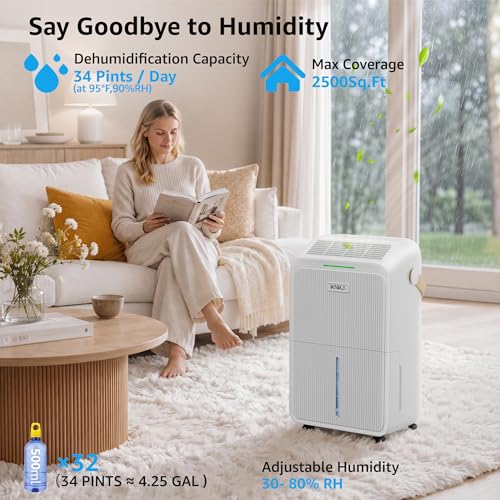
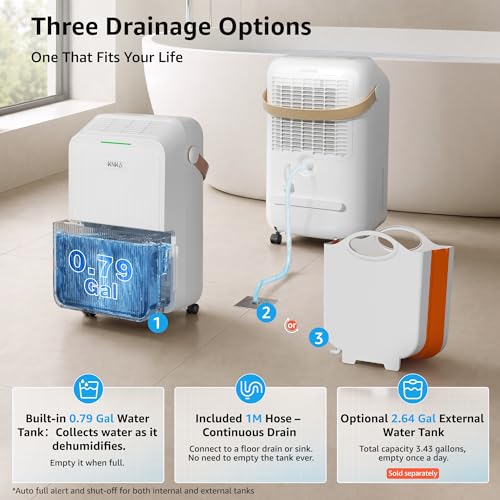
KNKA 2500 Ft² Max 34 Pints Dehumidifier for Basement with Drain Hose, White | Dehumidifiers for Home, Bedroom, Bathroom, Large Room, Three Modes, Intelligent Humidity Control, Dry Clothes, 24HR Timer



As an Amazon Associate we earn from qualifying purchases. Product prices and availability are accurate as of the date/time indicated.
Coverage numbers and tank sizes below come straight from each listing title. Anything the title does not say, such as wattage, noise at a real distance, or warranty length, is left for you to confirm on the listing page.
| Model | Key spec (from the title) | Price tier | Best for |
|---|---|---|---|
| TABYIK 35 oz | 280 sq ft, 35 oz tank, 28 dB claim | Budget | Galley kitchen or pantry corner |
| Newo 44 oz | 260 sq ft, 44 oz tank, defrost, 5 timers | Budget | Closed kitchen, one-room use |
| BeOkay 58 oz | 230 sq ft, 58 oz (1657 ml) tank, 5 timers | Budget | Small kitchen with a chatty cook |
| ToLife 95 oz | 1000 sq ft, 95 oz tank, sleep mode | Budget | Kitchen plus dining nook |
| NineSky 95 oz | 1000 sq ft, 95 oz tank, sleep mode | Budget | Same job, different listing |
| BEDRED 95 oz | 1000 sq ft, 95 oz tank, deep black finish | Mid-range | Black or stainless kitchens |
| GoGuess 21 pint | 1600 sq ft, compressor, drain hose | Mid-range | Open-plan, steady humidity |
| KNKA 34 pint | 2500 sq ft, drain hose, 24-hour timer | Mid-range | Large kitchen, laundry-adjacent |
Price tier is relative to this list: Budget is the cheapest band, Mid-range sits above it. Check the live listing for the current price.
Where kitchen moisture really comes from
Before choosing a machine, it helps to know how much water you are actually fighting. The figures below are rough physics-based estimates for a standard home range, not measurements from a real kitchen, and they will move with burner power, pot size and lid use.
| Cooking activity | Rough water released | Why |
|---|---|---|
| 20-minute uncovered pasta boil | about 1 pint | A rolling boil on a full burner can evaporate around 3 pints per hour |
| 40-minute covered simmer | about 0.3 to 0.5 pint | The lid traps most vapor and returns it to the pot |
| One gas burner on high, 1 hour | about 0.9 pint | Burning natural gas produces water vapor as a byproduct |
| Electric kettle, 3 boils | about 0.2 pint | Short, spout-directed bursts |
| Dishwasher vent at end of cycle | varies, check the manual | Hot, wet air escapes when the door opens |
Add up a busy dinner: a pasta boil (1 pint), a covered sauce (0.4 pint), 45 minutes of gas flame (0.7 pint) and a few kettle boils (0.2 pint). That is about 2.3 pints released over roughly two hours, and a good range hood vented outdoors takes a large share of it before it reaches the room. A 44-ounce tank holds 2.75 pints, a 95-ounce tank holds close to 6 pints. In other words, even a modest tank is sized well above the vapor from one dinner, which is why the tank-versus-hose decision matters more for damp climates than for cooking itself.
The real issue is the leftover. Humid air from cooking settles into cabinet backs, the window frame over the sink and the grout behind the faucet, and in a warm region it can hover above 60 percent for hours. A dehumidifier earns its place in homes where the kitchen stays damp between meals, not in homes where it spikes and clears on its own. If an inexpensive digital hygrometer shows your kitchen already falls under 50 percent within an hour of cooking, save the money.
Compact plug-in units for a closed kitchen
These three suit a kitchen of roughly 100 to 200 square feet where the door is usually shut after dinner. Their tanks are small, so plan on emptying them daily during the muggy months.
TABYIK 35 oz: the pantry-corner option
The TABYIK listing is the smallest in the group: a 35-ounce tank (about 2.2 pints), a 280 square foot coverage figure, a 28 dB quiet claim, auto shut-off and a seven-color light. Its title also mentions bedroom, RV, bathroom and closet use, which tells you the design target is a small enclosed space rather than a working kitchen.
In a galley kitchen the footprint is the attraction. It can sit at the far end of a counter or on a low shelf beside the pantry door, out of range of the stove. The title does not give a pint-per-day rating, so do not expect to clear a whole open-plan floor; treat 280 square feet as the ceiling and the real working size as smaller, perhaps 120 to 150 square feet in a humid season. Whether the 28 dB figure holds in a room with a running fridge compressor is something only the listing’s buyer feedback can hint at.
A rough sizing check helps here. At 35 ounces the tank holds about 2.2 pints, and our steam estimate for a pasta-and-sauce dinner is around 2 pints released into the room. In theory that means one evening could fill the tank if it caught every drop, which it will not, but it explains why you should plan to empty it each morning and why the auto shut-off matters. Keep a small towel under it on a laminate counter, because condensation can bead on the tank when the kitchen is warm.
Pros
- Lowest footprint of the eight, easy to tuck beside a pantry
- Auto shut-off when the tank fills means no overflow onto the counter
- The quietest claim in the group
Cons
- Small tank: a muggy day can fill it in a day or less
- No daily pint rating in the title, so capacity is unclear
- Decorative light is irrelevant in a kitchen and can be switched off
Who it is for: renters with a narrow galley kitchen who want the cheapest, smallest unit to nudge humidity down at night.
Newo 44 oz: our pick for a standalone kitchen
Newo makes the most kitchen-relevant feature list of the compact trio. The title names auto off, a defrost function, three modes, five timers and 260 square feet. The 44-ounce tank is about 2.75 pints, a decent cushion for the single-dinner scenario above.
The defrost line matters if your kitchen runs cool in winter, say 55 to 60 degrees overnight in an older house, because some small dehumidifiers ice up in cold air. We do not know the exact temperature at which this unit protects itself, so check the manual before running it in an unheated mudroom-kitchen. Five timers make it straightforward to run for two hours after dinner and then stop, which is the usage pattern that fits cooking humidity best.
Pair it with a 2 hour post-dinner run, 1 to 2 feet away from the wall for airflow, and a cord routed along the back edge of a shelf rather than across a counter.
One planning note: the title gives no pint-per-day figure and no wattage, so the 260 square foot number is the only capacity clue. If your kitchen has a window over the sink, picture the 260 as a cap for a sealed room and subtract about a third when the window is cracked or the back door opens often. That leaves an effective working area near 170 square feet, which still covers most apartment kitchens. If you want to know what the unit costs to run, a plug-in watt meter will answer in one afternoon.
Pros
- Defrost function listed for cooler rooms
- Five timers match short after-dinner cycles
- Mid-sized 44 oz tank without a large footprint
Cons
- Ten color lights and three brightness levels are clutter in a kitchen
- 260 square foot rating is the listing’s claim; real coverage is lower
- No drain hose option stated in the title
Who it is for: anyone with a closed kitchen under 200 square feet who wants a timer-driven unit for post-dinner clean-up.
BeOkay 58 oz: bigger tank, smaller footprint on paper
Here is a quirk worth noticing: the BeOkay listing offers a larger tank than the Newo (58 ounces, which the title also gives as 1657 ml, about 3.6 pints) but a lower coverage number of 230 square feet. A bigger tank and a smaller room rating usually means the manufacturer expects a lower removal rate per hour, so the extra tank volume buys you time between empties rather than extra drying power.
That is not a flaw for a kitchen. If you cook heavily on weekends and want a unit that runs for most of a day without a trip to the sink, 3.6 pints is a comfortable reserve. The title also lists three setting modes, five timers, ten colors, auto shut-off protection and low noise, but gives no decibel figure, so the noise claim is just a claim.
Because the coverage is the lowest in the group, size down your expectations: this is for a kitchen of about 100 to 150 square feet or a small pantry, not an eat-in space.
Think of it as the weekend-batch-cook option. Someone simmering stock for four hours on a Sunday can release a lot of vapor even with a lid ajar, and a 3.6 pint reserve means the unit can keep running through the afternoon instead of stopping halfway. On weekdays, when you cook for 30 minutes, the large tank is more than you need and you may find the daily empty is just a habit rather than a necessity. Check the three modes in the manual so you know which one prioritizes quiet over speed.
Pros
- Larger tank for fewer trips to the sink
- Auto shut-off protection listed
- Low price tier for the capacity
Cons
- Lowest coverage figure of the eight
- No decibel number in the title
- Large tank with small coverage suggests modest drying rate
Who it is for: small-kitchen cooks who want fewer tank-emptying trips and are fine with a gentle, slow unit.
95-ounce tank units for kitchens that open to the dining area
If the kitchen shares air with a table, a hallway or a living room, a closed-room rating means little. These three listings carry the same 1000 square foot figure and a tank near 6 pints, so the decision is more about details and finish than raw capability.
ToLife 95 oz: the default pick for a kitchen-dining combination
ToLife lists 1000 square feet, a 95-ounce tank (about 5.9 pints, or roughly 2.8 liters), sleep mode, auto shut-off and a seven-color LED. It is described as portable for home, bedroom, bathroom and basement, which is the broadest brief of any budget unit here.
For a kitchen, the large tank is the draw. You could run it for most of a humid day and empty it once. Sleep mode, listed in the title, is relevant if the kitchen opens to a bedroom hallway. Do not read 1000 square feet as a guarantee; the number is a ceiling, and a kitchen with a window, a door to the outside and a gas stove is a tougher job than a bedroom of the same size.
Plan the position carefully: the tall body is easy to knock with a hip during a busy dinner. A corner next to the refrigerator, not in the walkway, keeps it out of danger.
It is also worth deciding at the outset whether you want it running in sleep mode overnight. A kitchen that stays above 60 percent after you go to bed is a risk for mold behind the fridge and under the sink, and a quiet overnight setting is a cheap defense. In that case, a 5.9 pint tank means a unit can run for most of the night without filling. If the kitchen is dry by midnight, skip it and run the machine only after dinner, which saves power and wear on the fan.
Pros
- Large tank of about 5.9 pints before shut-off
- Sleep mode listed for overnight use
- Broad 1000 square foot claim covers open plans
Cons
- Taller body needs floor or low-shelf space
- Pint-per-day removal is not in the title
- Seven-color light has no kitchen purpose
Who it is for: households where the kitchen, dining table and living room are one open space.
NineSky 95 oz: same specs, different name
Read the NineSky title next to the ToLife one and the overlap is striking: 1000 square feet, a 95-ounce tank, auto shut-off, sleep mode, a seven-color LED and the same list of rooms. The only visible differences are the brand name and the generic opening phrase, Dehumidifiers for Home. We cannot say whether the internals match; the title does not say, and that is exactly the kind of detail to check in the listing images and manual.
The practical consequence is that the choice between these two is a shopping decision, not a performance one. Compare delivery speed, return window, listed cord length, warranty language and recent buyer comments about noise or leaks. If both are in stock at the same price tier, pick the one whose listing shows a manual or clearer photographs of the control panel.
For a kitchen, the cord length deserves particular attention. A short cord pushes you toward an extension cable, which is a poor idea near a sink. Look for the length in the listing before ordering.
A second thing to compare is how each listing describes its controls. A touch panel with a humidity target is easier to wipe clean than a row of buttons with gaps, and in a kitchen, where flour and cooking spray drift through the air, that detail adds up over a year. Look at the product photos for the tank handle and the water-level window too; a tank that is awkward to pull out will get emptied less often, and a tank that never gets emptied means a machine that stays off.
Pros
- Large 95 oz tank with a 1000 square foot claim
- Budget price tier
- Auto shut-off listed
Cons
- Spec line matches other listings, so little to separate it
- Title is generic; check the manual for the actual model details
- No kitchen-specific features
Who it is for: bargain hunters who are happy to treat the 95-ounce format as interchangeable and pick on shipping or return terms.
BEDRED 95 oz: when the color of the machine matters
The BEDRED listing repeats the 1000 square foot, 95-ounce, auto shut-off and sleep mode formula and adds a Deep Black finish. In the mid-range price tier, it costs noticeably more than the near-identical budget listings, and the most visible thing that buys is the color. In a kitchen with black stainless steel appliances or dark cabinets, a black box beside the fridge looks intentional, while a grey one looks like an afterthought.
Whether that is worth the premium is a personal call. If you are comparing it to the ToLife and NineSky listings on function alone, the title offers no clear advantage, so the question to ask is what BEDRED covers in warranty or support. We have not seen the terms and will not guess; check the listing and the manufacturer page.
Black glossy plastic shows fingerprints and splashes quickly, so a wipe-down habit helps in a kitchen environment.
One more consideration is the resale and replacement angle. A premium over the budget listings is easier to justify when the machine stays out on a counter or floor for years and you see it every day. If it will live in a closet between humid spells, the finish stops mattering and the cheaper listings deliver the same on-paper specs. Ask yourself honestly where the unit will sit for most of the year before paying for the color. If you do buy it for the finish, also check the listing photos for how the vents and control panel are laid out, since a glossy black front with tiny touch icons can be hard to read in a bright kitchen.
Pros
- Deep Black finish blends with dark appliances
- Same 95 oz tank and 1000 square foot rating as the budget options
- Sleep mode and auto shut-off listed
Cons
- Higher price for specs that match cheaper listings
- Glossy dark surface shows splashes and fingerprints
- Warranty terms not in the title
Who it is for: design-conscious buyers who care how a visible appliance looks next to a dark kitchen.
Hose-drain compressor units for large or very humid kitchens
Both of these list a drain hose and are pitched at basements and large rooms. In a kitchen, they make sense only when the room is big, or when the humid problem extends beyond the cooking zone, for example a kitchen beside a laundry or a below-grade space.
GoGuess 21 pint: steady drying without a tank
GoGuess is a compressor unit, per its title, with a maximum rating of 21 pints per day, a 1600 square foot claim, a timer, humidity control and a drain hose. A compressor design generally removes far more water per day than a small tank unit, and the pint rating is the first honest capacity number in this roundup.
The drain hose is a practical feature for a kitchen because you can lead it toward the sink. One catch: gravity drainage works only if the unit sits higher than the drain point, so an on-floor machine with a hose to a sink above it will not drain on its own. A counter-height perch can work, but a compressor unit is heavy and vibrates; the sturdier option is a laundry sink or floor drain nearby. If that is not available, use the tank, which the title does not detail, and check the manual.
At 21 pints a day, this size suits an open kitchen of 400 to 700 square feet when humidity is high. Smaller closed kitchens will cycle it on and off often, wasting a little energy.
A monthly running-cost sketch shows why the pint rating matters. As an assumption only, say a compressor unit in this class draws about 250 watts while the compressor runs, and it runs for 6 hours a day at an electricity rate of 16 cents per kilowatt-hour. That is 1.5 kWh per day, 45 kWh per month and about 7 dollars. Your wattage, run time and rate will differ, and the title does not state the wattage, so plug these figures into your own numbers before relying on them.
Pros
- Compressor design with a clear 21 pint per day maximum
- Drain hose supports continuous operation
- Humidity control and a timer to schedule runs
Cons
- Larger and heavier than plug-in tank units
- Gravity drain to a kitchen sink often will not work at floor height
- Overkill for a closed kitchen
Who it is for: open-plan homes in humid regions where cooking steam adds to an already damp baseline.
KNKA 34 pint: the large-room option with a 24-hour timer
KNKA lists 2500 square feet, a maximum of 34 pints, a drain hose, three modes, intelligent humidity control, a clothes-drying mode and a 24-hour timer. Of all eight, this is the one that targets a whole floor or a basement, and in a kitchen scenario it is relevant only if the kitchen is part of a large open space or sits next to a laundry area where you would also use the dry-clothes mode.
The 24-hour timer is more useful than it sounds. You can set it to start before you get up and stop before dinner, avoiding running at peak electric rates. We do not know the wattage from the title; use a plug-in power meter, or see our guide to power usage meters for kitchen appliances, to check what it actually draws, then decide whether continuous operation is worthwhile.
Because the rating is so high, the unit will usually reach the target humidity quickly and then cycle. That cycling is fine, but it means noise comes in on-and-off waves, which can annoy in a kitchen that doubles as a living area.
Because the title lists a clothes-drying mode, think about how you would use the unit through the year. In winter you might park it in the laundry corner to dry sweaters on a rack, and in summer you might move it to the kitchen when basement air creeps upstairs. A machine that can move around the house earns its footprint more easily than one fixed to a single spot, though a heavier body is not fun to carry up stairs. Check the weight on the listing, and whether there are caster wheels, before you commit.
Pros
- 34 pint maximum and 2500 square foot claim for big open spaces
- Drain hose and 24-hour timer for scheduling
- Dry-clothes mode useful if the kitchen adjoins a laundry
Cons
- Too large for a standard kitchen
- Bulky; needs floor space away from foot traffic
- Noise level not given in the title
Who it is for: a large kitchen-laundry combination or a ground-floor open-plan space with persistent dampness.
Placement checklist for a kitchen dehumidifier
Where you put the machine matters as much as which machine you buy. Use this list before plugging in.
- Stay 3 feet or more from the stove and sink. Heat and splashes are the two enemies of small appliances, and the unit does not need to be near the steam to work.
- Leave 6 to 12 inches around the intake and exhaust. Pushing the machine against a wall or inside a cabinet cuts airflow and raises the run time.
- Keep the cord on a dry route. Avoid running it across a counter, over the sink edge or under a pot rack. Plug it into an outlet that is not carrying a toaster oven or air fryer at the same time.
- Use a hard, level surface. A wobbling machine can trip the full-tank float switch, shutting down early.
- Close the door and windows while it runs. Pulling in new humid air from outside defeats the purpose.
- Put a hygrometer at eye level, across the room. The reading at the unit itself is drier than the rest of the kitchen.
- Run it after cooking, not during. Starting 15 minutes after the burner shuts off avoids sucking greasy vapor into the screen.
Cord, splash and stove safety
Moisture control and electricity are an uncomfortable pairing. Most of the units here have auto shut-off, which stops the compressor or fan when the tank is full, but auto shut-off does not protect the plug from a boil-over. Keep the cable on the side of the machine away from the stove. If your outlets are on the wall behind the cooktop, that is a sign to move the unit to another wall rather than reach with an extension cord.
For anything you would route near the sink, a ground-fault circuit-interrupter (GFCI) outlet is the norm in many kitchens and adds a margin of safety. If you are not sure whether your outlet has one, look for the test and reset buttons on its face or ask an electrician. Also be aware that a clothes-drying mode, on units that have one, produces warm exhaust that should not point at stored paper goods or cooking oils.
Lastly, empty the tank at the sink rather than carrying it across the room; a brimming 6-pint tank is heavy and spills easily on a tile floor.
How we picked these
The Editorial team built this list by comparing published specifications, manufacturer documentation and buyer reviews for each listing. Nobody on the team used or measured these units, so no figure here is an observed result. Where a number appears, it is either quoted from the listing title (coverage, tank size, pint rating) or labeled as an estimate (steam released while cooking, tank refill intervals).
We weighted five things: whether the listed coverage is plausible for a kitchen-sized room, tank capacity relative to a cooking day, the presence of auto shut-off and timers, noise claims, and a drain hose option. We also noted when a title says nothing about a feature, such as wattage or warranty, and sent you to the listing rather than guess.
Listings that were near duplicates (ToLife, NineSky and BEDRED share an almost identical spec line) are flagged as such, because treating them as different on-paper products would be misleading. Prices change daily; the price tier column is a relative guide only.
Tank or hose: what happens to the water
A kitchen has a sink, and that tempts people to buy hose-drain units. Think it through first. A tank unit stores water and stops when full; a hose unit pushes water out and runs until the room hits the set humidity.
For a standalone kitchen that sees an hour of heavy steam in the evening, a tank unit with a 2 to 6 pint capacity matches the load. For a kitchen that is damp all day because of climate, a hose unit with continuous drainage is a better fit, but only if you have a floor drain, a laundry sink lower than the unit or an elevated placement with a short, downhill hose. Another approach used with some compressor models is to add an external condensate pump, which is not mentioned in these titles and which needs separate research.
If you do route a hose, secure it so it cannot kink under a cabinet toe-kick, and check the tube once a week for algae in humid summer months.
Noise in a room where people talk
Only the TABYIK title quotes a decibel number (28 dB), and that is a manufacturer claim. A quiet library sits around 30 to 40 dB, a refrigerator hums at roughly 40 to 45 dB, and a typical compressor dehumidifier is often reported in the range of 45 to 55 dB. These are general ranges, not measurements of the units above. The important point for a kitchen is that the fridge, hood fan and dishwasher already add background noise, so a small unit is easier to ignore than in a bedroom. Large compressor models cycle on and off, and the start-up thump is more noticeable in a quiet house at night than a constant low hum.
Mistakes to avoid when buying for a kitchen
- Buying before measuring humidity. Many kitchens never go over 55 percent for long. Measure for a week first.
- Believing the sq ft number. Coverage figures describe an enclosed room with no outside air. An open kitchen with a window leaks that advantage.
- Parking it next to the cooktop. Heat, grease and splashes shorten its life and add a safety risk.
- Skipping the range hood. A hood that vents outdoors removes steam at the source, and it does it for the cost of a fan. A dehumidifier cannot replace it. If you want to tackle smells as well, our air purifiers for kitchen odors roundup covers the part dehumidifiers cannot.
- Using extension cords. They add resistance and a fire risk near water.
One more related cooking source: pressure cookers release a burst of steam when you vent them. If that is how you cook, read our look at which Instant Pot fits your kitchen and position the vent away from cabinets and the dehumidifier intake.
Verdict
For a closed kitchen, the Newo 44 oz is the pick: a defrost function, five timers and a tank sized for a day of cooking. For the budget pick, the TABYIK 35 oz does the basic job at the lowest tier and fits a pantry corner, though it will need emptying daily. For open-plan living, step up to the GoGuess 21-pint compressor if you can drain it into a laundry sink, or the ToLife 95 oz if you want a tank. The KNKA 34 pint is the premium choice for big rooms and laundry combinations, and BEDRED is for buyers who want the black finish. Whatever you choose, aim for 45 to 50 percent, measure with a hygrometer and keep the machine well away from the burners.
Frequently asked questions
Where should I put a dehumidifier in a kitchen?
Put it on a stable, dry surface at least 3 feet from the stove and sink splash zone, with 6 to 12 inches of clear space around the air intake and exhaust. A spot near the room’s doorway or the far side of the dining area usually works, because the unit pulls in room air rather than catching steam at the source. Never place it where grease spatter or boiling-pot splashes can reach the cord or the vents, and keep the plug away from wet counters.
Will a dehumidifier remove cooking odors and grease?
No. A dehumidifier pulls water vapor out of the air, and most models only have a basic dust screen, so grease particles and smells stay in the room. A range hood vented outdoors, an open window, or an air purifier with a carbon stage handles odor and grease. Think of the dehumidifier as the cleanup crew for leftover humidity after the cooking is done, not as a replacement for ventilation.
What size dehumidifier does a small kitchen need?
A closed kitchen of 100 to 200 square feet is usually fine with a compact unit listed for 230 to 280 square feet, such as the 35, 44 or 58 ounce tank models here. Open-plan kitchens that share air with a dining room and living room are better served by a unit listed for 1000 square feet or more, or a 21 to 34 pint compressor unit. Coverage figures are the listing’s claims, so leave some margin.
Is it safe to run a dehumidifier while cooking?
Generally yes, if you place it away from burners, keep the cord clear of hot surfaces and splashes, and plug it into a dry outlet that is not shared with a heavy appliance. Many people simply run it after cooking to clear the humidity bump. Check the manual for the operating temperature range, because a hot kitchen near an oven can exceed what small units are designed for.
How much humidity should a kitchen have?
Most guidance for homes points to roughly 30 to 50 percent relative humidity, with 45 to 50 percent a practical upper target in warm weather. Persistent readings above 60 percent invite mold on grout, cabinet undersides and window frames. A basic digital hygrometer costs far less than any dehumidifier and tells you whether the kitchen actually has a problem before you buy anything.





Write Your Review
No reviews yet. Be the first to share your experience!