

Our Top Picks
 OXO Brew Conical Burr Electric Coffee Bean GrinderOne Size6.8 x 11.8 x 14.8 inches4.5 poundsCheck on Amazon
 CEVING Mini Manual Coffee Grinder With 40 AdjustableCeramic Burr7.4 x 2.3 x 6.7 Inches0.8 poundsCheck on Amazon

The OXO Brew Conical Burr Grinder is the best all-round pick for a French press: it pairs stainless steel conical burrs with a 12 oz hopper and a settings range that reaches well into the coarse end. A French press needs a coarse, even grind, because the metal mesh filter lets fine particles slip straight into the cup, and burr grinders crush beans to a far more uniform size than blade grinders do. The other five picks cover the rest of the field, from a compact hand mill for travel to a big-hopper electric model for households that brew several cups a day.
Quick List
- OXO Brew Conical Burr – best for an everyday, set-it-and-forget-it French press routine
- CEVING Mini Manual – best for travel, camping and tiny kitchens
- Aromaster Conical – best for anyone who wants a timer and a removable burr for easy cleaning
- SHARDOR Electric Burr 2.0 (first listing) – best for a simple, compact electric burr grinder
- Hamilton Beach Electric Burr – best for large batches and big hoppers
- SHARDOR Electric Burr 2.0 (second listing) – best as a same-name alternate if the first listing is unavailable
Which One Is Right for You?
| If you… | Choose |
|---|---|
| brew a pot for the whole household and grind a lot of beans at once | Hamilton Beach Electric Burr |
| want one-touch grinding with a wide range of settings | OXO Brew Conical Burr |
| carry your press to a cabin, office or campsite | CEVING Mini Manual |
| like a timer and a brush for cleaning stale grounds out of the burr | Aromaster Conical |
| want a straightforward electric burr grinder without extras | SHARDOR Electric Burr 2.0 (first listing) |
| find the first SHARDOR listing out of stock or want to compare finishes | SHARDOR Electric Burr 2.0 (second listing) |
Most people brewing one or two presses a day will be happiest with an electric conical burr model. If you only ever make a single mug, or you travel often, the manual mill saves counter space and costs nothing to run. Whichever way you go, grind right before you brew and keep the hopper from sitting half empty for weeks.
All 6 Picks in Detail
1. OXO Brew Conical Burr Electric Grinder – Best for an everyday French press routine
As an Amazon Associate we earn from qualifying purchases at no extra cost to you.
This is the grinder to look at first if you want a dependable daily machine and do not want to fiddle. The listing describes stainless steel conical burrs, one-touch automatic operation and a 12 oz hopper, with a long run of grind settings that stretches from fine to coarse. For a French press you will live near the coarse end of that dial, and the large number of steps means you can nudge the grind a notch coarser if your brew tastes bitter, or a notch finer if it tastes thin.
It suits people who brew the same way every morning and want repeatable results. Because it grinds into a container and shuts itself off, you can start it and pour water while it works.
In practice, a good starting routine is to weigh the beans, pour them into the hopper, set the dial toward the coarse end and press the button. Because the container catches the grounds directly, you can tip them into the press without transferring them through a second vessel, which cuts down on static mess.
- Stainless steel conical burrs, according to the listing
- 12 oz bean hopper
- One-touch automatic operation
- Listing names 43 grind settings (the maker’s own page describes a smaller set of main sizes with finer steps between them, so treat the exact count as something to confirm on the product page)
- Suited to drip, French press and other methods
Pros
- Very wide range of adjustment for dialing in a coarse grind
- Simple operation with no timer to program
Cons
- Takes up more counter space than a hand mill
- Hopper holds less than the Hamilton Beach for large households
Compared with the Hamilton Beach pick, it has a smaller hopper but a finer-stepped dial, so it wins for precision while the Hamilton Beach wins for volume.
2. CEVING Mini Manual Coffee Grinder – Best for travel and tiny kitchens

A hand-crank mill is a perfectly good way to make French press coffee, because the coarse setting requires very little effort to crush. The listing describes 40 adjustable settings, ceramic conical burrs and a 30 g capacity, which is roughly one strong mug or a small press. It needs no power, no cord and no counter, so it fits a backpack or a desk drawer.
Choose it if you brew for one or two people, or if you want a backup grinder that works during a power cut. It is not the right tool if you regularly grind enough beans for a full-size press, since the small chamber means repeated refills.
One tip for hand mills: grind a measured amount, then check the particles against a pinch of coarse salt. If they look like powder in places, open the setting one step. A mill this size also works well for steeping a single-serving press at a desk.
- Manual crank operation, no electricity needed
- Ceramic conical burrs, per the listing
- 40 adjustable settings
- 30 g bean capacity
- Portable, compact body
Pros
- Quiet and portable
- Coarse grinding takes little effort
Cons
- Small capacity means several batches for a large press
- Slower than any of the electric models
Next to the electric Aromaster, it trades speed and convenience for portability and silence.
3. Aromaster Conical Coffee Bean Grinder – Best for a timer and easy cleaning
The Aromaster stands out for its feature list: 48 settings, an anti-static design, a stainless steel build, an adjustable timer that runs up to 40 seconds, a removable burr and a brush for cleaning. For French press that matters in two ways. A timer lets you grind a repeatable dose by time rather than by eye, and a removable burr makes it easy to clear out oils and fines that otherwise build up and turn rancid.
It is a good match for tinkerers who like to adjust one variable at a time, and for anyone who has been annoyed by grounds clinging to the container.
The anti-static claim is worth checking in your own kitchen, since grounds cling less in dry winter air only when the container and chute are clean. Wipe the chute with the brush after each session and the machine will stay tidy.
- Conical burr design with 48 settings
- Anti-static feature, per the listing name
- Stainless steel finish
- Adjustable timer, up to 40 seconds
- Removable burr and cleaning brush included
Pros
- Timer makes dosing repeatable
- Removable burr simplifies cleaning
Cons
- Timed dosing still needs a kitchen scale to be precise
- Hopper size is not stated in the listing name, so confirm on the product page
Where the OXO relies on a one-touch routine, the Aromaster gives you a timer, which is better if you like to control dose and worse if you want zero decisions.
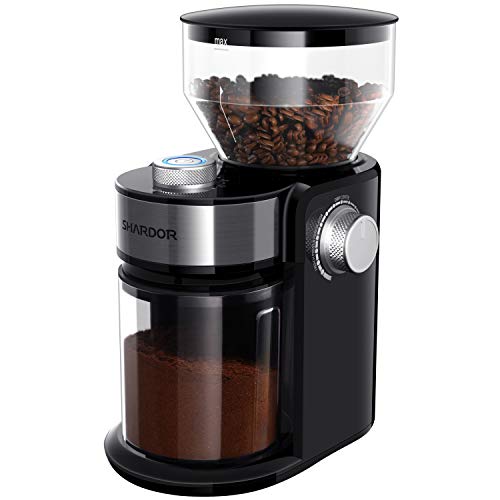
4. SHARDOR Electric Burr Coffee Grinder 2.0 (first listing) – Best for a simple compact electric burr
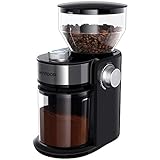
SHARDOR positions this model as an automatic burr grinder for home use with an adjustable burr mill and 16 settings spanning espresso through coarser methods. Sixteen steps is fewer than the OXO or Aromaster, but a French press does not need dozens of steps: it needs one dependable coarse setting and perhaps a neighboring one for fine-tuning.
This is a sensible pick for a first burr grinder. It replaces a blade grinder without asking you to learn a new routine, and it keeps the countertop footprint modest.
Because the listing lists fewer, bigger steps, expect the French press range to sit within the last few clicks of the dial. Mark your preferred setting with a small piece of tape so you can return to it after grinding for another method.
- Electric, automatic operation
- Adjustable burr mill with 16 settings
- Designed for home use
- Range runs from espresso fineness toward coarse brewing
- Hopper and cup capacities: confirm on listing
Pros
- Easy to understand, with few controls
- A big upgrade in consistency over a blade grinder
Cons
- Fewer steps than the leading picks
- Capacity details are not in the listing name
Compared with the Aromaster it is plainer and has fewer settings, which keeps it approachable but gives you less room to fine-tune.
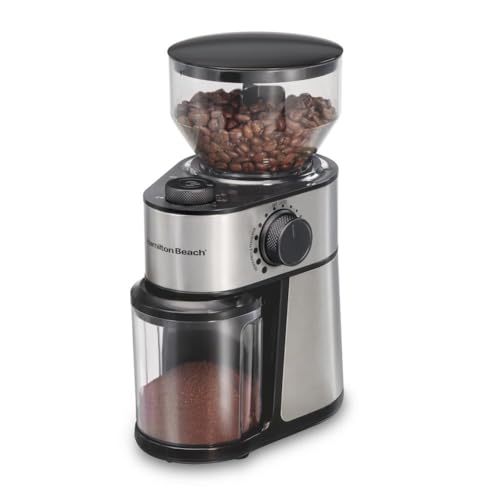
5. Hamilton Beach Electric Burr Coffee Grinder – Best for large batches

The headline here is the big hopper: 16 oz of beans, with 18 grind settings that the listing says run from espresso to French press, and a stated output of 2 to 14 cups. If your household goes through a lot of coffee, or you grind for guests, you can fill the hopper once and grind several presses without refilling.
The trade-off with any large hopper is that beans sit exposed for longer, so it works best if you actually drink through the beans quickly. If you only brew one cup a day, a smaller hopper keeps beans fresher.
To keep beans fresh, many owners of large-hopper grinders fill only what they will use in a week and store the rest in an airtight container. That habit costs nothing and removes the main drawback of a roomy hopper.
- 16 oz hopper
- 18 grind settings from espresso to French press
- Makes 2 to 14 cups per the listing
- Electric burr design
- Footprint and burr material: confirm on listing
Pros
- Largest stated hopper of the six
- Explicitly aimed at French press fineness
Cons
- Fewer settings than the OXO and Aromaster
- Large hopper encourages leaving beans out too long
Against the OXO, it holds more beans but offers fewer steps, so it is the better volume grinder and the less precise one.
6. SHARDOR Electric Burr Coffee Grinder 2.0 (second listing) – Best as a same-name alternate

This listing carries the same name and the same headline specs as the first SHARDOR entry: an automatic electric burr grinder with 16 settings for home use. Two listings with one name usually mean separate color or finish variants, or a repackaged version of the same grinder, so the practical advice is to compare the two product pages and pick whichever matches your kitchen and is currently available.
Everything said about the first listing applies here, including the modest number of steps and the simple operation. Confirm any differences, such as color, included accessories and warranty, directly on the page.
If you buy this one, keep the packaging details from whichever page you order from, so that you can match accessories and warranty terms to the correct listing later.
- Automatic electric burr operation
- 16 precise settings, per the listing name
- Adjustable burr mill
- Suited to home use
- Variant differences from the first listing: confirm on listing
Pros
- Same easy operation as the first SHARDOR
- Gives you a second option if one version is unavailable
Cons
- Not clearly different from the first listing
- Limited detail in the title about capacity
The nearest alternative is the first SHARDOR listing, and the choice between them comes down to finish and availability rather than performance.
Specs Compared
| Grinder | Type | Burr | Settings | Capacity | Extras |
|---|---|---|---|---|---|
| OXO Brew Conical Burr | Electric | Stainless steel conical | 43 (per listing) | 12 oz hopper | One-touch automatic |
| CEVING Mini Manual | Manual | Ceramic conical | 40 | 30 g | Portable hand mill |
| Aromaster Conical | Electric | Conical, removable | 48 | Confirm on listing | Timer up to 40 s, brush, anti-static |
| SHARDOR Electric Burr 2.0 (first) | Electric | Adjustable burr mill | 16 | Confirm on listing | Automatic |
| Hamilton Beach Electric Burr | Electric | Burr (confirm material) | 18 | 16 oz hopper | 2 to 14 cups |
| SHARDOR Electric Burr 2.0 (second) | Electric | Adjustable burr mill | 16 | Confirm on listing | Automatic |
How We Chose These
We started from the six burr grinders in the current product set and read each listing name, specification field and manufacturer page we could find. Our criteria were the ones that matter most for a French press: a burr mechanism rather than a blade, a setting range that clearly reaches the coarse end, enough capacity for a typical press, and practical features such as removable parts or a timer. We also weighed how easy each grinder looks to clean, because stale oils change flavor. Where a listing does not state a value, we say so rather than guess. This is a research-based comparison drawn from published specifications, not a lab evaluation.
What to Look For
Why burrs beat blades for French press
A blade grinder chops beans at random, leaving a mix of boulders and powder. In a French press the powder slips through the mesh and over-extracts, giving a muddy, bitter cup, while the boulders under-extract and taste sour. Burrs crush beans between two abrasive surfaces set a fixed distance apart, so the particle size is far more even. Conical burrs, which nest one cone inside a ring, tend to run slower and cooler, and they are the style used on most home grinders in this list.
The right grind size and setting range
Aim for a coarse grind, similar to coarse sea salt, with particles roughly the size of breadcrumbs or a little larger. Grinders list settings in different ways, so a higher number is not always coarser; check the dial direction in the manual. Having more steps is helpful mainly because it lets you change the grind by a small amount. If the cup is bitter or harsh, go one step coarser. If it is weak, sour or thin, go one step finer. A grinder that tops out well past the French press range gives you headroom for cold brew as well.
Capacity, dosing and the ratio rule of thumb
Hopper size tells you how many beans fit; the grounds container tells you how much you can grind at once. Most French press recipes use a ratio between about 1:15 and 1:17 coffee to water by weight. For reference, the Specialty Coffee Association’s Golden Cup standard for filter brewing works out to roughly 55 g of coffee per liter of water, which is a lighter strength than many press drinkers choose.
Worked example: a 34 oz press holds about 1 liter of water. At 1:16 you want about 62 g of coffee, and at the SCA figure about 55 g. A 30 g manual mill therefore needs two fills for a large press, but only one for a 17 oz press, which takes about 30 g at the same strength.
Cleaning, static and noise
Coffee oils build up on burrs and in chutes. A grinder with a removable upper burr and a brush is easier to keep clean. Static makes grounds jump and cling to the container, so anti-static design or a quick spritz of water on beans can help. Electric burr grinders are louder than hand mills, so if you brew early and others are asleep, a hand mill has a real advantage.
Dose consistency and freshness
Fresh beans matter as much as the grinder. Whole beans start losing aroma soon after roasting, and grinding exposes far more surface to air, so grind just before brewing. Weighing the dose on a small scale is the most effective single upgrade for consistency: scoops vary by roast and bean size, but grams do not. If you do not own a scale, use the same scoop and level it every time, then adjust the grind rather than the dose.
A reliable workflow is to weigh the beans, grind, add water just off the boil, stir once, wait four minutes, break the crust, skim, and press slowly. Pour out the entire pot immediately, because coffee left on the grounds keeps extracting and turns bitter.
Manual or electric?
Electric grinders save effort and time for daily use. Manual grinders cost less to run and travel well. For French press specifically, a hand mill is more practical than for espresso because you are grinding coarse, which takes few turns. Think about how much coffee you brew in one sitting before deciding.
Questions
What grind setting should I use for a French press?
Start in the coarse range, close to the coarsest few steps your grinder offers, and brew for around four minutes. Adjust one step at a time: coarser if the cup is bitter, finer if it is weak. Every grinder numbers its dial differently, so treat the first brew as a calibration.
Can I use a blade grinder for French press?
You can, but the result is usually uneven. The fine dust from a blade grinder passes through the press mesh and leaves silt in the cup, while larger chunks under-extract. A burr grinder at a coarse setting gives a cleaner result.
How much coffee do I need per cup in a French press?
A common starting point is one part coffee to fifteen or sixteen parts water by weight, which is about 60 to 65 g of coffee for a liter. Smaller presses scale down proportionally. Adjust stronger or weaker to taste.
Are hand grinders good enough for French press?
Yes. Coarse grinding takes less effort than fine grinding, and ceramic or steel conical burrs produce a consistent size. The main limit is capacity and speed, not quality.
How often should I clean my burr grinder?
Brush out the burrs and chute every week or two if you use it daily, and do a deeper clean when you change to a different bean. Rancid oils from old grounds affect flavor, so do not skip this step.
Is a bigger hopper better?
Only if you go through beans quickly. A large hopper is convenient for big households, but beans exposed to air and light lose aroma over time. If you brew a single cup per day, a smaller hopper or a manual mill keeps beans fresher.
Update History
- October 20, 2026 – Initial publication; product set drawn from current catalog listings.
- Check the product page for current specifications and availability before buying.
Sources
- Manufacturer product and specification pages for OXO
- Retailer listing titles and specification fields for all six grinders
- Specialty Coffee Association brewing ratio guidance (Golden Cup standard) for the strength figure





Write Your Review
No reviews yet. Be the first to share your experience!