

Key takeaways
- Aluminum alloy: light, durable, and common on value-oriented calibrated tampers. Anodized finishes can eventually show scratches around the adjustment collar.
- Stainless steel: heavier and resistant to corrosion. The extra mass is not essential for tamping, but many users prefer its solid feel.
- Wood: comfortable and visually appealing, but it should not be left wet or soaked. Wipe it rather than immersing it.
- Polymer or composite: often warm and comfortable in the hand. Inspect the threaded connection if the handle and base can be separated.
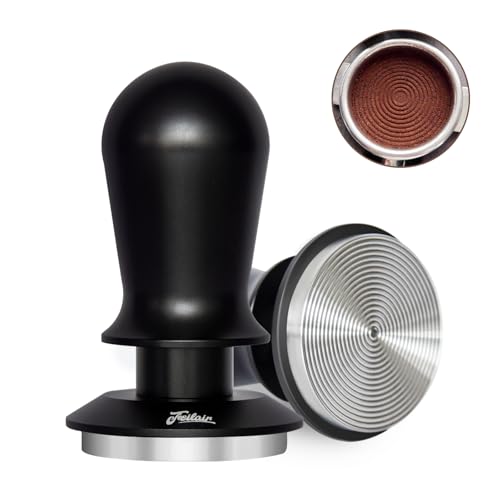
The best calibrated espresso tampers for consistent shots are the Normcore V4 for most home baristas, the Force Tamper for highly repeatable daily use, and an adjustable spring tamper with a 58.5 mm base when you need to match different baskets.
A calibrated tamper cannot correct an uneven dose, poor distribution, an incorrectly sized basket, or a grinder that produces inconsistent particles. Its main benefit is repeatable downward pressure and depth, which removes one variable from espresso preparation. The most important buying decisions are the tamper’s actual diameter, calibration range, spring design, handle ergonomics, and how consistently the mechanism resets.
Our top picks


As an Amazon Associate we earn from qualifying purchases at no extra cost to you. Ratings are shown as listed on Amazon.
Best calibrated espresso tampers by situation
| Best for | Recommended type or model | Typical specification | Why it stands out |
|---|---|---|---|
| Most home espresso machines | Normcore V4 Calibrated Tamper | 58.5 mm; adjustable spring system; commonly supplied with multiple springs | Good balance of price, adjustability, and repeatable depth |
| Frequent espresso preparation | Force Tamper | Common 58.5 mm configuration; adjustable calibrated mechanism; interchangeable bases on some versions | Fast, consistent tamping with a substantial metal construction |
| Users changing pressure deliberately | Adjustable spring-loaded tamper | Usually 58 or 58.5 mm; approximately 10–30 lb adjustment on many designs | Lets you compare pressure settings without buying another tamper |
| Traditional workflow with a defined depth | Spring-loaded depth-stop tamper | Often 58.5 mm; fixed or limited pressure range; adjustable collar | Stops at the same puck height every time |
| Small 54 mm or 51 mm baskets | Size-specific calibrated tamper | 54 mm, 53.3 mm, or 51 mm base depending on the machine | Better edge coverage than a universal 58 mm tamper |
Specifications vary between generations and basket configurations, so verify the exact diameter and supplied spring before ordering. A “58 mm” label is not enough: a 58.0 mm base and a 58.5 mm base leave different edge clearances in many baskets.
Head-to-head: the leading choices
Normcore V4: the practical all-rounder
The Normcore V4 is a strong choice when you want calibrated tamping without moving into premium pricing. Its spring-loaded design is generally adjustable by changing the spring or setting, and common versions use a 58.5 mm stainless-steel base with an aluminum-alloy handle. The depth collar helps make the final puck height repeatable, while the spring gives tactile feedback when the selected pressure is reached.
Its main advantage is flexibility. A lighter setting can suit a new user who is learning puck preparation, while a firmer setting can provide a consistent routine for a light-roasted coffee. The limitation is that the spring and collar need to be kept clean. Coffee dust can make the mechanism feel less smooth, and the tamper may not fit every basket equally well.
Force Tamper: the premium repeatability option
The Force Tamper uses a mechanically calibrated, spring-based system and is available in configurations intended for common commercial basket sizes. It is designed to make the tamping action quick: press until the mechanism completes its travel, then lift. The heavy metal construction and replaceable or selectable base options on some versions make it appealing to households preparing several shots each day.
Choose it when speed, mechanical consistency, and long-term ownership matter more than the lowest purchase price. Its disadvantages are cost and the need to select the correct base for your basket. A premium tamper with the wrong diameter is still the wrong tool.
Generic adjustable calibrated tampers: useful, but inspect the mechanism
Adjustable spring tampers are widely available in 51 mm, 53.3 mm, 54 mm, 57.5 mm, 58 mm, and 58.5 mm sizes. They can offer excellent value, but quality varies. Look for a clearly defined pressure scale, a spring that returns to the same position, a locking adjustment collar, and a base machined flat rather than a loosely fitted insert.
Some inexpensive models advertise a pressure range but provide little tactile difference between settings. If the adjustment collar moves during use, the stated range is less meaningful. For occasional espresso, this may be acceptable; for recipe development or a busy household, a better-controlled mechanism usually saves frustration.
How much calibration do you actually need?
Espresso does not require one universal tamping pressure. Once the coffee bed is fully compressed, pressing much harder generally does not create a proportional change in extraction. Levelness, distribution, grind size, dose, and headspace usually have a greater effect.
For most home recipes, a calibrated range around 15–30 lb, or roughly 7–14 kg, is more useful than an unusually broad scale. Start near the middle of the range, such as 20–25 lb, and keep the setting unchanged while adjusting grind size to control shot time. A wide adjustment range is valuable only if you have a reason to compare different coffees, basket designs, or puck depths.
A depth stop can be more useful than a high pressure limit. If the tamper stops at a repeatable height, it helps standardize the compressed puck and reduces accidental over-tamping. However, the stop must be set for your dose and basket. A collar set too low can prevent full compression; one set too high can leave inconsistent headspace.
Diameter is the specification most buyers get wrong
Measure the inside of the basket, not just the portafilter label. A 58 mm commercial portafilter may work best with a 58.4 or 58.5 mm tamper, while some precision baskets are designed around a slightly different clearance. Smaller home machines may use 51 mm, 53.3 mm, or 54 mm baskets.
A useful fit leaves very little untamped coffee around the perimeter without binding against the basket wall. Excessive clearance creates a ring of loose grounds that can encourage uneven water flow. Too little clearance causes the base to drag, scrape coffee from the walls, or become difficult to remove.
For example, suppose a basket’s measured internal diameter is 58.65 mm. A 58.5 mm tamper leaves approximately 0.15 mm of radial difference in total diameter, or about 0.075 mm per side before accounting for basket taper and measurement error. That is close enough for strong edge coverage, but the real fit must still be checked with the actual basket because manufacturing tolerances vary.
Handle materials and ownership details
- Aluminum alloy: light, durable, and common on value-oriented calibrated tampers. Anodized finishes can eventually show scratches around the adjustment collar.
- Stainless steel: heavier and resistant to corrosion. The extra mass is not essential for tamping, but many users prefer its solid feel.
- Wood: comfortable and visually appealing, but it should not be left wet or soaked. Wipe it rather than immersing it.
- Polymer or composite: often warm and comfortable in the hand. Inspect the threaded connection if the handle and base can be separated.
The first parts to wear are usually not the flat base. Springs can lose some consistency, threads can collect coffee oils, silicone adjustment rings can flatten, and decorative coatings can wear at contact points. A replaceable spring or base improves the useful life of a calibrated tamper. Avoid putting a precision tamper in a dishwasher unless the manufacturer specifically permits it.
Setup routine for repeatable shots
- Confirm the basket size. Check the machine manual or measure the basket opening. Do not assume that “58 mm” means every 58 mm accessory will fit.
- Set one pressure value. Begin around 20–25 lb, or the middle of the tamper’s stated range. Record the setting if you are comparing coffees.
- Distribute before tamping. Break up clumps with a thin distribution tool or another consistent method. A calibrated tamp does not repair a dense clump on one side.
- Keep the tamper level. Place the base straight into the basket and press vertically. A calibrated mechanism measures force, not angle.
- Stop at the mechanism’s endpoint. Do not add a second hard tamp unless your workflow specifically requires it. Repeated twisting or polishing can disturb the puck surface.
- Clean the base. Brush or wipe away grounds after each session. Clean the spring and adjustment area periodically according to the manufacturer’s instructions.
After changing tampers, do not immediately change the grinder. Pull several shots using the same dose, yield, and grind setting, then adjust one variable at a time. If flow becomes faster or slower, the difference may come from basket fit or puck height rather than pressure alone.
Decision matrix: which one should you buy?
| Your situation | Best specification | Practical choice |
|---|---|---|
| One or two shots per day on a standard 58 mm machine | 58.5 mm base, moderate 15–30 lb range, easy cleaning | Normcore V4 or a comparable adjustable spring tamper |
| Several shots daily or multiple users | Strong metal body, reliable reset, replaceable parts | Force Tamper or another premium serviceable model |
| Small kitchen with limited storage | One correct-size tamper with no extra bases | Choose the exact 51, 53.3, or 54 mm version for the machine |
| Experimenting with different coffees | Adjustable pressure and depth, clearly marked settings | Adjustable spring-loaded model |
| Lowest sensible cost | Fixed spring, accurate diameter, solid base | Basic calibrated tamper rather than a decorative premium model |
Bottom line
For most buyers, the best calibrated espresso tampers combine the correct basket diameter, a moderate adjustable range, a stable spring, and a depth stop that can be cleaned and reset. The Normcore V4 is the sensible starting point for many home users; the Force Tamper is the stronger premium choice for frequent preparation; and a size-specific adjustable spring tamper is the best route when budget or basket compatibility is the main concern. Spend less time chasing an extreme pressure number and more time matching the base to the basket, distributing the dose evenly, and keeping the mechanism clean.







Write Your Review
No reviews yet. Be the first to share your experience!