

Key takeaways
- Basket diameter: Common sizes include 51, 54, and 58 mm. The number refers to the portafilter system, not necessarily the exact diameter of the tamping surface.
- Capacity: A basket marked 18 g is a starting range, not a strict maximum. Coffee density, roast level, grind size, and desired headspace all change the practical dose.
- Hole pattern: More open area can support higher flow, but it also makes puck preparation and grinder quality more important.
- Rim and height: The rolled lip must lock into the portafilter spring, while the basket’s height must leave enough room for the portafilter to engage the group head.
- Material and finish: Stainless steel is normal. Electropolishing or a smooth interior can make the basket easier to clean and less likely to retain coffee residue.
The best precision espresso baskets for most 58 mm machines are the VST Precision Filter Basket for repeatable measurement, the IMS Competition basket for a broad range of compatible machines, and the Decent Espresso basket when you want a design optimized for modern, high-flow extraction. The right choice depends less on the brand name than on dose, rim fit, hole pattern, and whether your portafilter and tamper match the basket precisely.
Our top picks

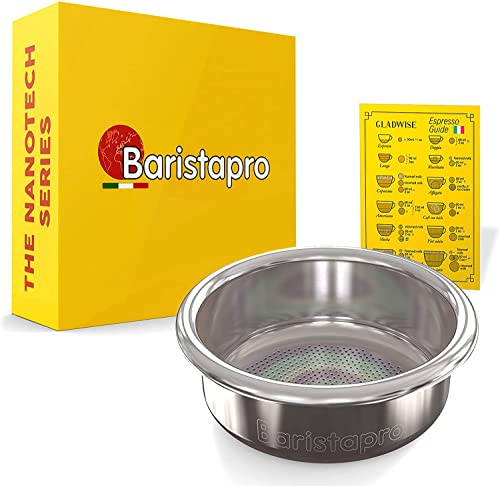


As an Amazon Associate we earn from qualifying purchases at no extra cost to you. Ratings are shown as listed on Amazon.
Best precision espresso baskets by situation
| Situation | Best choice | Useful size | Why it fits the situation |
|---|---|---|---|
| Dialing in a conventional 58 mm setup | VST Precision | 18 g or 20 g | Consistent geometry and clearly specified capacity make dose changes easier to track |
| Replacing a stock basket across several 58 mm machines | IMS Competition | 14–16 g, 18–20 g, or 20–22 g | Many machine-specific rim and height options are available |
| High-flow recipes or a Decent Espresso machine | Decent Espresso precision basket | 18 g or 20 g | Designed around even flow and modern pressure or flow-profiling techniques |
| Small single-boiler machine with a 54 mm portafilter | 54 mm IMS-compatible basket | 14–18 g | Improves consistency without requiring a 58 mm conversion |
| Maximum flexibility with different doses | Two matched baskets | 18 g and 20–22 g | More predictable than forcing a large dose into a shallow basket or underfilling a deep one |
What makes a basket “precision”?
A precision basket is manufactured with tighter control over its internal dimensions and perforations than a typical stock basket. That usually means a more uniform hole pattern, a more consistent open area, and a smoother internal wall. These details do not eliminate poor distribution or stale coffee, but they reduce one source of variation.
The most important variables are:
- Basket diameter: Common sizes include 51, 54, and 58 mm. The number refers to the portafilter system, not necessarily the exact diameter of the tamping surface.
- Capacity: A basket marked 18 g is a starting range, not a strict maximum. Coffee density, roast level, grind size, and desired headspace all change the practical dose.
- Hole pattern: More open area can support higher flow, but it also makes puck preparation and grinder quality more important.
- Rim and height: The rolled lip must lock into the portafilter spring, while the basket’s height must leave enough room for the portafilter to engage the group head.
- Material and finish: Stainless steel is normal. Electropolishing or a smooth interior can make the basket easier to clean and less likely to retain coffee residue.
Head-to-head: VST Precision versus IMS Competition
VST Precision
VST baskets are a strong choice when repeatability and measurement matter. Their published basket sizes, such as 15 g, 18 g, 20 g, and 22 g versions, give the user a more defined starting point for recipes. The perforations are designed to provide a consistent brewing area rather than simply copying the hole layout of a stock basket.
The advantage is a predictable workflow: choose an 18 g basket, weigh 18 g, keep the ratio and brew time consistent, and adjust grind size. VST baskets are often relatively unforgiving of uneven distribution. If one side of the puck is denser, the more open and uniform hole field can expose that weakness through channeling.
Choose VST when you use a capable grinder, weigh every dose, and want to compare recipes with as few hardware variables as possible. Check the basket’s external dimensions carefully because some tall precision baskets may not fit every portafilter or locking mechanism.
IMS Competition
IMS offers a wider variety of shapes and machine-specific configurations. The practical benefit is fit: the range includes baskets for different portafilter diameters, rim profiles, heights, and dose bands. Some versions are identified by codes that indicate dimensions and capacity, so the product code matters as much as the IMS name.
IMS is often the easier recommendation for a machine owner who needs a replacement that locks correctly without interfering with the group gasket. Its competition baskets commonly cover ranges around 14–16 g, 18–20 g, and 20–22 g, although the exact capacity depends on the model and coffee.
Choose IMS when compatibility is the main concern, when your machine uses a less common portafilter size, or when you want a basket matched to a particular tamper diameter. Do not assume every IMS basket is interchangeable simply because it has the same nominal diameter.
How size and dose affect extraction consistency
A basket works best when the coffee bed occupies its intended depth. An 18 g basket filled with 13 g may leave excessive headspace and create a puck that is too shallow for the intended shower-screen geometry. Packing 21 g into the same basket can press the puck against the screen, especially after the coffee swells.
A useful starting calculation is the brew ratio. For an 18 g dose at a 1:2 ratio:
18 g coffee × 2 = 36 g espresso out.
That does not prove the basket is correctly filled, but it provides a repeatable baseline. If you change to a 20 g basket and keep the same 1:2 ratio, the target becomes 40 g out. Changing basket size and dose at the same time makes it harder to tell whether a flavor change came from extraction, puck depth, or recipe ratio.
Dark, porous coffees can occupy more volume at the same weight than dense light-roasted coffees. For that reason, the printed capacity should be treated as a dose range rather than a guarantee. After brewing, inspect the puck only as a secondary check; the more useful signs are taste, flow behavior, and whether the portafilter locks without unusual resistance.
Rim fit and compatibility: the checks that prevent a bad purchase
- Measure the portafilter diameter: A 58 mm basket is not suitable for a 54 mm or 51 mm portafilter. Some manufacturers use slightly different internal dimensions within the same nominal size.
- Match the tamper: A 58.5 mm tamper may fit a basket better than a 58 mm tamper, but clearance varies. Too much clearance leaves a ring of loose coffee; too little can cause binding.
- Check the rim shape: A standard rolled rim, ridgeless rim, or machine-specific lip may interact differently with the retaining spring.
- Check basket height: A deeper basket may not lock into a bottomless portafilter comfortably, while a shallow basket may collide with the shower screen at higher doses.
- Confirm single, double, or triple geometry: A single basket’s tapered shape is usually less forgiving than a straight-sided double basket.
For a 58 mm machine, measure the inside of the portafilter and compare it with the basket’s stated outer diameter and height. If the manufacturer lists a model-specific compatibility chart, use that instead of relying only on the “58 mm” label.
Hole patterns: more holes are not automatically better
A precision basket may have a dense, evenly distributed pattern that extends farther toward the edge than a stock basket. This increases the usable brewing area, but it also means the outer puck contributes more to the shot. Poor edge distribution, an uneven tamp, or a grinder producing many fines can therefore cause visible spurting or rapid channeling.
High-flow baskets are most useful with a grinder that produces a relatively uniform grind and with careful puck preparation. If your grinder is inconsistent, a less aggressive basket may be easier to control, although it cannot compensate for a poor grind. Precision baskets tend to reward single dosing, consistent weighing, gentle distribution, and a level tamp.
Setup and maintenance for longer service life
- Wash the new basket: Remove manufacturing residue with hot water and a mild, unscented detergent, then rinse thoroughly.
- Check the retaining spring: The spring should hold the basket securely without distorting the rim. Replace a loose or damaged spring rather than bending the basket.
- Start at the printed dose: Use the middle of the stated range, such as 18 g in an 18 g basket, and adjust only one variable at a time.
- Distribute before tamping: Break up clumps and level the coffee. A precision basket makes uneven density more apparent.
- Backflush and rinse regularly: Coffee oils accumulate around the rim and in the holes. Follow the espresso machine manufacturer’s cleaning schedule.
- Inspect against light: If several holes remain blocked after soaking and rinsing, use an appropriate basket-cleaning tool. Avoid enlarging holes with a sharp needle.
The rim and retaining spring are usually the first fit-related wear points. The perforations can also become partially blocked by oils or mineral residue. Replace the basket if it is bent, visibly damaged, permanently clogged, or no longer sits level. A premium basket does not require special daily chemicals; consistent rinsing, periodic detergent cleaning, and gentle handling are usually more important.
Final buying recommendation
Buy a VST Precision basket if you want a clearly defined, repeatable recipe platform and already have a good grinder. Buy an IMS Competition basket if machine compatibility, rim options, and available sizes are more important than using one standardized design. Choose a Decent Espresso basket for a modern high-flow setup or flow-profiled recipes. Whichever you select, prioritize the correct diameter, height, rim profile, and dose range before the brand. A perfectly fitting 18 g basket will produce more consistent results than a theoretically superior basket that sits poorly in the portafilter.







Write Your Review
No reviews yet. Be the first to share your experience!