

Key takeaways
- Run cold water for several minutes, or follow the kit instructions, so the sample represents the supply rather than stagnant faucet water.
- Use a clean container free of detergent residue. Rinse it with the water being tested before collecting the final sample.
- Measure the exact sample volume. A half-full test tube can double the apparent drop count and invalidate the result.
- For strips, dip for the specified time and compare under neutral, bright light. Do not wait until the colors continue changing.
- For titration, add drops slowly near the endpoint and swirl after every drop. Record the final drop count rather than estimating between drops unless the instructions permit it.
- Repeat an unexpected result. Two readings within one drop or one stated measurement increment are more useful than a single outlier.
- Test both untreated water and water after a softener if you are checking equipment performance. Do not test softened water with a kit whose range is too high to distinguish low readings.
The best water hardness test kits for home use are drop-count titration kits for accurate softener decisions, test strips for quick screening, and digital meters only when you understand what they measure—and what they do not.
Our top picks


As an Amazon Associate we earn from qualifying purchases at no extra cost to you. Ratings are shown as listed on Amazon.
Quick picks by household situation
| Situation | Best choice | Why | Typical cost |
|---|---|---|---|
| You need a fast check before buying equipment | Hardness test strips | Inexpensive, simple, and ready in seconds | $8–$20 |
| You are setting a water softener | Drop-count titration kit | Usually the most useful balance of accuracy, range, and cost | $15–$45 |
| You test frequently and want numerical readings | Digital hardness or calcium test system | Convenient when calibrated and used with the correct reagents | $40–$150+ |
| You have private well water or an unusual result | Drop-count kit plus certified laboratory test | Home testing identifies a likely range; laboratory testing resolves uncertainty | $25–$150+ total |
What water hardness means for your buying decision
Hardness is mainly the amount of dissolved calcium and magnesium in water. It is commonly reported as milligrams per liter (mg/L) or parts per million (ppm) as calcium carbonate. The two units are numerically equivalent for ordinary hardness reporting.
| Hardness as calcium carbonate | Common classification | Practical implication |
|---|---|---|
| 0–60 mg/L | Soft | Usually little scale; a softener may provide limited benefit |
| 61–120 mg/L | Moderately hard | Some spotting and scale may appear in heated appliances |
| 121–180 mg/L | Hard | Softener or targeted scale-control measures may be worthwhile |
| Over 180 mg/L | Very hard | Scale control becomes a significant equipment and maintenance consideration |
These categories are useful, but they do not determine the entire treatment plan. A softener addresses hardness ions; it does not automatically remove sediment, chlorine, sulfur odors, nitrate, bacteria, or every dissolved contaminant. For those concerns, use a properly selected filter or laboratory analysis rather than assuming hardness is the cause.
Strip, drop-count, or digital: which is most accurate?
Hardness test strips
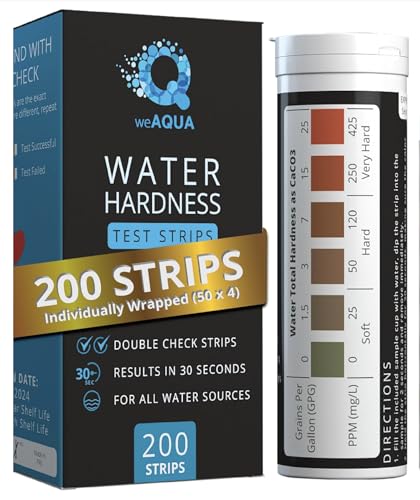
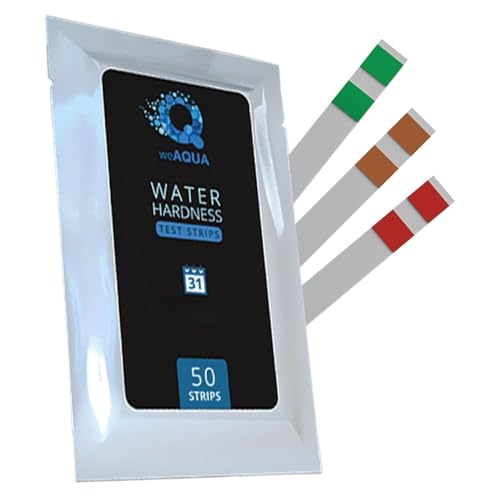
Strips contain reagent pads that change color after a measured dip time. They are the easiest option for a first survey of several taps, rental properties, or occasional checks. Many provide broad bands such as 0, 50, 100, 250, and 425 ppm rather than a precise number.
Their main limitation is resolution. If your strip places the water somewhere between 100 and 250 ppm, that may be enough to confirm that the water is hard but not enough to program a softener accurately. Color matching is also affected by poor lighting, expired strips, wet fingers, and reading the pad too early or too late.
Choose strips with a stated hardness range that covers your expected water, individually sealed packaging, and a clear result chart. Strips are a screening tool, not the best final reference when two treatment options are close in capacity.
Drop-count titration kits
Drop-count kits add reagent to a measured water sample until the color changes. The number of drops is converted to grains per gallon (gpg) or ppm, depending on the kit. Because the endpoint is based on a chemical reaction rather than a printed color block, a good titration kit normally gives finer and more repeatable results than strips.
Accuracy depends on measuring the sample correctly, holding the bottle vertically, adding one drop at a time, and identifying the endpoint consistently. Some kits measure in 1 gpg increments; others offer a finer scale. One grain per gallon is approximately 17.1 mg/L as calcium carbonate, so a reading of 12 gpg is about 205 mg/L.
For most homeowners choosing or adjusting a softener, a drop-count kit is the strongest overall choice. Look for a stated sample volume, a defined endpoint color, a known measurement range, and replacement reagents that are easy to obtain. Store reagents away from heat and sunlight, and replace them when the manufacturer’s expiration date passes.
Digital meters and electronic testers
A digital device may display a number immediately, but “digital” does not always mean “hardness test.” Many inexpensive meters measure electrical conductivity or total dissolved solids (TDS). Calcium and magnesium contribute to conductivity, but so do sodium, chloride, bicarbonate, and other dissolved substances. A TDS meter therefore cannot reliably calculate hardness unless it is specifically designed and calibrated for that purpose.
Digital photometers and reagent-based electronic testers can be more precise, particularly for frequent testing, but they require calibration, clean cells, fresh reagents, and careful handling. A dirty sample chamber, fingerprints, bubbles, or a weak battery can produce misleading readings. For occasional household use, the convenience may not justify the extra ownership cost.
How to use a hardness kit without wasting a result
- Run cold water for several minutes, or follow the kit instructions, so the sample represents the supply rather than stagnant faucet water.
- Use a clean container free of detergent residue. Rinse it with the water being tested before collecting the final sample.
- Measure the exact sample volume. A half-full test tube can double the apparent drop count and invalidate the result.
- For strips, dip for the specified time and compare under neutral, bright light. Do not wait until the colors continue changing.
- For titration, add drops slowly near the endpoint and swirl after every drop. Record the final drop count rather than estimating between drops unless the instructions permit it.
- Repeat an unexpected result. Two readings within one drop or one stated measurement increment are more useful than a single outlier.
- Test both untreated water and water after a softener if you are checking equipment performance. Do not test softened water with a kit whose range is too high to distinguish low readings.
Using the result to choose a softener or filter
A softener is normally sized from hardness, household water use, and the desired regeneration interval. A practical planning estimate is:
Daily hardness load = people × gallons per person per day × hardness in gpg.
For example, four people using an estimated 60 gallons each per day with 12 gpg hardness create approximately 2,880 grains per day:
4 × 60 × 12 = 2,880 grains per day.
Over seven days, that is about 20,160 grains. A design margin may be added, but the usable capacity stated by a softener is not always the same as its maximum laboratory capacity. Compare the manufacturer’s capacity at the intended salt setting, and account for iron if the water report or test indicates it. If your measured hardness is near a sizing threshold, confirm it with a second method or a laboratory report instead of rounding aggressively.
Hardness results guide other equipment differently. A sediment filter can protect valves and fixtures but does not soften water. A carbon filter can reduce chlorine and some tastes or odors but does not generally remove hardness. Reverse osmosis can reduce dissolved minerals at a drinking-water tap, but it is not usually a whole-house substitute for a softener. Choose treatment for the measured problem rather than buying a filter because its name sounds broader.
Ownership details that product listings often omit
Test strips are the least expensive to own, but humidity can damage unused strips and color charts become difficult to interpret when pads age. Keep the container sealed and note the expiration date. A strip kit used twice a year may be cheaper than a titration kit, while a household adjusting a softener several times a year may spend less per useful reading with replaceable reagents.
Drop-count kits commonly wear out through lost caps, stained sample tubes, and contaminated droppers rather than through the test chemistry itself. Rinse glassware with clean water, let it air-dry, and keep reagent tips from touching the sample. Do not pour leftover reagent back into its original bottle.
Digital testers need the most maintenance. Calibration solution, replacement batteries, cleaning, and occasional electrode or cell replacement can outweigh the initial purchase price. If a digital reading conflicts sharply with a drop-count result, check whether the device measures hardness specifically; a generic TDS reading is not a tie-breaker.
Bottom line
Buy hardness strips for a quick, low-cost screening question: “Is this water probably soft, moderate, or hard?” Choose a drop-count titration kit when the result will determine softener size, salt settings, or whether a treatment purchase is justified. Choose a digital system only for repeated testing and only when its specification identifies a true hardness measurement, not merely conductivity or TDS. For private wells, major treatment purchases, or results that change unexpectedly, use the home kit as a diagnostic step and confirm important decisions with an appropriately certified laboratory.





Write Your Review
No reviews yet. Be the first to share your experience!