

Key takeaways
- Install the filter after the main shutoff and pressure-reducing equipment, but before branch lines, unless the manufacturer specifies another arrangement.
- Provide a bypass valve so the house can receive water while the housing is serviced.
- Leave enough vertical and side clearance to remove the sump and cartridge. A system that fits the pipe but cannot be opened is not a practical installation.
- Use a mounting bracket for large housings. Do not make the plumbing carry the weight of a full water-filled filter.
- Match port size and avoid unnecessary elbows, undersized flexible tubing, and restrictive valves.
- Flush new carbon cartridges according to the instructions. Initial carbon fines can make water appear gray or contain black particles.
- Install a pressure gauge before and after the filter when possible. A growing pressure difference indicates clogging more reliably than appearance alone.
The best whole house water filters are matched to your water report, peak flow demand, and maintenance budget: choose a sediment-and-carbon system for municipal chlorine, add specialty media for a documented contaminant, and use a certified treatment stage when filtration alone cannot address the problem.
Our top picks

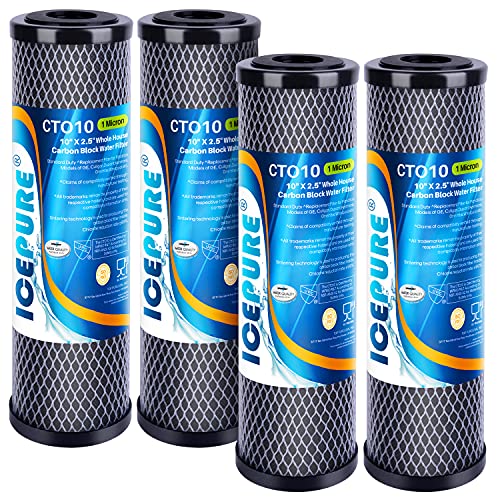
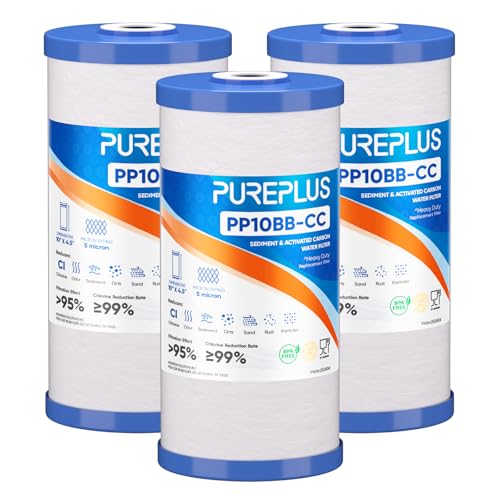

As an Amazon Associate we earn from qualifying purchases at no extra cost to you. Ratings are shown as listed on Amazon.
Best whole house water filters by household situation
| Household situation | Best-fit system | Typical flow target | What to expect |
|---|---|---|---|
| One to two people, city water, limited budget | 10-inch or compact 20-inch sediment-and-carbon housing | 6–10 gallons per minute | Lower purchase cost; cartridges may need changing every 3–6 months |
| Three to five people, city water | 20-inch “Big Blue”-style dual-stage system | 10–15 gallons per minute | Better pressure stability and longer cartridge capacity |
| Large home or simultaneous showers and appliances | 4.5-inch-by-20-inch high-capacity housing or backwashing media filter | 15–20 gallons per minute | Higher upfront cost; requires adequate plumbing and installation space |
| Private well with sand or grit | Washable or replaceable sediment prefilter, followed by contaminant-specific treatment | Based on well-pump output | Prefilter protects later stages; testing should determine the second stage |
| Iron, sulfur odor, hardness, or bacteria concern | Specialty treatment selected after laboratory testing | Varies by media and plumbing | A basic carbon cartridge may be the wrong tool and can clog quickly |
What a whole-house filter can—and cannot—do
A point-of-entry system treats water as it enters the house, so filtered water can reach showers, sinks, laundry equipment, and hose bibs. Most systems combine a sediment stage with activated carbon. Sediment media catches particles such as sand, rust, and pipe debris, while carbon can reduce chlorine, unpleasant tastes, and odors when the cartridge is rated for those purposes.
Filtration is not the same as disinfection, softening, or reverse osmosis. A standard cartridge system is not a universal solution for hardness, dissolved salts, nitrates, bacteria, or every type of chemical contamination. Private-well owners should test for relevant contaminants before choosing media. If a report identifies a health-related contaminant, consult a qualified water-treatment professional and look for certification applicable to that specific reduction claim.
How the main filter types compare
Sediment cartridges
These are the first line of defense against visible particles. A coarse 20- or sediment cartridge may be suitable when a well produces sand, while a 5-micron cartridge captures finer material. Finer filtration can improve clarity but may reduce flow sooner. A washable screen or spin-down separator can reduce the load on disposable cartridges where the incoming water contains heavy grit.
Activated carbon cartridges
Carbon is the usual choice for municipal chlorine, taste, and odor concerns. Carbon block cartridges generally provide more consistent contact than loose granular carbon, but they can create greater pressure loss as they fill. Check the stated gallon capacity, not just the cartridge dimensions. A carbon cartridge rated for 100,000 gallons may have a shorter practical life if the water contains substantial sediment or the household uses much more water than the rating assumes.
Backwashing carbon or specialty media tanks
Tank-style systems contain substantially more media than a cartridge and automatically rinse it on a schedule. They can reduce frequent cartridge replacement, but they need a drain connection, electricity or control-valve programming in many installations, and enough space for servicing. Specialty media for iron, manganese, sulfur odor, or other concerns must be selected to match the water chemistry.
Ultraviolet and other final treatment stages
Ultraviolet treatment is a disinfection stage rather than a particle filter. It requires relatively clear water and regular lamp replacement, and it does not remove dissolved minerals. It may be part of a private-well design, but the complete system should be sized and maintained according to laboratory results and professional guidance.
Important specifications before you buy
| Specification | Useful range to compare | Why it matters |
|---|---|---|
| Housing size | 10-inch standard, 20-inch standard, or 4.5-by-20-inch high-capacity | Larger cartridges usually offer more media and lower pressure loss |
| Nominal flow | 6–10 GPM for compact systems; 10–20 GPM for larger systems | Prevents weak showers and slow appliance filling |
| Maximum pressure | Often about 80–100 psi, depending on the housing | The rating must exceed your household’s actual pressure |
| Cartridge capacity | About 10,000–100,000 gallons, depending on media and claim | Determines replacement frequency; capacity is not universal across contaminants |
| Connection size | Usually 3/4-inch, 1-inch, or 1 1/4-inch ports | A small inlet can become a restriction in a high-demand home |
| Replacement cost | Roughly $15–$80 per cartridge; specialty sets can cost more | A cheaper housing may have higher long-term ownership costs |
Representative systems from established manufacturers include the Aquasana Rhino, iSpring WGB-series systems, 3M whole-house filtration assemblies, and Culligan whole-house housings. Model specifications differ by cartridge, connection size, and configuration, so verify the current data sheet rather than assuming that every version has the same flow rate or reduction claim.
Calculate the flow rate your house needs
Start by listing fixtures that may operate at the same time. For example, two showers at 2.5 GPM each, a washing machine using 3 GPM during fill, and a kitchen faucet using 2 GPM create a possible demand of 10 GPM:
2.5 + 2.5 + 3 + 2 = 10 GPM
A system rated at 6 GPM may technically filter the water, but it can restrict pressure during that combination. Choose a filter whose service flow is at least the expected peak, preferably with some margin. Do not use a cartridge’s maximum flow as if it were always pressure-neutral; the flow rating may be measured under a specified pressure drop.
If you have a well, measure pump output or ask a well professional for the pump’s recovery and pressure-switch settings. A filter that exceeds the pump’s ability to supply water can cause cycling, low pressure, or premature cartridge loading.
Installation requirements and common mistakes
- Install the filter after the main shutoff and pressure-reducing equipment, but before branch lines, unless the manufacturer specifies another arrangement.
- Provide a bypass valve so the house can receive water while the housing is serviced.
- Leave enough vertical and side clearance to remove the sump and cartridge. A system that fits the pipe but cannot be opened is not a practical installation.
- Use a mounting bracket for large housings. Do not make the plumbing carry the weight of a full water-filled filter.
- Match port size and avoid unnecessary elbows, undersized flexible tubing, and restrictive valves.
- Flush new carbon cartridges according to the instructions. Initial carbon fines can make water appear gray or contain black particles.
- Install a pressure gauge before and after the filter when possible. A growing pressure difference indicates clogging more reliably than appearance alone.
Many homeowners can replace cartridges, but cutting into the main water line, adding a drain, modifying a well system, or installing electrical equipment may require a licensed plumber and local permit. Check for leaks after pressurizing the housing slowly.
Replacement costs and ownership reality
A simple cost estimate helps compare systems. Suppose a two-cartridge setup uses a $20 sediment cartridge every three months and a $45 carbon cartridge every six months. Annual consumables would be:
(4 × $20) + (2 × $45) = $170 per year
That does not include water used for flushing, labor, replacement O-rings, or occasional housing maintenance. A tank system may cost more initially—often several hundred to more than $2,000 depending on treatment stages and installation—but can reduce routine cartridge purchases. It may still require control-valve servicing, media replacement, salt, oxidant, electricity, or drain water.
The sediment cartridge usually clogs first. Carbon media eventually loses capacity even when water still looks clear, so replacement should follow the manufacturer’s gallon or time limit and the household’s pressure readings. Inspect the sump, lubricate the approved O-ring only as directed, and replace cracked housings or damaged seals rather than attempting a temporary repair.
A practical buying decision
- Choose a compact cartridge system when space and initial cost matter more than maximum flow, and the home has one or two occupants with relatively clean municipal water.
- Choose a high-capacity dual-stage system for a typical family home where chlorine, taste, odor, rust, or sediment are the main concerns.
- Choose a tank-based or specialty system when testing shows iron, sulfur, heavy sediment, or another problem that would exhaust ordinary cartridges quickly.
- Add a point-of-use system at a drinking-water tap when you need tighter treatment for a specific dissolved contaminant rather than treating every gallon used in the house.
The strongest purchase is not the system with the largest gallon claim or the most stages. It is the one with a verified reduction claim for your water concern, sufficient service flow for peak demand, replacement parts you can afford, and an installation layout that allows safe, regular maintenance.





Write Your Review
No reviews yet. Be the first to share your experience!