

Key takeaways
- Foam compression: Constant pressure from a stock, muzzle, or optic eventually leaves a permanent channel. Rotate storage orientation when practical and avoid storing unnecessary weight on the closed case.
- Zippers: Dirt and grit damage zipper teeth. Brush them clean, avoid overstuffing, and do not force a zipper around a misaligned firearm.
- Moisture: Foam can retain humidity against metal. Open the case after wet-weather transport and inspect the shotgun before storage.
- Hinges and latches: Hard-case hardware can loosen after repeated impacts. Check screws, hinge pins, and latch alignment every few trips.
- Dividers: Hook-and-loop dividers are convenient but can shift if overloaded. Keep heavy accessories in dedicated pockets or a separate pouch.
The best shotgun cases for most owners are a lockable hard case for air travel, long-distance transport, and maximum weather protection, or a padded soft case for lighter, faster trips where storage space and weight matter more than crush resistance.
The right choice depends less on brand than on your shotgun’s configuration: a short field gun fits almost any standard case, while an over-under with a long barrel, a semi-automatic with an extended magazine tube, or a shotgun with an optic may require a longer or deeper interior. Before buying, measure the firearm as it will actually be transported, including removable chokes, optics, sling swivels, and any attached accessories.
Our top picks


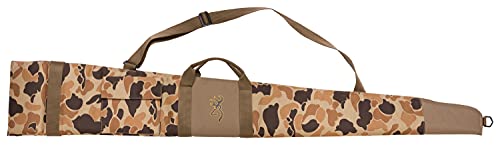
As an Amazon Associate we earn from qualifying purchases at no extra cost to you. Ratings are shown as listed on Amazon.
Quick picks by transport situation
| Situation | Best case type | Useful target specifications | Why it fits |
|---|---|---|---|
| Air travel or checked baggage | Lockable hard case | Reinforced polymer, two or more padlock points, 1.5–2.5 in of foam | Better resistance to crushing, impact, and rough handling |
| Frequent range trips by car | Padded soft case or hybrid case | 600–1,000 denier fabric, 1–2 in padding, lockable zippers | Lighter to carry and easier to store |
| Shotgun with optic or tall rib accessories | Deep hard case | Interior height of at least 4 in, adjustable foam or dividers | Prevents pressure on the sight and allows a tailored fit |
| Two takedown shotguns | Long double-gun case | Interior length around 50–52 in, removable or adjustable dividers | Separates receivers and barrels while keeping the load organized |
| Compact storage in a small vehicle | Takedown soft case | Separate compartments, 1 in or more of closed-cell foam | Uses less space once the shotgun is disassembled as intended |
Hard versus soft shotgun cases
Hard cases: the safer all-weather choice
Hard cases usually use molded polypropylene or another impact-resistant polymer. Their advantages are structural: the shell takes the load instead of the shotgun, and a gasketed design can limit dust and water entry. Models such as the Pelican 1750 Protector Long Case, SKB iSeries cases, and Plano All Weather cases represent this category. Exact dimensions and included foam vary by model, so compare the interior rather than the advertised outside length.
A hard case is the stronger choice for checked air travel, long storage, truck transport, or any situation where another object could land on the case. Look for two sturdy padlock locations, reinforced hinges, positive latches, and a pressure-equalization valve if the case will encounter major altitude changes. A case with only one small latch or thin hinge hardware may protect against scratches but is not a convincing travel case.
The trade-off is weight and bulk. A long hard case can weigh roughly 15–30 pounds before the shotgun and accessories are added. It may also be difficult to fit in a compact trunk. Pluck foam makes customization convenient, but removing too much foam can leave thin unsupported sections that collapse over time. For repeated reconfiguration, a layered foam system or adjustable divider is usually more durable.
Soft cases: efficient for routine transport
Soft cases commonly use nylon or polyester fabric over closed-cell or open-cell foam. A 600-denier fabric is a reasonable minimum for occasional use; 1,000-denier material, bartacked stress points, and a water-resistant lining are preferable for frequent trips. Well-known soft-case ranges include products from Boyt and Allen, while specialty padded cases are also available from brands such as Savior Equipment.
Soft cases are easier to carry, fold, and store. They work well when the shotgun travels inside a vehicle, the owner controls how it is handled, and the case is not exposed to prolonged rain. They are also less conspicuous than a rigid case, although local laws may specify how a firearm must be enclosed or transported. A soft case should have padding on the bottom, sides, and top—not merely a thin fabric sleeve with padding only on one face.
Water resistance is not the same as waterproofing. A coated exterior and covered zipper can delay rain, but a soft case can still absorb moisture through seams and the zipper path. If the case becomes wet, remove the shotgun promptly, dry both items separately, and leave the case fully open until it is completely dry.
Interior fit matters more than advertised length
Measure from the longest point of the barrel or assembled shotgun to the opposite end of the stock, then add clearance. For a soft case, about 1–2 inches of extra usable length prevents the muzzle or recoil pad from constantly pressing against the seams. For a hard case, aim for roughly 2 inches of end clearance if the foam will be cut around the firearm.
Width and depth are equally important. A standard field shotgun may need only about 8–10 inches of internal width for a single assembled gun, but a case holding a takedown over-under, spare barrels, choke tubes, and tools may need 12–16 inches. A receiver-mounted optic or raised red-dot sight can require 4–5 inches of internal height. Never close the lid to “test” fit if the foam is pressing against an optic, safety, rib, or magazine cap.
For a two-piece shotgun, place the barrel assembly and receiver in separate padded channels. The pieces should not touch one another when the case is shaken gently. Dedicated double-gun cases are often better than forcing two firearms into one generic case because they provide better separation and reduce movement.
Lockability and legal transport
A lockable case helps prevent unauthorized access, but the case’s lock design is only one part of secure transport. Hard cases should accept robust padlocks through metal-reinforced or thick polymer hasps. Soft cases should have zipper pulls that can pass through a lock, although zipper locks generally offer less structural resistance than hard-case hasps.
For air travel, check the current requirements of the airline and the relevant authorities before departure. Requirements can differ by jurisdiction and may distinguish between a case that is merely closed and one that is locked. Keep the key or combination under your control, and do not rely on a small luggage lock when a stronger lock is appropriate. Transport rules can also cover ammunition, declarations, and whether the case must be a dedicated hard-sided container.
Outside air travel, local rules may address whether the shotgun must be unloaded, locked, separated from ammunition, or inaccessible from the passenger compartment. A case cannot make an otherwise unlawful transport method lawful, so verify the rules where the journey begins, ends, and passes through.
Handles, straps, and everyday ergonomics
A centered, padded carry handle is best for a single long case because it keeps the load balanced. The handle should be stitched or riveted into reinforced panels rather than attached only to the outer fabric. For a heavy hard case, side handles can be useful when loading into a vehicle, but they add bulk.
A shoulder strap makes a soft case practical for longer walks, provided it has a wide pad, secure swivels, and attachment points that do not interfere with the zipper. Backpack straps are useful for compact takedown cases but can make a long case awkward. If the case will carry a shotgun plus gear, calculate the total weight: a 9-pound case containing a 7-pound firearm, 2 pounds of accessories, and 1 pound of locks creates a 19-pound load. That is enough to expose weak stitching and uncomfortable handles quickly.
Ownership realities: what wears first
- Foam compression: Constant pressure from a stock, muzzle, or optic eventually leaves a permanent channel. Rotate storage orientation when practical and avoid storing unnecessary weight on the closed case.
- Zippers: Dirt and grit damage zipper teeth. Brush them clean, avoid overstuffing, and do not force a zipper around a misaligned firearm.
- Moisture: Foam can retain humidity against metal. Open the case after wet-weather transport and inspect the shotgun before storage.
- Hinges and latches: Hard-case hardware can loosen after repeated impacts. Check screws, hinge pins, and latch alignment every few trips.
- Dividers: Hook-and-loop dividers are convenient but can shift if overloaded. Keep heavy accessories in dedicated pockets or a separate pouch.
One common mistake is choosing a case based on exterior length. A 52-inch case may have only 50 inches of usable interior space after curved ends, padding, and dividers. Another is cutting pluck foam too tightly around the firearm. Leave enough material around the edges to preserve lid support and prevent the case from becoming flexible.
Best choice by budget and frequency
| Use pattern | Typical market range | Recommended specification | Best value logic |
|---|---|---|---|
| Occasional local trips | About $30–$80 | Padded soft case, 600-denier fabric, lockable zipper | Spend on padding and fit rather than decorative pockets |
| Weekly range or field use | About $70–$180 | 1,000-denier fabric or reinforced hybrid shell, strong strap | Better stitching and weather resistance reduce replacement risk |
| Frequent road travel | About $150–$350 | Rigid shell, adjustable foam, two lock points | Protection and serviceable hardware justify the added weight |
| Air travel or long-term protection | About $200–$500 or more | Gasketed hard case, reinforced latches, pressure valve, tailored foam | Minimizes crushing, water intrusion, and movement |
Bottom line
Choose a gasketed hard case when protection, lock strength, and weather resistance come first. Choose a padded soft case when you mainly make controlled vehicle trips and value low weight, flexible storage, and a lower price. For either type, the best shotgun case is the one with enough internal clearance, padding that supports rather than presses on the firearm, secure hardware, and a carry system suited to the actual loaded weight. Measure your complete configuration before buying, and inspect the case regularly instead of treating it as permanent protection.









Write Your Review
No reviews yet. Be the first to share your experience!