
Our Short List of 3

- Layers: 3 germination trays
- Power: 20W, 110V
- Material: food grade PP plastic
- Size: 10.2 x 10.2 x 13 inches
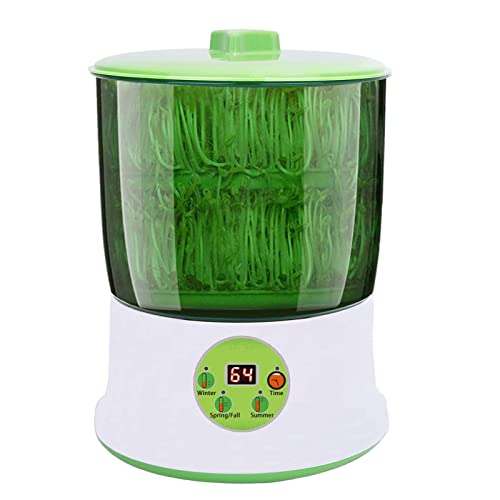
- Layers: 2 germination trays
- Power: 100 to 120 volts, 60 hertz
- Material: plastic, green and white finish
- Weight: 3.64 lb

- Layers: 2 trays
- Power: 20W constant temperature, 8W pump
- Material: food grade PP
- Size: about 12.8 x 10.24 x 10.24 inches
All 4 Picks at a Glance
| Product | Specs | Action |
|---|---|---|
| OYSIR Bean Sprouts Machine, 3 Layers, LED Display |
| Check price on Amazon |
| OYSIR Bean Sprouts Machine, 2 Layers, Green and White |
| Check price on Amazon |
| TOPINCN Bean Sprouts Machine, Large Capacity, 2 Trays |
| Check price on Amazon |
 ZestiGreens 4-Tier Stackable Seed Sprouter |
| Check price on Amazon |
Key takeaways
- Compare the best seed sprouters for home use, from three-layer automatic bean sprout machines with LED timers to a compact automatic germinator.
A seed sprouter takes over the rinse-and-drain routine that sprouting jars and trays depend on. Instead of rinsing seeds by hand two or three times a day, an automatic sprouter uses a small pump and a rotating sprinkler to wet the seeds on a timed cycle, while a heating element holds a steadier temperature across the seasons.
This guide covers complete seed sprouter machines rather than loose jars, lids, or manual trays, which are covered in separate guides on this site. Four of the five picks are electric automatic machines with two or three layers and seasonal modes. The fifth is a manual four-tier stackable sprouter for readers who prefer no pump and no cord. None of the five includes seeds.
As an Amazon Associate, we earn from qualifying purchases.
Quick answer
For most households, a two or three layer automatic seed sprouter with a rotating sprinkler, seasonal temperature modes, and a timer is the practical choice. Pick the three layer OYSIR machine for the largest batches and an LED countdown display, the two layer OYSIR for a smaller footprint in green and white, and the TOPINCN machine if you also want a unit listed for yogurt and natto. Choose the ZestiGreens stackable sprouter if you want no electricity at all, and the compact Qcwwy germinator for the smallest counter space.
OYSIR Bean Sprouts Machine, 3 Layers, LED Display
- Layers: 3 germination trays
- Power: 20W, 110V
- Material: food grade PP plastic
- Size: 10.2 x 10.2 x 13 inches
The three layer OYSIR machine is the largest automatic sprouter in this group, with a listed capacity of six to eight people per cycle. A rotating sprinkler head sprays water over the seeds for one minute every ten minutes, and an LED display counts down the growing time, adjustable in two hour steps up to 128 hours. Three seasonal modes set the default timing at 60 hours for summer, 72 hours for spring and autumn, and 84 hours for winter.
The box includes the machine, three trays, a blackout cloth, the sprinkler head and pipe, and a user manual. The design keeps water and electricity separated, and an eight hour power-off memory function resumes the cycle after a short interruption. The listing states that the water should still be changed once a day, so the machine reduces the routine rather than removing it entirely.
OYSIR Bean Sprouts Machine, 2 Layers, Green and White
- Layers: 2 germination trays
- Power: 100 to 120 volts, 60 hertz
- Material: plastic, green and white finish
- Weight: 3.64 lb
This two layer version of the OYSIR machine suits smaller households that want the same automatic watering system in a lighter unit. It keeps the LED time display, the adjustable countdown, and the three seasonal modes of the three layer model, and the listing gives the same default timings of 60, 72, and 84 hours by season. The trays are designed so the growing sprouts sit under light pressure, which the maker describes as producing thicker sprouts than an open tray.
At 3.64 pounds, this is the heavier of the two OYSIR listings despite holding one fewer layer, so check the stated weight if you plan to move the machine often. Like the larger machine, it is listed for soybean, mung bean, black bean, radish, alfalfa, wheatgrass, and broccoli seeds.
TOPINCN Bean Sprouts Machine, Large Capacity, 2 Trays
- Layers: 2 trays
- Power: 20W constant temperature, 8W pump
- Material: food grade PP
- Size: about 12.8 x 10.24 x 10.24 inches
The TOPINCN machine, sold under the Yunplsad-US storefront, separates its power figures into a 20W constant temperature element and an 8W pump. The listing gives a germination time of 2.5 to 4 days for bean sprouts and describes three seasonal modes keyed to outdoor temperature, stated in Celsius on the listing, so United States buyers should convert when comparing modes.
Beyond sprouts, the listing also names yogurt, natto, and rice wine among its uses, which makes this the most flexible unit in the group. The package includes the machine, a lid, the housing, two trays, and three accessories, and the seed list covers soybeans, mung beans, red beans, radish, alfalfa, peas, wheatgrass, barley, chickpeas, broccoli, and lentils.
ZestiGreens 4-Tier Stackable Seed Sprouter
- Layers: 4 stackable trays, usable one to four at a time
- Power: none, manual rinse and drain
- Drainage: integrated sink-draining spout on the bottom tray
- Ventilation: air holes in the trays
The ZestiGreens sprouter is the manual option in this guide and the current four-tier version of the brand’s stackable system. There is no pump, heater, or timer: you rinse the trays at the sink, and an integrated spout on the bottom tray drains rinse water directly into the sink. Air holes in the trays provide ventilation, and the modular design lets you run anywhere from one to four trays at a time, so a small test batch and a full staggered rotation use the same hardware.
The listing describes harvests in about three to five days for broccoli, alfalfa, radish, mung beans, and lentils. Because watering is manual, this sprouter asks for the same twice daily attention as a sprouting tray, and in exchange it has no electrical parts and nothing that can fail mid-batch. Dimensions and weight were not stated consistently in the records read, so confirm both on the listing.
Qcwwy Automatic Seed Germinator, Compact Cube
The Qcwwy germinator is the smallest automatic seed sprouter in this group, a cube of about 7.1 inches on each side that weighs about 840 grams, or 29.6 ounces. The listing describes it as a fully automatic soybean sprout machine that can also be used for yogurt, natto, and rice wine, and it lists a broad seed range that adds cauliflower to the usual beans, peas, radish, alfalfa, wheatgrass, barley, chickpeas, and lentils. The package is short: the machine, a chassis, a cover, and a filter.
That compact size is the trade-off: a cube this small grows modest batches, suiting a one or two person household rather than a family. One caution matters more here than for any other pick: the product record read for this guide came from a non-United States Amazon storefront and did not state a United States voltage, so confirm the voltage and plug type on the listing, and skip this model if it does not clearly show a 110V United States version.
Specs
- Size: about 7.1 x 7.1 x 7.1 inches
- Weight: about 840 grams (29.6 oz)
- Material: food grade PP
- Model number: Qcwwyagh42wb3p6
- Included: machine, chassis, cover, filter
- Voltage: Confirm on the listing
- Also listed for: yogurt, natto, rice wine
- Seeds included: no
How to choose
Start with batch size. A three layer machine grows enough sprouts for a larger household in one cycle, while a two layer machine or the compact cube suits one or two people, since fresh sprouts keep only a few days in the refrigerator. Next, decide how much automation you want. The electric machines spray the seeds on a timer and hold a steadier temperature, but every one still needs a daily water change, so the saving is the repeated rinsing, not all contact with the process.
Check the timer and modes next. A countdown display with adjustable hours, like the OYSIR units carry, makes it easier to line a harvest up with a meal plan, and seasonal modes adjust the cycle for warm and cold kitchens. Then look at what else the machine is listed to do: the TOPINCN and Qcwwy units also name yogurt and natto. Finally, confirm the basics on the listing: voltage and plug type, the tray count in the box, and whether seeds are included, since none of these five ships with seeds.
Who should skip
Skip an automatic seed sprouter if you only sprout once or twice a year, since a simple jar kit costs less and asks for the same daily water change. Skip the electric models if you have no spare outlet near the counter, or if pump noise in a quiet kitchen would bother you; the manual ZestiGreens stack fits both cases. Skip the compact Qcwwy cube if you cook for a family, and skip any listing if the voltage for your country is not stated clearly. Growers who mainly want wheatgrass juice or tall microgreens should look at dedicated trays and wheatgrass juicers instead.
FAQ
How long do sprouts take in an automatic seed sprouter?
Most listings in this guide state about two and a half to five days depending on the seed and the season mode selected. Bean sprouts sit at the fast end of that range, while small seeds such as alfalfa and broccoli usually take longer. Warmer temperatures generally shorten the cycle, which is why the machines offer separate summer and winter timings.
Do I still need to change the water in an automatic sprouter?
Yes. The listings for the automatic machines here direct users to change the water once a day, and twice a day is described as better in warm weather. The pump handles the repeated spraying between changes, which removes the manual rinsing routine, but fresh water each day remains part of the process for every electric model in this guide.
What seeds can I grow in a seed sprouter?
The listings name soybeans, mung beans, black beans, red beans, radish, alfalfa, peas, lentils, chickpeas, broccoli, wheatgrass, barley, and corn among the suitable seeds. Use seeds sold for sprouting rather than garden or cooking seeds, follow the quantity guidance on the seed packet, and spread the seeds in a single even layer so the sprinkler reaches all of them.
Can a seed sprouter make anything besides sprouts?
Two of the machines here, the TOPINCN and the Qcwwy, are also listed for yogurt, natto, and rice wine. The OYSIR machines and the manual ZestiGreens stack are listed for sprouting only. Check the listing for the model you choose, because the extra uses are model specific.
Final verdict
For most readers, the two layer OYSIR machine is the balanced pick: automatic watering, an LED countdown, and seasonal modes in a size that suits everyday batches. Step up to the three layer OYSIR if you feed more people or want two seed types running at once, and consider the TOPINCN if the added yogurt and natto uses appeal to you. Choose the ZestiGreens four-tier stack if you prefer a sprouter with no electrical parts at all, and choose the Qcwwy cube only if counter space is your main limit and the listing clearly confirms a United States voltage version.
Product and ASIN Reference
| Product | ASIN |
|---|---|
| OYSIR Bean Sprouts Machine, 3 Layers, LED Display | B09PLCXYGF |
| OYSIR Bean Sprouts Machine, 2 Layers, Green and White | B07HK295YG |
| TOPINCN Bean Sprouts Machine, Large Capacity, 2 Trays | B0B1F4D68X |
| ZestiGreens 4-Tier Stackable Seed Sprouter | B0FF3ZM3CZ |
| Qcwwy Automatic Seed Germinator, Compact Cube | B0D837XJQ1 |
More from Amazon
Programs that pair well with the guide above. Offers and eligibility are set by Amazon and may change.
Set up recurring deliveries of everyday items on eligible products. Terms and savings are set by Amazon.
Explore Subscribe & SaveCollect the home and kitchen items you want in one registry that guests can shop from.
Create a wedding registryFree shipping on eligible items, Prime Video and more. Eligible new members can start with a free trial.
Start a Prime free trialAudiobooks and podcasts to listen to on the go. Eligible new members can start with a free trial.
Try Audible freeAs an Amazon Associate we earn from qualifying purchases.


Write Your Review
No reviews yet. Be the first to share your experience!