

Key takeaways
- 1.5–2-inch casters: suitable for smooth indoor-style floors and light loads.
- 3-inch casters: a good patio standard for concrete, tile, and small joints.
- 4-inch or larger casters: preferable for pavers, thresholds, and heavy carts.
- Two brakes: adequate for most carts; four brakes help on slopes or uneven surfaces.
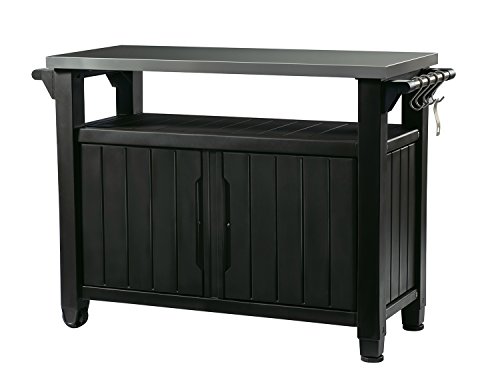
The best rolling outdoor kitchen carts for entertaining are a weather-resistant cart with a 30–36-inch prep surface, at least two locking wheels, 100–150 pounds of useful load capacity, and enclosed storage for tools, fuel accessories, and serving dishes.
The right choice depends less on the largest countertop and more on how your patio is used. A compact cart is easier to maneuver around a grill and store after the party; a wider stainless-steel workstation is better for frequent cooking, large platters, and multiple guests.
Our top picks


As an Amazon Associate we earn from qualifying purchases at no extra cost to you. Ratings are shown as listed on Amazon.
Quick comparison: which cart fits your patio?
| Cart type | Typical dimensions | Useful load capacity | Best surface material | Storage | Best for |
|---|---|---|---|---|---|
| Compact serving cart | 24–30 in. wide × 18–24 in. deep | 50–90 lb | Powder-coated steel or resin | Open shelf or one cabinet | Small balconies and occasional entertaining |
| Mid-size prep cart | 32–40 in. wide × 20–25 in. deep | 100–150 lb | 304 stainless steel or sealed hardwood | One cabinet plus shelf or drawers | Most patios and regular grilling |
| Large outdoor workstation | 48–60 in. wide × 24–30 in. deep | 150–250 lb | 304 stainless steel | Two cabinets, drawers, and side shelves | Frequent cooks and large gatherings |
| Grill-side utility cart | 28–36 in. wide × 20–24 in. deep | 75–125 lb | Powder-coated steel or aluminum | Hooks, bottle rack, and lower shelf | Holding tools, sauces, and serving trays |
Best overall: a mid-size stainless-steel prep cart
For most homes, the best rolling outdoor kitchen cart is a mid-size model with a stainless-steel top, a lower shelf or cabinet, and four 3-inch or larger casters. It provides enough room to season food, hold a cutting board, and stage cooked items without taking over the patio.
Look for a 32- to 40-inch width and 20- to 25-inch depth. That produces roughly 640 to 1,000 square inches of top area. A 36-by-24-inch surface, for example, offers 864 square inches—enough for a large tray, a 15-inch cutting board, and bowls of ingredients with some separation between raw and cooked food.
304 stainless steel is the strongest choice for the worktop because it resists moisture and food acids better than ordinary painted steel. A powder-coated steel frame can still be a good value, but inspect the joints and edges for exposed metal where rust can begin. Aluminum is lighter and naturally corrosion-resistant, although it can dent more easily and may flex under heavy cookware.
Best for small patios: a compact serving cart
Choose a compact cart when every inch matters or when the cart will be stored indoors between uses. A width below 30 inches can fit beside many grills, but the trade-off is limited prep space. These carts are better for transporting plates, condiments, drinks, and finished food than for preparing an entire meal.
Prioritize a folding or removable side shelf, a lower rack, and a handle that does not protrude into a walkway. Two locking casters are usually sufficient for light carts, provided the other two wheels are large enough to roll over patio joints. Small 1.5-inch casters tend to catch on thresholds and pavers; 3-inch wheels are more practical outdoors.
Best for frequent entertaining: a large workstation
A 48- to 60-inch cart makes sense when it will remain on a covered patio and serve as a permanent outdoor prep station. The extra width accommodates serving platters, a cooler, utensils, and ingredients at the same time. Choose one with at least 150 pounds of evenly distributed capacity and a rigid frame.
Large carts need stronger mobility hardware than compact models. Four heavy-duty casters, two with brakes, are preferable. A fixed leveling foot or adjustable leg is useful if the cart will stay in one place, because it reduces rocking while chopping or setting down a hot pan.
Do not assume a large cart is suitable for a countertop appliance or grill. Check the manufacturer’s temperature and weight guidance. A worktop designed for food preparation may not be rated for a hot cast-iron Dutch oven or a portable burner.
How the important specifications compare
Dimensions and usable prep space
Measure the available area with cabinet doors and grill lids open. Leave at least 30 inches of clear passage in front of the cart, and preferably 36 inches where people will pass in both directions. Also account for the handle and wheel swing; the advertised width may not include them.
For serving, 500–700 square inches is usually adequate. For active prep, aim for 800–1,000 square inches. If the cart will hold both a cooler and a cutting board, a 40-inch-wide top is a more comfortable minimum.
Weight capacity
Capacity should include everything placed on the cart, not just cookware. A practical calculation is:
food and dishes 35 lb + cooler or beverage tub 45 lb + cookware and tools 25 lb + safety margin 30 lb = 135 lb.
That example calls for a cart rated for at least 150 pounds. Keep heavy items low and centered. A cart that technically supports 150 pounds can still tip if a full cooler sits at the outer edge of a high side shelf.
Wheel quality
Wheel construction often separates a useful outdoor cart from a frustrating one. Seek polyurethane or rubberized wheels rather than small hard plastic rollers. Ball-bearing casters roll more smoothly under load, while locking swivel casters prevent the cart from drifting on sloped concrete.
- 1.5–2-inch casters: suitable for smooth indoor-style floors and light loads.
- 3-inch casters: a good patio standard for concrete, tile, and small joints.
- 4-inch or larger casters: preferable for pavers, thresholds, and heavy carts.
- Two brakes: adequate for most carts; four brakes help on slopes or uneven surfaces.
Weather-resistant materials
Stainless steel, aluminum, high-density resin, and properly powder-coated steel can all work outdoors. The weakest points are usually fasteners, weld seams, drawer tracks, and the underside of the top rather than the visible surface.
Choose stainless hardware where possible. If the cart uses ordinary steel screws, corrosion can appear even when the frame is powder-coated. Resin cabinets will not rust, but they may fade or become brittle after long exposure to ultraviolet light. Wood surfaces need periodic resealing, and they should not be left wet beneath a waterproof cover.
Decision matrix by situation
| Your situation | Recommended specification | Why |
|---|---|---|
| Budget-conscious, occasional use | 24–32 in. cart, 75–100 lb capacity, resin or powder-coated steel | Lower cost and adequate for serving without paying for permanent cabinetry |
| Weekly grilling | 32–40 in. cart, 100–150 lb capacity, stainless top, two locking casters | Balances prep area, durability, and maneuverability |
| Large parties or frequent cooking | 48–60 in. cart, 150–250 lb capacity, four heavy-duty casters | Supports platters, supplies, and heavier cookware |
| Uneven pavers or a sloped patio | 4-inch wheels, two or four brakes, rigid frame, adjustable foot | Improves control and reduces rocking |
| Uncovered storage | 304 stainless or aluminum, sealed cabinet, drainable surfaces, fitted cover | Reduces rust, standing water, and sun damage |
Storage features worth paying for
An enclosed cabinet protects serving pieces from dust and reduces the number of items carried from the house. Adjustable shelves are more useful than a single fixed shelf because they accommodate bottles, tall containers, and small appliances. A drawer is valuable for tongs, thermometers, skewers, and brushes, but it should have corrosion-resistant slides and a way for trapped moisture to escape.
Hooks and towel bars are inexpensive but practical. A built-in bottle opener, paper-towel holder, or trash-bag ring can improve workflow, provided these attachments do not reduce the usable prep area. Avoid storing charcoal, propane cylinders, or flammable liquids inside a sealed cabinet unless the cart is specifically designed and ventilated for that purpose.
Ownership realities: what wears first
Casters, drawer hardware, and finish at the lower frame usually show wear before the countertop. Grease and salt accelerate corrosion, particularly near a grill. Rinse residue after cooking, dry the cart, and do not use chlorine bleach or abrasive steel wool on stainless steel.
Once a month during the active season, inspect wheel fasteners, tighten loose bolts, clear debris from caster swivels, and check whether water is pooling inside cabinets. Replace damaged casters rather than continuing to push a loaded cart that wobbles. Use a breathable, fitted cover—not plastic wrapped tightly around a damp cart—because trapped condensation can cause rust.
Never place a hot grill, burner, or pan on a surface unless the cart documentation explicitly permits it. Keep raw-food containers separate from clean serving dishes, and wash the worktop before and after food preparation.
Bottom line
For the widest range of patios and entertaining styles, select a 32- to 40-inch rolling cart with a 304 stainless-steel prep top, 100–150 pounds of capacity, 3-inch polyurethane casters, two wheel locks, and a cabinet or lower shelf. Downsize to a compact resin or powder-coated model for a tight balcony, or move up to a 48- to 60-inch stainless workstation when the cart will function as a permanent outdoor kitchen station. Measuring the clearance, calculating the real load, and checking the wheel hardware will matter more than choosing the cart with the most accessories.







Write Your Review
No reviews yet. Be the first to share your experience!