

Key takeaways
- Floor space: Prioritize usable floor area over decorative balconies or steep ramps. A pair of small-to-medium rabbits generally needs a hutch around 72 by 24 inches or larger, plus a connected run. Larger rabbits need more length and width.
- Weather resistance: Look for exterior-grade timber, a genuinely waterproof roof, raised legs, sealed joints, and protected wire edges. A thin stain or fabric cover alone will not prevent moisture damage.
- Predator protection: Use welded wire mesh with openings no larger than 1/2 by 1 inch where possible, secure door bolts, and a run roof or buried apron to discourage climbing and digging predators.
- Ventilation: Large mesh panels on at least two sides provide airflow. Avoid solid plastic-sided designs with only small vents, especially in warm or humid weather.
- Cleaning access: A removable tray, wide-opening doors, and smooth, sealed surfaces reduce the time needed for daily care.
The best rabbit hutches are spacious, weather-resistant, predator-secure homes with strong ventilation and a removable, well-fitted tray; for most rabbits, a hutch measuring at least 72 inches long by 24 inches deep by 24 inches high, connected to a larger exercise run, is a better choice than a compact “starter” model.
Our top picks


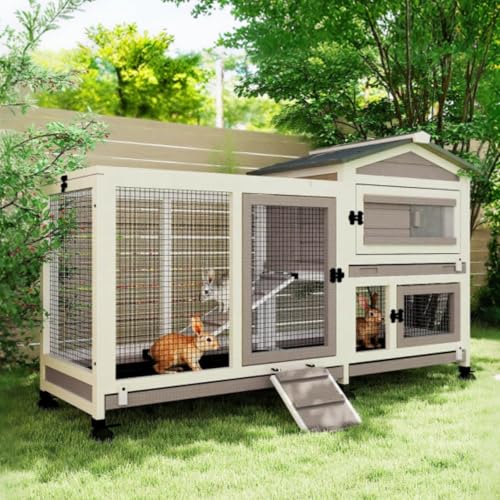

As an Amazon Associate we earn from qualifying purchases at no extra cost to you. Ratings are shown as listed on Amazon.
What makes a rabbit hutch comfortable and easy to clean?
A hutch should function as a dry sleeping and shelter area rather than your rabbit’s entire living space. Rabbits need room to stand fully upright, stretch out, turn around, move between resting and toileting areas, and exercise daily. A permanently attached run is preferable because transferring a rabbit between separate spaces can be inconvenient and may reduce exercise time.
- Floor space: Prioritize usable floor area over decorative balconies or steep ramps. A pair of small-to-medium rabbits generally needs a hutch around 72 by 24 inches or larger, plus a connected run. Larger rabbits need more length and width.
- Weather resistance: Look for exterior-grade timber, a genuinely waterproof roof, raised legs, sealed joints, and protected wire edges. A thin stain or fabric cover alone will not prevent moisture damage.
- Predator protection: Use welded wire mesh with openings no larger than 1/2 by 1 inch where possible, secure door bolts, and a run roof or buried apron to discourage climbing and digging predators.
- Ventilation: Large mesh panels on at least two sides provide airflow. Avoid solid plastic-sided designs with only small vents, especially in warm or humid weather.
- Cleaning access: A removable tray, wide-opening doors, and smooth, sealed surfaces reduce the time needed for daily care.
Best rabbit hutch types by situation
| Situation | Best hutch type | Useful minimum specification | Important compromise |
|---|---|---|---|
| Limited garden space | Single-level hutch joined to a compact run | 72 × 24 × 24 in hutch; run at least 72 × 48 in | Requires careful layout because vertical levels do not replace floor area |
| Two bonded rabbits | Wide double-door hutch with one continuous floor | At least 72 × 24 in of uninterrupted internal floor space | Higher purchase and bedding costs than a single-rabbit enclosure |
| Cold, wet climate | Raised timber hutch with overhanging waterproof roof | Exterior-grade panels, 2–4 in roof overhang, raised base | Timber needs periodic inspection and resealing |
| Frequent cleaning or limited mobility | Full-width front doors and a deep removable tray | Tray extending at least 2 in beyond the sleeping area; doors 24 in or wider | Large doors need robust latches to remain predator-safe |
| Strong digging or predator pressure | Hutch attached to a heavy-duty welded-mesh run | 16-gauge or heavier mesh, roof, and 12–18 in buried mesh apron | Heavier and usually more expensive to move |
Floor space: choose the inside dimensions, not the advertised size
Manufacturers may quote the roof, legs, or external frame, but the rabbit experiences only the internal floor. Measure the usable area after allowing for a hay rack, litter box, water bowl, hide, and divider. A listed 72-inch hutch may offer considerably less uninterrupted space once a central partition and internal fixtures are installed.
As a practical sizing check, calculate the open floor area:
Internal length × internal depth = usable square inches.
For example, a 72 × 24-inch internal floor provides 1,728 square inches. If a permanent 12 × 24-inch feeder shelf occupies the end, 288 square inches disappear, leaving 1,440 square inches—about 17% less than the headline footprint. A low-profile hay rack mounted to the wall usually preserves more floor space than a bulky freestanding feeder.
Ramps and upper platforms can add enrichment, but they should not be counted as a substitute for a generous main floor. Avoid hutches that force a rabbit to use a narrow ramp to reach essential food, water, or shelter.
Materials and weather protection
Timber
Exterior-grade plywood, treated timber designed for outdoor use, and sealed edges generally last longer than thin untreated boards. Check the underside of the roof and the lower edges of wall panels first: these areas commonly swell, soften, or rot because they stay damp. The rabbit should not be able to chew treated, painted, or peeling surfaces, so inspect all accessible wood regularly.
Roof and base
A sloped waterproof roof should extend beyond the walls by roughly 2 to 4 inches. This helps keep rain away from door openings and wall joints. Raised legs improve drainage and airflow underneath, but the structure must remain stable and should not wobble when a rabbit jumps against a wall.
A solid resting floor is usually more comfortable than a fully wire floor. Wire can catch feet and may be difficult to rest on for long periods. Use washable mats or bedding only if the rabbit cannot chew and ingest unsafe material, and replace anything frayed or damp.
Metal mesh
Welded mesh is preferable to lightweight poultry netting, which can be cut or pulled apart more easily. Inspect corners and door frames for gaps. A predator may exploit a surprisingly small opening, while a rabbit can injure its nose or feet on sharp cut wire.
Ventilation without drafts
Good ventilation removes dampness and odors while avoiding a direct cold-air tunnel through the sleeping area. Mesh panels on opposite or adjacent sides allow cross-flow, but the enclosed bedroom should be positioned away from the prevailing wind. In hot weather, provide shade over the roof and run; do not rely on a small vent or enclosed plastic box to keep the interior cool.
Place the hutch in a sheltered location away from direct midday sun, standing water, and exhaust fumes. A thermometer near the rabbit’s resting area can reveal temperature swings that are not obvious from outside. If the enclosure becomes hot, damp, or poorly ventilated, change its location or design rather than simply adding more bedding.
Removable trays and the reality of daily cleaning
The most useful tray is one that slides out completely without lifting the hutch, has a raised edge to contain bedding, and is made from rust-resistant metal or thick, easy-clean plastic. A tray that stops short of the rear wall allows urine and hay to collect underneath, creating a hidden cleaning problem.
Allow enough clearance to remove the tray even when it is full. A 2-inch-deep tray may be easy to lift but can overflow quickly; a 3- to 4-inch tray usually offers a better balance between capacity and weight. Test whether the tray can be removed through the available door or service opening before buying.
A simple maintenance routine
- Daily: Remove wet bedding and droppings, refresh water, replenish hay, and check that latches and mesh are intact.
- Every few days: Empty the tray fully, brush out loose hay, and wipe urine-prone areas with a rabbit-safe cleaner according to its label.
- Weekly: Wash the tray, inspect the roof and floor for dampness, and check the run perimeter for digging or gaps.
- Monthly: Examine hinges, screws, mesh staples, roof covering, and timber joints. Tighten or replace damaged hardware before it becomes a security failure.
Do not use strong fragrances to mask odors, and never mix cleaning chemicals. Dry all surfaces before replacing bedding. Persistent odor usually indicates trapped moisture, an undersized litter area, or a leaking floor rather than a need for more perfume.
Common buying mistakes
- Choosing by rabbit count alone: Two rabbits need more than twice the usable furnishings and enough room to avoid competing over food and shelter.
- Counting the run as hutch space: A run is valuable, but the sheltered area still needs adequate internal floor space.
- Buying a wire-bottom enclosure: This may simplify sweeping while creating an uncomfortable resting surface.
- Ignoring door width: Narrow doors make tray removal, cleaning, and emergency access unnecessarily difficult.
- Trusting a cover as predator protection: A fabric cover offers shade and rain protection but does not replace welded mesh, secure bolts, and a solid run structure.
- Putting the hutch directly on soil: Moisture, parasites, and digging predators can reach the enclosure more easily.
Final buying recommendation
For the best balance of comfort and easy cleaning, choose a single-level hutch with at least 72 × 24 × 24 inches of internal space for small-to-medium rabbits, a solid resting floor, welded predator-resistant mesh, a sloped overhanging roof, ventilation on multiple sides, and a full-width removable tray. Connect it to the largest secure run your space allows, then judge the final setup by uninterrupted floor area, ease of access, dryness, and security—not by the number of levels or decorative features.









Write Your Review
No reviews yet. Be the first to share your experience!