

Key takeaways
- Compare the best nakiri knives for vegetable prep, from forged German steel to a VG-MAX Japanese blade, with checks on edge, handle and care.
The real decision with a nakiri is not whether the flat, tall blade helps with vegetables, because anyone who has pushed one through a cabbage knows it does. The decision is which version of the shape fits your cooking: a forgiving forged German-style blade you can sharpen on basic gear, a hard Japanese blade that holds a finer edge but chips if you treat it roughly, or a low-cost starter that lets you learn the push-cut before spending more.
This guide is for home cooks who prep vegetables most days, plant-forward cooks working through piles of produce, and first-time nakiri buyers who want the differences in steel, edge and handle explained plainly. Every pick below comes from the maker’s own listing details, so the specs you read are the specs the knife ships with.
Quick Picks
As an Amazon Associate we earn from qualifying purchases
| Product | Best for | Key spec from title |
|---|---|---|
| Mercer Culinary Genesis 7-Inch Nakiri Vegetable Knife | A first nakiri that behaves like a pro workhorse | Precision-forged high-carbon German steel |
| Shun Classic 6.5″ Nakiri Knife | A premium Japanese edge for daily vegetable prep | VG-MAX core with Damascus stainless cladding |
| Wüsthof Classic 7″ Hollow Edge Nakiri Knife | Cooks who already like German knife weight | Forged X50 CrMoV 15 steel at 58 HRC |
| HOSHANHO 7 Inch Nakiri Knife | Hard steel and a thin edge on a budget | 10Cr15CoMoV core with 15-degree edge |
| PAUDIN Nakiri Knife 7 Inch | The lowest-cost way to try the nakiri shape | 5Cr15Mov stainless with ergonomic handle |
How to Choose
Steel and hardness decide your sharpening routine
A nakiri’s steel sets two things at once: how fine an edge the blade can take and how much work it takes to bring that edge back. Softer German-style steels around 56 to 58 HRC roll rather than chip, and a few strokes on a honing rod or a basic whetstone restore them, which suits cooks who sharpen casually. Harder Japanese steels at 60 HRC and above hold a thinner edge through weeks of board work, but they ask for a proper whetstone and more care around hard squash skins and frozen food. Match the steel to the sharpening gear you actually own.
Edge profile and food release
Every nakiri here has a flat edge that meets the board along its full length, which is what makes the push-cut work: the whole blade lands at once, so slices separate cleanly instead of staying joined like an accordion. The differences sit on the blade face. Hollow-edge or scalloped dimples break the suction that glues potato and cucumber slices to flat steel, while a plain flat face gives the stiffest, most predictable cut through dense roots. Edge angle matters too. A 15 or 16 degree double bevel slices with less force than a wider grind, but the thinner edge is the first thing to suffer if the blade twists in a hard vegetable.
Handle shape and wet grip
Vegetable prep means wet hands, so the handle matters as much as the blade. Western handles in Santoprene or synthetic materials fill the palm and stay grippy under water, and a bolster adds a finger stop that beginners tend to appreciate. Traditional Japanese wa handles are lighter and often octagonal or D-shaped, which suits a pinch grip and keeps the balance point closer to the blade. Neither style is better in the abstract. If your hands are small, a bulky bolstered handle can feel clumsy on a 6.5 inch blade; if you grip hard and chop fast, a slim wa handle can feel insecure when wet.
Blade length, weight and daily care
Most nakiri blades run 6.5 or 7 inches. The shorter length feels nimble on small boards and suits cooks who mostly handle onions, herbs and fruit, while the 7 inch blade clears taller piles and longer vegetables like leeks and daikon in fewer strokes. Weight follows construction: forged full-tang knives carry more heft, which helps the blade sink through sweet potato, while lighter Japanese-style knives tire the wrist less over a long session. Care is simple but non-negotiable for all five picks here. Hand wash, dry straight away, and store on a strip or in a guard rather than loose in a drawer.
The 5 Best Options
Mercer Culinary Genesis 7-Inch Nakiri Vegetable Knife
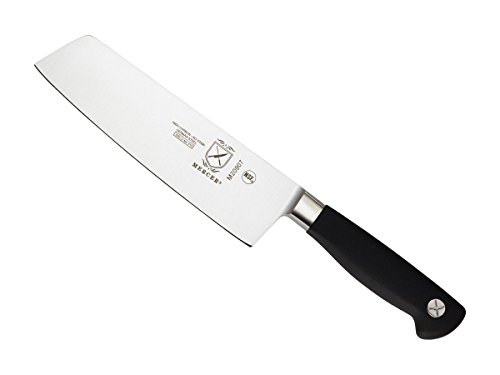
This is the nakiri to hand a cook who wants the shape without the fragility. The Genesis is precision-forged from high-carbon German steel with a taper-ground edge, so it push-cuts carrots, celery and onions with little downward force, yet the steel is forgiving enough to survive the learning curve. The Santoprene handle is the standout for home kitchens: it stays non-slip with wet hands, and the full tang and bolster give it the planted feel of a Western chef’s knife. It doubles as a bench scoop for moving chopped vegetables from board to pot.
Specs
- Blade length: 7 inches
- Blade material: high-carbon German steel (X50 CrMoV 15), precision-forged
- Edge: taper-ground, plain edge
- Handle: Santoprene, ergonomic non-slip, full tang with bolster
- Model number: M20907
- Certification: NSF certified
- Warranty: limited lifetime
- Care: hand wash recommended
Best for: first-time nakiri buyers and busy home cooks who want a durable daily prep knife.
Watch out for: the forged build is heavier than the Japanese-style picks here, so check the weight if you prefer a light blade.
ASIN: B000OOQZWY
Shun Classic 6.5″ Nakiri Knife

The Shun Classic is the premium Japanese option in this group, built around a VG-MAX steel core wrapped in Damascus stainless cladding. That hard core takes the hand-sharpened 16 degree double-bevel edge the listing describes, and it holds that edge through long stretches of daily vegetable work. The D-shaped ebony PakkaWood handle suits a pinch grip and keeps the knife feeling quick on the board. At 6.5 inches it is the shortest blade here, which makes it easy to control for cooks with smaller boards or hands. It rewards careful habits and punishes rough ones.
Specs
- Blade length: 6.5 inches
- Core steel: VG-MAX stainless steel
- Cladding: Damascus stainless steel
- Edge: hand-sharpened 16-degree double bevel
- Handle: D-shaped ebony PakkaWood
- Model number: DM0728
- Origin: handcrafted in Japan
Best for: experienced home cooks who want a fine, long-lasting edge for daily vegetable prep.
Watch out for: the hard, thin edge can chip on frozen food, bones or twisting cuts in hard rinds, so keep it for produce only.
ASIN: B000FR2YWK
Wüsthof Classic 7″ Hollow Edge Nakiri Knife

Wüsthof’s Classic nakiri keeps the Japanese outline and fills it with Solingen habits: a precision-forged full-tang blade in X50 CrMoV 15 steel tempered to 58 HRC, a full bolster, and a triple-riveted synthetic handle that shrugs off water and heat. The hollow edge is the practical detail. The dimples ground into the blade face reduce the suction that sticks slices of potato, apple and cucumber to flat steel, so cut pieces fall away instead of needing a flick of the finger. Cooks who already own German knives will find the weight and balance familiar from the first onion.
Specs
- Blade length: 7 inches, blade width 1.9 inches
- Blade material: X50 CrMoV 15 steel, precision-forged
- Hardness: 58 HRC
- Edge: hollow edge with PEtec sharpening
- Handle: full tang, triple-riveted synthetic, 4.4 inches long
- SKU: 1040132617
- Origin: made in Solingen, Germany
Best for: cooks who like German knife weight and want easy food release on starchy vegetables.
Watch out for: the full bolster can get in the way when you sharpen the heel of the edge on a stone over the years.
ASIN: B085V63F23
HOSHANHO 7 Inch Nakiri Knife

The HOSHANHO brings Japanese-style steel numbers to a mid-range knife: a 10Cr15CoMoV high-carbon core, vacuum heat treated, with a hand-polished 15 degree edge. That combination gives it a thin, hard blade that moves through dense butternut squash and sweet potato with little wedging, helped by scalloped hollows along the face that keep slices from clinging. The pakkawood handle is contoured rather than traditional, which makes it an easy transition for cooks coming from Western knives. For vegetable-heavy cooking on a budget, it is the sharpest tool in this list relative to what it asks of your wallet.
Specs
- Blade length: 7 inches
- Blade material: 10Cr15CoMoV high-carbon stainless steel core
- Hardness: 60 HRC, vacuum heat treated
- Edge: hand-polished 15 degrees
- Blade thickness: 2.5 mm
- Handle: ergonomic pakkawood
- Face: scalloped hollow pits for food release
Best for: vegetable-heavy cooks who want a hard, thin edge without paying premium brand prices.
Watch out for: the brand sells several similar-looking nakiri models, so confirm the 7 inch size and steel on the listing before ordering.
ASIN: B0CWH4MF7W
PAUDIN Nakiri Knife 7 Inch

The PAUDIN is the inexpensive way to find out whether the nakiri shape suits your cooking before committing to forged or Japanese steel. Its 5Cr15Mov stainless blade is softer than the others here, which cuts both ways: the edge dulls sooner under daily use, but it also comes back quickly on a honing rod or a simple pull-through sharpener, and it tolerates the odd knock against a pan or bone better than a hard blade would. The ergonomic handle is shaped for a full grip rather than a pinch grip. Treat it as a learning knife that still does honest work.
Specs
- Blade length: 7 inches
- Blade material: 5Cr15Mov high-carbon stainless steel
- Hardness: 56+ HRC
- Edge: double bevel, razor-sharp finish
- Handle: ergonomic pakkawood
- Use: slicing, dicing, chopping and mincing vegetables
Best for: curious beginners and spare-knife buyers who want the nakiri shape at the lowest commitment.
Watch out for: the wave pattern on the blade is a surface finish, not layered Damascus, so judge it as the plain stainless knife it is.
ASIN: B07KC949P2
Which One Fits Your Situation
You prep vegetables almost every day
Pick the Shun Classic if your sharpening habits are already settled, because its VG-MAX core holds a fine edge through weeks of board work. If your prep is high volume but your sharpening is occasional, the Mercer Culinary Genesis is the safer daily driver: the taper-ground German steel edge is quicker to restore, and the non-slip handle stays secure through a sink-side session of wet produce.
You are buying your first nakiri
Start with the Mercer Culinary Genesis or the PAUDIN. Both forgive the mistakes beginners make while learning the push-cut, and both sharpen on basic equipment. The Genesis is the better long-term buy if the budget stretches, with its forged build and lifetime warranty. The PAUDIN costs less to replace if you discover you prefer a chef’s knife after all.
Your household shares one knife drawer
Choose the Wüsthof Classic. Its 58 HRC forged blade and synthetic handle tolerate the handling a shared knife gets: quick rinses, the occasional crowded drawer, and cooks who will not baby an edge. The harder Japanese-style blades here, the Shun and the HOSHANHO, are better kept as personal knives with a guard or strip of their own.
You cook a lot of dense roots and squash
The HOSHANHO’s thin 2.5 mm blade and hard core wedge least in sweet potato, celeriac and butternut squash, and its scalloped face sheds slices as you work. If you would rather lean on weight than thinness, the forged Wüsthof and Mercer blades carry enough heft to power through the same vegetables with a slower, steadier stroke.
Common Mistakes
- Using a nakiri like a cleaver on bones, frozen food or thick squash rinds, which chips hard edges and rolls soft ones.
- Rock-chopping with the tip down like a chef’s knife, instead of the straight push-cut the flat edge is built for.
- Choosing a blade only by hardness number, without owning the whetstone or rod that steel needs to stay sharp.
- Storing the knife loose in a drawer, where the thin edge knocks against other tools between uses.
- Buying a 7 inch blade for a small board, or a 6.5 inch blade for tall piles of greens, and blaming the knife.
Frequently Asked Questions
What is a nakiri knife actually for?
A nakiri is a vegetable specialist. Its flat edge lands on the board all at once, so it push-cuts onions, cabbage, roots and herbs into clean, even pieces without the rocking motion of a chef’s knife. The tall blade also works as a scoop for moving chopped produce. It is not built for bones, frozen food or prying tasks.
Should I buy a nakiri or a santoku?
Buy the nakiri if most of your board work is vegetables and you like a straight up-and-down cut. Buy a santoku if you want one knife that also handles meat and fish and uses a slight rocking motion, since its curved tip is more versatile. Many cooks end up owning both, with the nakiri taking over the daily produce prep.
How do I keep a nakiri sharp?
Hone lightly and often, and sharpen on a whetstone when honing stops restoring the edge. Keep the bevel angle steady, around 15 to 16 degrees per side for the Japanese-style blades here and a little wider for the German-style ones. A fine grit finishing stone suits the harder steels; softer steels respond well to a rod between sharpenings.
Can I put a nakiri in the dishwasher?
No pick in this guide should go in the dishwasher. Detergent, heat and rattling against other items dull the edge and can damage handles, including the pakkawood ones. Every maker here recommends hand washing. Wash in warm soapy water, dry the blade straight away, and store it on a magnetic strip, in a block or with a blade guard.
More from Amazon
Programs that pair well with the guide above. Offers and eligibility are set by Amazon and may change.
Set up recurring deliveries of everyday items on eligible products. Terms and savings are set by Amazon.
Explore Subscribe & SaveCollect the home and kitchen items you want in one registry that guests can shop from.
Create a wedding registryFree shipping on eligible items, Prime Video and more. Eligible new members can start with a free trial.
Start a Prime free trialAudiobooks and podcasts to listen to on the go. Eligible new members can start with a free trial.
Try Audible freeAs an Amazon Associate we earn from qualifying purchases.
Write Your Review
No reviews yet. Be the first to share your experience!