

Key takeaways
- Highest-quality aerial photos and video: DJI Mavic 4 Pro
- Best balance of price, cameras, safety, and endurance: DJI Air 3S
- Best portable camera drone: DJI Mini 4 Pro
- Best for first-person-view action footage: DJI Avata 2
- Best alternative with a large sensor and long flight time: Autel EVO Lite+
The best camera drones in 2026 are the DJI Mavic 4 Pro for maximum image quality, DJI Air 3S for most serious photographers, DJI Mini 4 Pro for travel and low-weight flying, and DJI Avata 2 for immersive, fast-moving video.
Our top picks
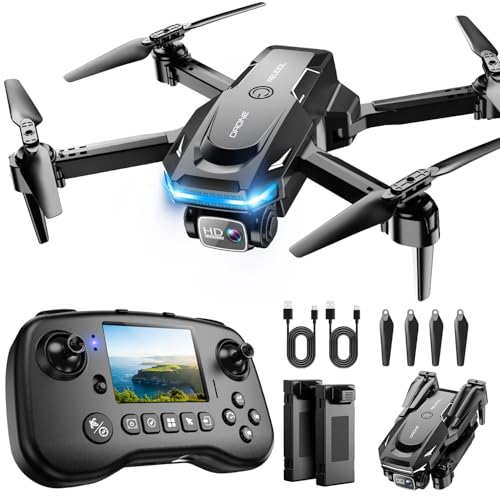


As an Amazon Associate we earn from qualifying purchases at no extra cost to you. Ratings are shown as listed on Amazon.
Quick picks by shooting situation
- Highest-quality aerial photos and video: DJI Mavic 4 Pro
- Best balance of price, cameras, safety, and endurance: DJI Air 3S
- Best portable camera drone: DJI Mini 4 Pro
- Best for first-person-view action footage: DJI Avata 2
- Best alternative with a large sensor and long flight time: Autel EVO Lite+
Resolution is only part of the decision. A large sensor usually produces cleaner images in dim light, a gimbal matters more than digital sharpness for smooth footage, and obstacle sensing can be more valuable than an extra telephoto camera if you fly near trees or buildings.
Camera drone comparison
| Drone | Main camera and video | Stabilization | Maximum flight time | Weight | Obstacle sensing |
|---|---|---|---|---|---|
| DJI Mavic 4 Pro | 100MP Hasselblad camera; up to 6K/60 video; additional medium-tele and tele cameras | Three-axis gimbal | 51 minutes | About 1,063g | Omnidirectional sensing with low-light capability and downward sensing |
| DJI Air 3S | 1-inch 50MP wide camera plus 48MP medium-tele camera; up to 4K/120 | Three-axis gimbal | 45 minutes | About 724g | Omnidirectional sensing plus forward-facing LiDAR assistance |
| DJI Mini 4 Pro | 48MP 1/1.3-inch camera; up to 4K/60 HDR and 4K/100 slow motion | Three-axis gimbal; vertical shooting | 34 minutes with standard battery | Under 249g with standard battery | Omnidirectional obstacle sensing |
| DJI Avata 2 | 12MP 1/1.3-inch camera; up to 4K/60 video | Electronic stabilization with HorizonSteady and RockSteady modes | 23 minutes | About 377g | Downward and backward visual sensing; propeller guards |
| Autel EVO Lite+ | 1-inch 20MP camera; up to 6K/30 video | Three-axis gimbal | 40 minutes | About 835g | Obstacle avoidance in several directions, with limits in low light |
Advertised flight times are measured in controlled conditions. Wind, cold weather, rapid acceleration, and carrying a heavier battery can reduce usable time. In practice, plan to land with a reserve rather than treating the final few minutes as recording time.
DJI Mavic 4 Pro: choose it for maximum image quality
The Mavic 4 Pro is the strongest choice for commercial-looking landscapes, real-estate exteriors, travel films, and photographs that may be cropped heavily. Its Hasselblad main camera combines high resolution with a large sensor, while the additional telephoto cameras let you frame distant subjects without flying closer to them.
Its three-axis gimbal provides mechanical stabilization, which is generally more dependable than software stabilization for slow pans, still photographs, and footage shot in changing wind. The long flight time also helps when a location requires several compositions.
The compromises are size, cost, and operating responsibility. A drone over 250g is less convenient for lightweight travel and may fall under more registration requirements than a sub-250g model. The Mavic is also excessive for occasional social-media clips, where a Mini 4 Pro can produce excellent results with less equipment.
DJI Air 3S: the best all-rounder for serious hobbyists
The Air 3S is the practical middle ground. Its 1-inch main camera is better suited to low-light scenes than the smaller sensor in the Mini 4 Pro, and its second camera provides a useful compressed perspective for buildings, mountains, and portraits from a safe distance.
Its obstacle-sensing system is particularly useful for people who fly near woodland, fences, or structures, although sensing is not a substitute for looking at the aircraft and checking the flight path. The 45-minute rated battery life is long enough for a productive outing without making the drone as large as a professional flagship.
Choose the Air 3S when you want high-quality stills and video, expect to fly regularly, and do not need the smallest possible kit. It is also a sensible upgrade from an entry-level drone when image quality and safety features matter more than minimum weight.
DJI Mini 4 Pro: the travel and casual-use pick
The Mini 4 Pro is the easiest recommendation for travelers, hikers, and occasional users who want a capable camera in a small package. Its sub-249g standard configuration can simplify some regulatory obligations, though weight alone does not make a flight unrestricted. It still has a camera, radio transmitter, and aircraft-specific rules to follow.
The drone records high-quality 4K video, supports vertical shooting for short-form content, and folds into a small bag. Its omnidirectional sensing is a major advantage over cheaper beginner drones that rely primarily on downward positioning sensors.
The smaller sensor cannot match the Mavic 4 Pro or Air 3S in difficult evening light, and 34 minutes is a rated maximum rather than a normal airborne target. For a typical flight, reserve about five minutes for a safe return and landing. That leaves approximately 29 minutes in ideal conditions, and less in wind.
DJI Avata 2: choose it for movement rather than still photography
The Avata 2 is a first-person-view drone designed for energetic footage through open spaces, around suitable obstacles, and close to the ground. Its integrated propeller guards provide some protection during minor contact, while the headset-based view makes the flight experience more immersive than a conventional camera drone.
It is not the best tool for high-resolution still photography. Its camera resolution is lower than the other recommendations, its flight time is shorter, and electronic stabilization can crop the frame. It is best for establishing shots, fast transitions, indoor-approved spaces, and dynamic video where motion matters more than maximum detail.
FPV flying requires extra attention to local rules and a spotter may be required or strongly advisable, especially when the pilot cannot continuously see the aircraft directly.
Autel EVO Lite+: a large-sensor alternative
The EVO Lite+ remains appealing for photographers who value a 1-inch sensor, a three-axis gimbal, and a 40-minute rated flight time. Its 6K video mode gives editors room to crop or reframe, while the relatively large sensor helps retain detail in lower light.
Before choosing it, check current firmware support, local availability of batteries and propellers, and the service process in your country. Ownership convenience can matter as much as specifications, particularly if the drone will be used frequently.
Decision matrix: match the drone to your needs
| Your situation | Best fit | Why | What to accept |
|---|---|---|---|
| First camera drone, occasional use, limited storage | DJI Mini 4 Pro | Small, light, stabilized, and relatively forgiving | Smaller sensor and shorter practical flight time |
| Frequent travel and hiking | DJI Mini 4 Pro | Low carry weight and vertical camera orientation | Less low-light performance than larger drones |
| Landscapes, property, and regular paid-looking work | DJI Air 3S | Large main sensor, second camera, and strong sensing | Heavier than the Mini and subject to more weight-related rules |
| Maximum detail, extensive cropping, or premium production | DJI Mavic 4 Pro | Highest-resolution camera system and long endurance | Higher cost, bulk, and regulatory complexity |
| Fast action and immersive first-person footage | DJI Avata 2 | FPV view, protected propellers, and strong electronic stabilization | Lower still-image resolution and shorter battery life |
What to check before buying
Resolution versus sensor size
More megapixels help with cropping and large prints, but they do not guarantee cleaner images. Sensor size, lens quality, dynamic range, and processing are more important when shooting at dawn, dusk, or in shaded streets. A 20MP one-inch camera can produce more useful low-light detail than a higher-resolution camera with a much smaller sensor.
Mechanical versus electronic stabilization
A three-axis gimbal physically keeps the camera level during movement and is preferable for photographs, slow pans, and professional-looking footage. Electronic stabilization can be excellent for action, but it usually crops the image and may create artifacts during rapid turns.
Obstacle sensing and its limits
Obstacle avoidance can fail with thin wires, branches, reflective surfaces, fog, darkness, or objects outside the sensor coverage. Check the aircraft’s path yourself, fly slowly in unfamiliar spaces, and do not assume the return-to-home function will clear every obstacle.
Legal and ownership considerations in 2026
Rules differ by country, state, and location. Before the first flight, check the aviation authority’s requirements for registration, remote identification, pilot competency, maximum altitude, visual line of sight, airports, emergency sites, national parks, and flights over people. A sub-249g drone may have lighter registration requirements in some jurisdictions, but it does not automatically permit flights over crowds, restricted airspace, or private property.
Commercial use may require additional registration, insurance, certification, or operating permissions. Respect privacy as well: avoid recording into homes, gardens, or private conversations, and obtain permission when filming identifiable people for a project.
Durability, maintenance, and real ownership costs
Propellers are usually the first consumable to replace. Even a light scrape can create vibration, noise, or unstable footage. Inspect them before every flight and replace damaged pairs rather than trying to straighten them. Batteries also age: store them at the manufacturer’s recommended partial charge, keep them cool and dry, and retire any pack that is swollen, unusually hot, or physically damaged.
After flying near sand, saltwater, or dusty ground, wipe the aircraft and gimbal area with a soft, dry cloth. Do not spray cleaner into motors, vents, sensors, or battery contacts. Keep firmware, maps, and controller software current, but avoid updating immediately before an important trip unless you have time to check the aircraft afterward.
A useful planning calculation is to carry three batteries for a long outing. If each battery provides roughly 25 to 30 minutes of practical filming time after safety reserves, three packs provide about 75 to 90 minutes in the air. Allow extra time for battery changes, setup, calibration, and scouting; the result is not three uninterrupted hours of shooting.
Bottom line
Buy the DJI Mini 4 Pro if portability and simplicity are your priorities. Choose the DJI Air 3S for the best balance of camera quality, flight time, and sensing. Step up to the DJI Mavic 4 Pro when maximum image quality justifies its size and legal overhead. Choose the DJI Avata 2 for immersive action video, and consider the Autel EVO Lite+ if a large sensor and long endurance are more important than the widest ecosystem of accessories and services.







Write Your Review
No reviews yet. Be the first to share your experience!