

Key takeaways
- A bread knife is a single-purpose tool, and that is exactly why a wrong choice stings. A short blade squashes a boule.
A bread knife is a single-purpose tool, and that is exactly why a wrong choice stings. A short blade squashes a boule, a flat edge skates across a hard crust, and a stiff handle makes a Sunday sourdough feel like a workout. The decision comes down to three things the listings spell out: blade length, edge style and any extras such as a cover or an offset handle. Pick the wrong combination and you will saw through a crumb you spent two days fermenting.
This guide is for home bakers, sandwich makers and anyone who slices crusty loaves, bagels or layer cakes more than a couple of times a week. Seven serrated knives are compared below, ranging from 8-inch workhorses to a 10.5-inch offset design, and every note is drawn from what the product titles say. The goal is to help you match a blade to your loaf, your cutting board and your drawer, so that the knife you buy in 2026 is the one you reach for first.
Quick Picks
Our top picks


As an Amazon Associate we earn from qualifying purchases at no extra cost to you.
| Product | Best for | Key spec from the title |
|---|---|---|
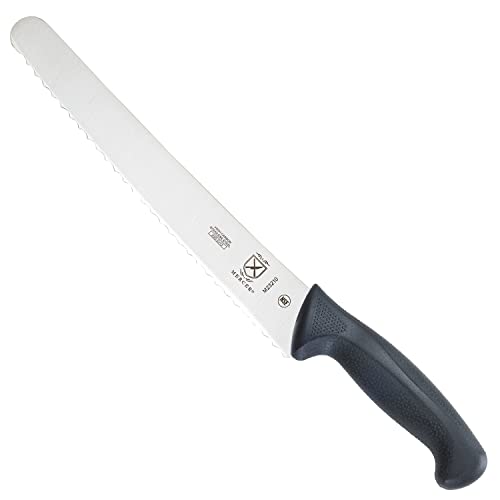
| Mercer Millennia M23210 | Large loaves, a wide blade for stable slicing | 10-inch wide wavy edge, black handle |
| Orblue Serrated Bread Knife | Bagels and cakes in small kitchens | 8-inch blade, wavy edge, stainless steel |
| Cuisinart 8-inch with Blade Guard | Drawer storage and safety | 8-inch stainless steel, blade guard |
| imarku 10-inch Japanese Steel | Long-reach slicing | 10 inches, Japanese high carbon stainless steel |
| Cutluxe 10-inch with Cover | Sourdough bakers | 10-inch serrated, cover included, anti-slip handle |
| SYOKAMI Offset 10.5-inch | Knuckle clearance, tall loaves | 10.5 inches, offset, resharpenable serrated edge |
| Mercer Millennia M23890 | Mid-length offset option | 9-inch offset wavy edge, black handle |
How to Choose
Blade length: 8, 9 or 10 inches and beyond
The blade should be at least as long as the widest loaf you slice, with a little to spare. An 8-inch blade handles baguettes, sandwich bread and bagels. A round country loaf or a sheet cake needs 9 to 10 inches so you can use a long, light sawing stroke rather than pressing down. Longer blades also need a longer board and a deeper drawer, so measure your storage before reaching for 10.5 inches.
Edge style: wavy, scalloped or pointed teeth
Several titles mention a wavy edge, which has gentle, rounded peaks that cut through crust without shredding the crumb. Pointed teeth bite harder into very tough crusts but can tear soft bread. Whichever you choose, look for a serration pattern that is deep enough to grab the crust yet shallow enough to leave a clean surface. If a listing mentions a resharpenable edge, that is a bonus because most serrated knives are treated as disposable.
Handle and offset design
A straight handle on a thick loaf can leave your knuckles scraping the board. Offset designs, like the 9-inch and 10.5-inch models here, raise the grip above the blade line to keep fingers clear. Anti-slip or ergonomic grips help when your hands are floury. Weight matters less than balance, since a serrated knife works by the saw motion rather than by force.
What to ignore and where budget models cut corners
Ignore generic language such as razor sharp, since it appears in nearly every title. Budget models sometimes use thin steel that flexes on a dense loaf, and covers or guards may be flimsy. Prioritize a named steel type, a stated blade length and a handle that suits your hand. A guard or cover is a practical extra if the knife shares a drawer with other tools, but it is not a substitute for solid construction.
The 7 Best Options
Mercer Culinary Millennia M23210 10-Inch Bread Knife
The title gives a 10-inch wide wavy edge and a black handle. The wide blade suggests more surface for guiding a cut through large rounds, which makes it a practical choice for bakers who cut whole loaves in one pass. Think of country boules, rye rounds and tall pullman loaves, where a short blade forces you to rock the knife and crush the crumb. The black handle keeps the look simple, and a wide profile gives your fingers a wider guide above the edge.
- Strength: the 10-inch length reaches across large boules and cakes.
- Strength: wavy edge and a straight, black handle listed plainly.
- Trade-off: a long blade needs a deep drawer or a sheath.
Skip it if you mostly cut bagels and small rolls, where an 8-inch knife is nimbler. Cooks with tiny drawers should also measure before ordering a blade this long.
Orblue 8-Inch Serrated Bread Knife
This listing leans on stainless steel and a wavy edge, and it names bagels and cake among its jobs. An 8-inch blade fits comfortably on a standard cutting board. For a household that slices a store-bought sandwich loaf, an occasional birthday cake and weekend bagels, that is plenty of length without taking over the drawer. Because the title names so many jobs, it reads as a general-purpose slicer for people who do not bake daily.
- Strength: compact length for cramped kitchens.
- Strength: the title mentions bagels, cake and homemade bread.
- Trade-off: the length can struggle with very large round loaves.
Skip it if you bake bread bigger than a standard sandwich loaf or want an offset handle. Bakers of tall loaves would be better served by a longer blade with extra knuckle clearance.
Cuisinart 8-Inch Stainless Steel Bread Knife with Blade Guard
The blade guard is the headline here. Paired with an 8-inch stainless steel blade, it suits drawer storage and households where safety matters. The guard slides over the serrated teeth, which prevents accidental nicks when you rummage for a spatula and keeps the edge from rubbing against other tools. For anyone who gives a first kitchen kit as a gift, it is also a tidy, ready-to-store package.
- Strength: the included blade guard protects both the edge and your hand.
- Strength: a familiar 8-inch size that suits most boards.
- Trade-off: the title offers few specifics about edge style or steel type.
Skip it if you want a longer reach or a detailed steel description. People who bake large rounds weekly will probably outgrow the length.
imarku 10-Inch Japanese High Carbon Stainless Steel Bread Knife
The listing highlights Japanese high carbon stainless steel and a professional-grade serrated edge at 10 inches. It targets cooks who want a long blade with a stated material. The words professional grade and cake knife in the title suggest it is meant for both crusty loaves and delicate sponge layers, so it can serve double duty if you bake desserts. A long, narrow serrated blade is helpful for leveling cake tops, as long as your board is big enough to support the stroke.
- Strength: the steel type is named in the title.
- Strength: 10 inches covers loaves and layer cakes.
- Trade-off: longer blades need more storage room.
Skip it if you slice mostly sandwich bread and want a short, light knife. The size is also a mismatch for compact storage or for anyone with a small hand who prefers a shorter tool.
Cutluxe 10-Inch Serrated Bread Knife with Cover
The title mentions a cover, a 10-inch serrated blade for sourdough and an anti-slip ergonomic handle. That combination suits bakers who store the knife in a drawer and want to pack it for a family gathering or a bake sale without worrying about the teeth. The ergonomic handle language suggests comfort during repeated slicing, which matters when you are cutting several loaves in a row.
- Strength: cover included for safer storage.
- Strength: handle described as anti-slip, helpful with floury hands.
- Trade-off: a straight handle may crowd knuckles on tall loaves.
Skip it if you prefer an offset grip or an extra-long blade. Those who want a named steel type in the title may prefer another entry.
SYOKAMI Offset Bread Knife, 10.5-Inch
The longest blade here, with an offset handle and a resharpenable serrated edge. It is aimed at bakers who slice tall homemade loaves, including sourdough with a thick crust and a tender, open crumb. The upgraded label in the title is marketing, not a spec, so judge it on the blade length, the offset grip and the resharpenable edge. The offset geometry is the main reason to choose it over a straight-handled 10-inch knife.
- Strength: offset handle keeps knuckles above the board.
- Strength: the listing says the serrated edge can be resharpened.
- Trade-off: 10.5 inches is long for small drawers and small boards.
Skip it if your storage is limited or you only slice small rolls. A shorter offset option is available in the Mercer line for those who want the clearance without the length.
Mercer Culinary Millennia M23890 9-Inch Offset Bread Knife
A 9-inch offset wavy edge with a black handle, placed between the shorter and longer knives here. It gives knuckle clearance without the length of the biggest blades, which makes it easier to store and easier to control. A 9-inch blade is long enough for most homemade loaves and layer cakes, and it fits more drawers than the 10.5-inch alternative. Buyers who like the Mercer approach but want an offset grip will find this the natural step.
- Strength: offset design with a manageable 9-inch blade.
- Strength: wavy edge named in the title.
- Trade-off: it may be short for very wide round loaves.
Skip it if you need a full 10 inches or more of reach. Bakers who cut extra-wide round loaves may find themselves wishing for another inch.
Which One Fits Your Situation
You bake sourdough every weekend
Choose the Cutluxe 10-inch with cover, whose title names sourdough directly, or the SYOKAMI Offset if tall loaves scrape your knuckles. Either one gives you the length for a full round, and the cover or the resharpenable edge adds a practical bonus.
You slice bagels, sandwiches and cake in a small kitchen
The Orblue 8-inch or the Cuisinart 8-inch with blade guard fit smaller boards and drawers. Both are easier to handle for children learning to help in the kitchen, and the guard on the Cuisinart is a plus for shared drawers.
You want knuckle clearance without the longest blade
The Mercer Millennia M23890 9-inch offset is the middle path. It keeps the knuckle clearance you get from an offset grip while saving drawer space compared with the longest knife in this guide.
You want a named steel and long reach
The imarku 10-inch Japanese high carbon stainless steel model states its material, and the Mercer M23210 gives a wide 10-inch blade. Pick the imarku if the named material matters most and the Mercer if you prefer a broad blade profile.
Common Mistakes
- Buying a blade shorter than your largest loaf and ending up pressing down.
- Ignoring knuckle clearance and scraping your hand on the board.
- Pushing instead of sawing, which crushes soft crumb.
- Storing a serrated blade loose in a crowded drawer, which dulls the teeth.
- Using the knife on frozen items or hard cutting surfaces like granite.
Specs and Terms Explained
Serrations and gullets
The gullets are the valleys between teeth. Deeper, wider gullets tend to grab a thick crust, while shallow scallops make cleaner cuts through soft sandwich loaves. If you bake artisan loaves, look for descriptions mentioning deep serrations.
Offset handle
An offset knife has a bent handle that raises your knuckles above the cutting board. It matters most for tall loaves and for people with larger hands, and it makes little difference on a thin baguette.
High carbon stainless
This label means the blade has enough carbon to take a sharper edge and enough chromium to resist rust. It is a common marketing phrase, so treat it as a general descriptor rather than a precise hardness number.
Setup and Care Tips
- Let a fresh loaf cool before cutting. Warm bread compresses under any blade, no matter how sharp.
- Use long, light strokes and let the teeth do the work instead of pressing down.
- Wash by hand and dry the teeth with a cloth pulled along the blade, away from the edge.
- Slide on the cover or blade guard when storing in a drawer, which protects both the teeth and your fingers.
- Do not use a standard sharpening stone on serrations. Use a tapered rod, or ask a sharpening service when the knife finally goes dull.
Which One Should You Buy?
| If you… | Choose… |
|---|---|
| Want a simple long blade for large loaves | Mercer Culinary Millennia M23210 10-Inch Bread Knife |
| Slice mostly sandwich bread and rolls | Orblue 8-Inch Serrated Bread Knife |
| Store the knife loose in a drawer | Cuisinart 8-Inch Stainless Steel Bread Knife with Blade Guard |
| Prefer a Japanese-style steel description | imarku 10-Inch Japanese High Carbon Stainless Steel Bread Knife |
| Want a cover included for gifting | Cutluxe 10-Inch Serrated Bread Knife with Cover |
| Need extra knuckle clearance on tall loaves | SYOKAMI Offset Bread Knife, 10.5-Inch |
| Want an offset in a slightly shorter length | Mercer Culinary Millennia M23890 9-Inch Offset Bread Knife |
Who Should Skip These
If you buy bread from the store already sliced, a bread knife is a rarely used tool, and a good serrated utility knife covers occasional loaves. Very short cooks or people with limited counter depth may find a 10-inch blade awkward in a small kitchen. Anyone who prefers to sharpen knives at home should know that serrated edges are harder to maintain than plain ones, so a long-lasting factory edge matters more than a feature list. Left-handed users should also look carefully at offset designs, which are usually shaped for right-handed grips.
Related guides
- Black Friday And Cyber Monday Kitchen Deals
- Knife Sharpener For Kitchen Knives
- Cuisinart Air Fryer Toaster Oven Review
Frequently Asked Questions
How long should a bread knife be?
Ten inches suits most round loaves and cakes. Eight inches is enough for baguettes, sandwich bread and bagels. Pick based on your biggest loaf.
Can I sharpen a serrated bread knife?
Some can, but many cannot. The SYOKAMI listing says resharpenable. For others, check the manufacturer’s guidance before attempting.
What does an offset handle do?
It raises the grip above the blade line so your knuckles stay clear of the board when slicing thick loaves.
Is a blade guard or cover necessary?
Not essential, but helpful if the knife lives in a shared drawer. It protects the teeth and your fingers.
Write Your Review
No reviews yet. Be the first to share your experience!