

Key takeaways
- If a tomato slides under your blade instead of splitting, the problem is the edge and not the knife.
If a tomato slides under your blade instead of splitting, the problem is the edge and not the knife. A kitchen knife sharpener is the simplest way to bring a dull chef knife back to work, but the category is crowded with pull-through gadgets, rolling kits and angle-adjustable tools that promise the same result in different ways. Choosing among them means deciding how much control you want, how many knife types you own and whether you will actually use the tool every few weeks.
This guide is for home cooks with ordinary stainless kitchen knives, including serrated bread knives and the odd pair of scissors, who want a manual sharpener that fits in a drawer. Seven options are compared using only the details in the product titles: stages, angles, abrasive materials and what each says it can sharpen. For anyone starting a sharpening habit in 2026, the goal is to match the tool to your skill level and storage rather than chase the longest feature list.
Quick Picks
Our top picks





As an Amazon Associate we earn from qualifying purchases at no extra cost to you.
| Product | Best for | Key spec from the title |
|---|---|---|
| AccuSharp Knife Sharpener | Quick touch-ups, straight and serrated blades | Ergonomic handle, compact, restores and hones |
| Henckels Handheld Sharpener | Easy pull-through use | Manual pull-through, non-slip ergonomic handle |
| Sharp Pebble 3-Stage Adjustable | Cooks who want angle options | 3 stages, adjustable angles, manual |
| KitchenIQ 50009 Edge Grip 2-Stage | Stable countertop sharpening | Coarse and fine slots, non-slip base, soft grip |
| SHARPAL 191H Knife and Scissors | Knives plus shears in one tool | Straight, serrated and scissors sharpening |
| AIERLIAN Rolling Sharpener Kit | Hobbyists wanting a guided kit | Rolling kit, diamond and ceramic, any steel hardness |
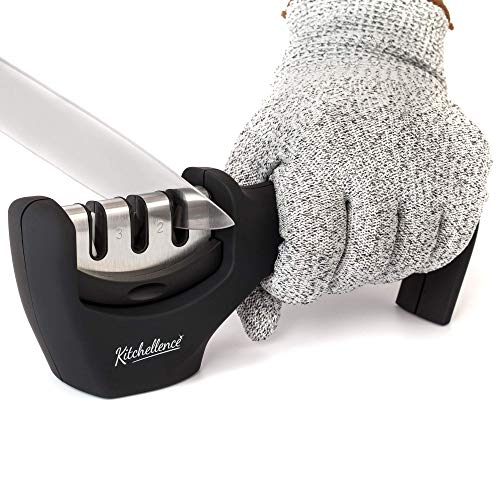
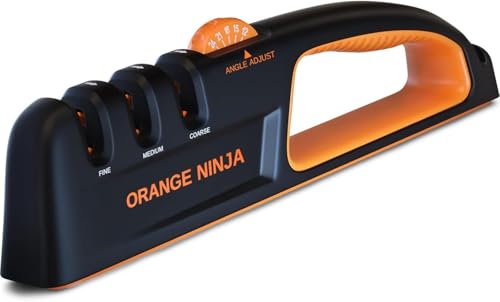
| Orange Ninja 4-Stage | Repairing very dull straight and serrated blades | 4 stages, repairs, sharpens and polishes |
How to Choose
Stages: what two, three and four slots actually do
A coarse stage removes metal to repair a damaged edge, a fine stage refines it, and a polishing stage finishes it. A two-stage tool covers coarse and fine, which is enough for routine maintenance. Three or four stages add repair or polish steps, which helps if your knives have been neglected for years. More stages do not guarantee a better edge, but they give you finer control over what the tool does to a blade.
Pull-through versus guided kits
Pull-through sharpeners fix the angle for you, so beginners get consistent results with almost no learning curve. The cost is less flexibility: they remove more steel than careful stone work and may not suit very thin Japanese blades. Rolling or guided kits, like the one listing diamond and ceramic abrasives, let you choose an angle and work more deliberately. If you want to learn, they are more rewarding. If you just want a usable edge tonight, a pull-through is faster.
Angles, serrations and special blades
Most western kitchen knives are sharpened at roughly 20 degrees per side, while many Asian-style knives use a narrower angle. A tool with adjustable angles, as in the Sharp Pebble listing, gives you room for both. Serrated knives need a tool that is designed for them, usually a tapered rod or a dedicated slot, so check that the title says serrated if you own a bread knife. Scissors sharpening is a bonus on certain tools.
What to ignore and where budget tools cut corners
Ignore lifetime-sharp slogans, which no abrasive can guarantee. Budget sharpeners often skimp on base stability, so a non-slip foot is worth more than an extra stage. Expect to replace pull-through slots or abrasive wheels eventually, and keep your best knives away from the most aggressive coarse slots. A handle that fits your grip matters because you will apply steady pressure each time.
The 7 Best Options
AccuSharp Knife Sharpener
The title describes an ergonomic handle, a compact design and the ability to restore and hone straight and serrated knives. It is a small, easy tool for quick touch-ups, the sort of gadget that lives in a utensil drawer and comes out when the paring knife starts tearing tomato skin. The white body and compact shape make it easy to stash, and the handle design is meant to keep your hand clear of the blade path while you work.
- Strength: compact and simple, with a comfortable handle.
- Strength: listed for both straight and serrated knives.
- Trade-off: no multiple stages are mentioned, so it offers less control.
Skip it if you want separate coarse and fine steps or adjustable angles. Cooks who restore very damaged edges may want a multi-stage tool instead, and anyone who enjoys the ritual of sharpening may find this too simple.
Henckels Handheld Knife Sharpener
A manual pull-through handheld with an ergonomic non-slip handle that the listing says restores sharpness in seconds. It suits beginners who want to pull a knife through and be done, and the brand name on the handle will reassure anyone who already owns Henckels knives and wants a matching accessory. Because the stroke is guided by the slot, results tend to be consistent from one session to the next.
- Strength: easy to use with no angle to set.
- Strength: non-slip handle for steady pulls.
- Trade-off: a fixed pull-through design leaves little room for angle customization.
Skip it if you own thin Japanese-style blades or want to refine the edge step by step. A tool that only does one job in one pass cannot be tuned for different steels.
Sharp Pebble 3-Stage Adjustable-Angle Sharpener
This one lists three stages and adjustable angles, with manual operation. It is aimed at cooks who own knives with different geometries and want to choose the angle for each. A mixed drawer is common: a heavy chef knife, a slim slicer, a petty knife and maybe a gift knife from a relative. Being able to change the angle means one tool can serve them all, instead of forcing every blade into a single slot geometry.
- Strength: adjustable angles accommodate different knife types.
- Strength: three stages cover repair, sharpen and finish roles.
- Trade-off: more settings mean a slightly longer learning curve.
Skip it if you want a single-step, no-setup tool or a very small footprint. Anyone who dislikes reading instructions will find a fixed pull-through more convenient.
KitchenIQ 50009 Edge Grip 2-Stage Sharpener
Two stages, coarse and fine, in a compact body with a stable non-slip base and a soft rubber grip. It is a straightforward countertop tool that stays put while you pull, so you can brace it on the counter with one hand and guide the knife with the other. The soft grip and non-slip base are the features that matter most for safety, especially with wet or oily hands.
- Strength: stable base makes pulling safer.
- Strength: separate coarse and fine slots for routine upkeep.
- Trade-off: only two stages, with no polishing step.
Skip it if you want adjustable angles or a scissors option. If you need to repair a chipped edge, this may take many passes through the coarse slot.
SHARPAL 191H Knife and Scissors Sharpener
The listing says it repairs, restores and sharpens straight, serrated and kitchen knives, and the name includes scissors. It is a versatile tool for a household with several cutting tools, including kitchen shears that rarely get any maintenance. Having one gadget cover the knife block and the scissors drawer reduces clutter, which is an underrated benefit of multi-purpose sharpeners.
- Strength: handles knives and scissors in one device.
- Strength: straight and serrated edges both listed.
- Trade-off: a do-everything tool may not match a dedicated stone for fine work.
Skip it if you only sharpen a couple of knives and want the simplest option. Dedicated sharpeners often do a more refined job on fine blades.
AIERLIAN Rolling Knife Sharpener Kit
A rolling kit using diamond and ceramic abrasives, which the title says works for steel of any hardness. It suits hobbyists who like a more guided process and want to learn how an edge is built. Diamond abrasives cut quickly, while ceramic finishes the edge, so the pairing mirrors the progression that stone users follow. The claim about any steel hardness suggests it is meant for harder steels that struggle with typical pull-through slots.
- Strength: diamond and ceramic abrasives are named.
- Strength: aimed at a wide range of steel hardness.
- Trade-off: rolling kits take more setup and practice than pull-through slots.
Skip it if you want a five-second pull-through fix or have limited counter space. Beginners should expect a few practice sessions on an old knife before touching a favorite.
Orange Ninja 4-Stage Serrated and Kitchen Knife Sharpener
Four stages that repair, sharpen and polish straight and serrated blades, with a non-slip ergonomic design. It is the most step-heavy tool among the pull-through options, and it is named for both serrated and kitchen knives. The repair, sharpen and polish language maps neatly onto a routine where a dull knife goes through each slot in turn, ending with a smoother edge.
- Strength: four stages cover repair through polish.
- Strength: serrated and kitchen knives both listed.
- Trade-off: more stages mean more passes and more steel removed.
Skip it if you only need occasional honing or want adjustable angles. Because each stage takes metal, owners of thin blades should go easy on the coarse slot.
Which One Fits Your Situation
You have one or two everyday knives
The AccuSharp or the Henckels Handheld gives you a fast, simple routine. Keep the tool where you cook, and a thirty-second touch-up before dinner becomes a habit instead of a chore.
You own serrated knives and scissors too
The SHARPAL 191H or the Orange Ninja 4-Stage lists serrated blades, and SHARPAL adds scissors.
You collect knives with different geometries
The Sharp Pebble 3-Stage with adjustable angles or the AIERLIAN rolling kit gives you more control.
You want a stable tool for steady pulls
The KitchenIQ 50009 with its non-slip base is a safe, predictable choice. It also suits households where several people share the job, because the stable base and coarse and fine slots make the process easy to teach.
Common Mistakes
- Using the coarsest slot on every session, which wears the blade needlessly.
- Pulling too fast instead of using light, steady strokes.
- Ignoring the knife’s angle when using a fixed pull-through tool on a thin blade.
- Skipping the cleanup of metal filings, which can dull the abrasive.
- Expecting a sharpener to fix chips without several coarse passes.
Sharpening Terms Explained
Grit
Grit describes how coarse an abrasive is. Lower numbers remove more metal quickly and are meant for reshaping a dull or damaged edge; higher numbers polish and refine. Multi-stage sharpeners usually put a coarse slot first and a fine or honing slot last, and the order of use matters.
Abrasive material
Carbide cuts fast and bites into steel, which is why it is common in simple pull-through tools. Ceramic is gentler and suited to finishing. Diamond coatings cut hard steels and last a long time. A tool that names its abrasive in the description is giving you more to go on than one that only says “professional”.
Burr and edge angle
A burr is the thin wire of metal that forms along the edge as you grind; forming and then removing it is how a sharp edge is made. Edge angle is the slope of the bevel. Many Western chef knives are ground around 20 degrees per side, while Japanese-style blades are often closer to 15, so a fixed-angle slot can leave a thin edge thicker than the maker intended.
Compatibility Checklist Before You Order
- List the knives you will actually sharpen: chef knife, paring knife, bread knife, scissors.
- Look at the heel of each blade. A wide bolster that extends to the cutting edge can block a slot and leave the last inch unsharpened.
- Check whether the tool lists serrated edges. Plain slots will flatten or skip serrations.
- Confirm the maximum blade thickness the slot accepts, especially for heavy cleavers.
- Look for a non-slip base or a handle you can brace with your hand.
- Decide who will use it. Guided kits suit patient people; pull-throughs suit anyone who wants a fast fix.
Signs It Is Time to Sharpen
- A tomato or onion skin resists the blade and slides sideways before the edge bites.
- You press harder than you used to when slicing, which is both tiring and the way fingers get cut.
- The edge reflects a thin line of light when you hold it under a bright lamp; a bright line means a rounded, worn edge.
- Honing no longer restores the bite for more than a day or two.
Sharpen lightly and often rather than rarely and aggressively. A few gentle passes remove far less steel than a long session on a badly dulled edge.
Who Should Skip These
Owners of expensive hand-ground Japanese knives should be cautious with aggressive pull-through slots, which remove material quickly and fix one angle for every blade. If you treasure a knife, a guided kit or a whetstone is a safer long-term choice. Anyone who sharpens only once a year may also prefer a professional service over buying a tool that will sit in a drawer.
Related guides
- Black Friday And Cyber Monday Kitchen Deals
- Cuisinart Air Fryer Toaster Oven Review
- Ninja Slushi Frozen Drink Maker Review
Frequently Asked Questions
How often should I sharpen kitchen knives?
For regular home use, a light sharpening every few weeks is common. Honing between sessions keeps the edge aligned.
Can one sharpener handle serrated knives?
Only if the listing says so. Several titles here mention serrated blades, but check the details first.
Are more stages better?
Not automatically. They give more control, but each pass removes metal. Two good stages can be enough.
Is a pull-through safe for premium knives?
It can remove more steel than a guided method. For premium blades, a guided kit or adjustable angles is gentler.
Write Your Review
No reviews yet. Be the first to share your experience!