

Key takeaways
- Open top: fastest access, lowest cost, and no hinge to fail; best for clean, dry recyclables.
- Lift lid: contains visual clutter and odour better, but requires a free hand.
- Pedal lid: allows hands-free use and is helpful while preparing food. A broad metal pedal and a controlled hinge generally outlast a light plastic mechanism.
- Soft-close lid: reduces noise and protects the hinge from repeated slamming. It adds moving parts, so inspect whether the lid can be removed for cleaning.
- Motion-sensor lid: convenient when hands are dirty, but batteries and sensors are additional ownership costs. It is less useful for recycling, since frequent openings can drain batteries without solving liner or capacity problems.
The best recycling bins for most kitchens are dual-compartment bins with a 30–40 litre waste section, a 15–25 litre recycling section, a tight-fitting lid, and removable inner buckets that accept standard liners.
The right choice depends less on appearance than on your recycling routine. A household that rinses containers daily needs quick access and generous recycling capacity; a compact kitchen may benefit more from a slim single bin with a removable divider; and a low-volume household can save floor space with a small open-top sorter.
Our top picks

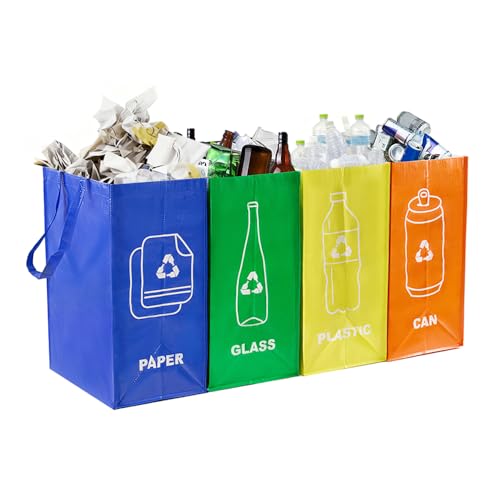

As an Amazon Associate we earn from qualifying purchases at no extra cost to you. Ratings are shown as listed on Amazon.
Best recycling bins by kitchen situation
| Kitchen situation | Most suitable layout | Useful capacity | What to prioritise | Typical market range |
|---|---|---|---|---|
| Small flat or narrow galley kitchen | Slim single compartment or 2-section vertical bin | 25–40 litres total | Footprint under 30 cm wide, removable divider, pedal or soft-close lid | About £35–£100 / $45–$130 |
| Two-person household with weekly collection | Dual compartment | 40–60 litres total | At least 20 litres for recycling, standard liner sizes | About £60–£180 / $75–$230 |
| Family producing packaging every day | Large dual compartment or separate bins | 60–90 litres total | Strong hinges, washable buckets, wide openings, high recycling ratio | About £90–£300 / $115–$380 |
| Frequent recycling collection | Open-top or divided sorter | 30–50 litres total | Fast access, easy lifting, no unnecessary electronic features | About £20–£90 / $25–$115 |
| Odour-sensitive kitchen | Sealed pedal bin with separate recycling section | 40–60 litres total | Close-fitting lid, removable gasket, smooth interior surfaces | About £80–£250 / $100–$320 |
How the main layouts compare
Dual-compartment bins
A dual-compartment bin combines general waste and recycling in one cabinet. It is usually the best recycling bin format when the two streams are emptied on a similar schedule. A practical arrangement is a 30-litre waste bucket beside a 20-litre recycling bucket, giving 50 litres overall without requiring two separate floor positions.
The compromise is reduced opening width. Each section may be too narrow for bulky cardboard, cereal boxes, or large plastic packaging. Check the internal shape rather than relying on the advertised total capacity: two tall buckets can hold more than two shallow ones, but their openings may be less convenient.
Separate recycling bins
Two independent bins offer the most flexible capacity. You can use a 40-litre recycling bin for packaging and a smaller waste bin, or add separate paper, glass, and metal containers if local collection rules require it. This arrangement is easier to replace or clean one bin at a time.
Its disadvantage is floor space. Measure the combined width, depth, and clearance needed to remove each liner. Two bins that fit side by side on paper may become awkward if a cupboard door or dishwasher opens into them.
Stackable and vertical sorters
Vertical units are useful where floor area is scarce. They typically provide two or three compartments, often between 10 and 25 litres each. Look for a stable base, a front-access door, and a way to remove the upper container without lifting the entire stack.
Small upper compartments fill quickly with lightweight packaging. They work best for households that empty recycling every few days, not for families waiting a week between collections.
Open-top recycling sorters
Open-top bins are the quickest to use and usually the easiest to clean. They suit dry paper, flattened boxes, cans, and bottles that are emptied frequently. They are a poor match for food residue, because there is no lid to contain smells or discourage pests.
Lid designs: convenience versus containment
- Open top: fastest access, lowest cost, and no hinge to fail; best for clean, dry recyclables.
- Lift lid: contains visual clutter and odour better, but requires a free hand.
- Pedal lid: allows hands-free use and is helpful while preparing food. A broad metal pedal and a controlled hinge generally outlast a light plastic mechanism.
- Soft-close lid: reduces noise and protects the hinge from repeated slamming. It adds moving parts, so inspect whether the lid can be removed for cleaning.
- Motion-sensor lid: convenient when hands are dirty, but batteries and sensors are additional ownership costs. It is less useful for recycling, since frequent openings can drain batteries without solving liner or capacity problems.
A lid is not a substitute for preparation. Rinse containers, drain bottles, and let wet items dry before placing them in a closed recycling section. Do not put food scraps into a recycling compartment simply because the lid seals; moisture contaminates paper and can create odours.
Capacity is about collection frequency, not household size
Estimate your required capacity from the amount of material produced between collection trips. As a starting calculation, suppose a household fills approximately 8 litres of recycling each day and collection is every seven days. The theoretical requirement is:
8 litres × 7 days = 56 litres.
Because packaging is irregularly shaped and should not be compressed in ways your local service prohibits, allow roughly 20% spare capacity:
56 litres × 1.2 = 67.2 litres.
That household needs about 65–70 litres of usable recycling capacity, or a smaller bin emptied midway through the week. If a dual-compartment bin advertises 60 litres total but allocates only 20 litres to recycling, it will not meet this routine even though the headline capacity sounds adequate.
When comparing models, ask whether the stated capacity is the internal usable volume or the external volume. Thick walls, a sloping base, and a large mechanism can reduce usable space by several litres.
Liner compatibility and odour control
Removable buckets make recycling bins easier to live with because liners can be tied and lifted without scraping the outer shell. Check the bucket rim dimensions before buying. A proprietary liner system may fit neatly, but it can increase ongoing costs and make replacements harder to find.
For a 20-litre recycling compartment, a correctly sized 20–30 litre bag is usually easier to secure than an oversized 50-litre bag. Excess material tends to fold into the compartment, reducing capacity and catching on the divider. For mixed dry recycling, a reusable washable liner or no liner at all may be practical, provided local hygiene requirements and household preferences allow it.
Odour control comes mainly from keeping moisture out. Activated-carbon filters can reduce smells inside a lidded waste compartment, but they are consumables rather than a permanent solution. Replaceable filters commonly last several months, depending on use. Avoid placing carbon filters in a recycling section that holds damp paper or unwashed containers; cleaning and drying are more effective.
Durability details that matter after purchase
- Hinges and pedals wear first: repeated force, overfilled buckets, and lids blocked by packaging shorten their life. Leave clearance above the lid and do not use the pedal to move the bin.
- Dividers collect residue: choose a divider that lifts out or has rounded, sealed edges. Fixed narrow channels are difficult to wash.
- Fingerprints are not the same as hygiene: stainless-steel exteriors can be attractive but still need regular wiping around the pedal and lid seam.
- Plastic buckets can crack when overloaded: lift them using the rim or handles, not by pulling a liner that is stuck to the base.
- Wheels improve manoeuvrability: they are valuable for large 70–90 litre units, but add bulk and can trap dirt. Locking wheels prevent the bin rolling while the pedal is used.
A practical buying checklist
- Measure the available width, depth, and height, including the lid’s opening arc.
- Calculate how many litres of recycling accumulate between collection trips.
- Confirm the recycling compartment’s capacity separately from the total capacity.
- Check whether your preferred liner size fits over the bucket rim without slipping.
- Choose an open top for clean, frequent recycling or a sealed lid for mixed kitchen use.
- Look for removable buckets, washable dividers, corrosion-resistant pedals, and replaceable filters if needed.
- Check local recycling rules before selecting compartments. Some services combine materials, while others require separate paper, glass, or food-waste containers.
Bottom line
Choose a 40–60 litre dual-compartment bin for the best balance of sorting and footprint in an average kitchen, but verify that at least half of the usable space is allocated to recycling if packaging is your larger stream. Choose separate bins when collection rules or household volume demand different capacities, and choose an open-top sorter when speed and low maintenance matter more than odour control. The best recycling bins are the ones whose real compartment capacity, liner fit, lid behaviour, and cleaning requirements match the way your kitchen actually handles waste.






Write Your Review
No reviews yet. Be the first to share your experience!