

Key takeaways
- Strengths: fast personal warmth, low noise, useful in tall or drafty spaces.
- Limitations: uneven room heating, hot front surfaces, and a need for generous clearance from combustibles.
- Look for: an oxygen-depletion sensor, tip-over shutoff, flame-failure protection, stable base, and an indoor-use listing where applicable.
The best propane garage heaters are matched to your garage’s size, insulation, ventilation, and heating speed: choose an indoor-rated radiant or blue-flame unit for occupied work areas, a vented wall or ceiling heater for regular use, and a forced-air construction heater only when you can provide substantial fresh air.
Our top picks

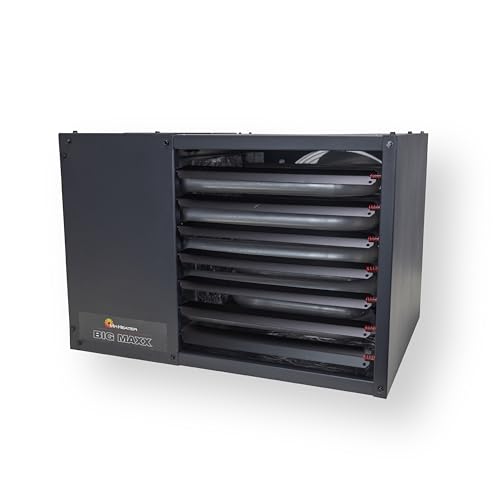


As an Amazon Associate we earn from qualifying purchases at no extra cost to you. Ratings are shown as listed on Amazon.
Quick picks by garage situation
| Garage situation | Best heater type | Typical output | Why it fits |
|---|---|---|---|
| Small, insulated one-car garage | Indoor-rated radiant or blue-flame heater | 10,000–20,000 BTU/h | Quiet, efficient-feeling warmth for a person or workbench |
| Two-car garage used several times a week | Vented wall or ceiling-mounted propane heater | 20,000–40,000 BTU/h | More suitable for longer sessions and permanent installation |
| Large, drafty, or poorly insulated garage | High-output forced-air propane heater | 30,000–125,000 BTU/h | Raises air temperature quickly, but requires careful ventilation |
| Occasional spot heating | Portable radiant propane heater | 4,000–18,000 BTU/h | Uses less fuel when aimed at one person or a small work area |
These are planning ranges rather than guarantees. A garage with an uninsulated metal door, leaky walls, or frequent door opening can need substantially more heat than a well-sealed space of the same floor area.
How much heat does your garage need?
A practical starting point is approximately 25–35 BTU per square foot for a reasonably insulated garage in a cold climate, 15–25 BTU per square foot for a mild climate or well-insulated room, and 35–50 BTU per square foot for a drafty or poorly insulated garage. These figures are intended for initial comparison, not a substitute for a heating-load calculation.
For example, a 20-by-20-foot garage contains 400 square feet. At 30 BTU per square foot, the estimated requirement is:
400 square feet × 30 BTU = 12,000 BTU/h.
A heater with a 10,000–20,000 BTU range may work in a reasonably tight garage, while a drafty space may need a larger unit or insulation improvements. Avoid buying solely by maximum BTU. A heater that is oversized for a small garage can create uncomfortable temperature swings and may cycle frequently if it has a thermostat.
Head-to-head: the main propane heater types
Radiant heaters
Radiant heaters warm people, tools, and nearby surfaces directly instead of heating all the air first. They are useful when you work at one bench or only occupy part of the garage. Portable infrared and catalytic-style heaters are often compact and relatively quiet.
- Strengths: fast personal warmth, low noise, useful in tall or drafty spaces.
- Limitations: uneven room heating, hot front surfaces, and a need for generous clearance from combustibles.
- Look for: an oxygen-depletion sensor, tip-over shutoff, flame-failure protection, stable base, and an indoor-use listing where applicable.
Blue-flame and other vent-free indoor-rated heaters
Blue-flame heaters warm the air primarily through convection and can heat a small enclosed room more evenly than a directional radiant model. Some include a thermostat and multiple heat settings. They are commonly available in roughly 10,000–30,000 BTU/h sizes.
“Vent-free” does not mean “no ventilation.” Propane combustion produces water vapor and combustion gases. Follow the manufacturer’s minimum ventilation requirements, keep a working carbon-monoxide alarm nearby, and never use the heater while sleeping or in a garage attached to living areas unless local rules and the installation instructions specifically allow it.
Vented wall or ceiling heaters
Vented propane heaters exhaust combustion products outdoors through an approved flue. They cost more to install, but are generally the better choice for a garage that is heated regularly, especially when the door is closed and people spend hours inside.
- Strengths: safer long-duration arrangement when correctly installed, fewer indoor combustion concerns, and often better thermostat control.
- Limitations: installation cost, required clearances, flue routing, and local permit or gas-code requirements.
- Best for: a dedicated workshop, home mechanic’s garage, or frequently used hobby space.
Forced-air construction heaters
These “torpedo” or “salamander” heaters move a large volume of hot air and can deliver 30,000–125,000 BTU/h or more. They are excellent for rapidly taking the chill out of a large open structure, but many are intended for temporary construction or agricultural use rather than a sealed, occupied garage.
They consume oxygen, produce combustion byproducts indoors, and can create strong airflow that stirs dust. Use one only with the required cross-ventilation and fuel setup. Do not assume that a carbon-monoxide alarm makes an unsuitable heater safe for an enclosed workspace.
Fuel use: a worked runtime estimate
One gallon of propane contains approximately 91,500 BTU. A standard 20-pound cylinder holds about 4.7 gallons when filled correctly, equivalent to roughly 430,000 BTU of fuel.
At a continuous 20,000 BTU/h setting:
430,000 BTU ÷ 20,000 BTU/h = about 21.5 hours of theoretical runtime.
Actual runtime is usually lower because heaters cycle, cylinders are not completely emptied, and cold conditions can reduce vaporization. At 40,000 BTU/h, the same cylinder provides about 10.75 hours theoretically. A portable heater with a low setting and thermostat may last longer in real use than a high-output unit running continuously.
For budgeting, compare local propane prices per gallon rather than judging fuel cost by cylinder size alone. A 20,000 BTU/h heater operating for four hours consumes about 0.87 gallons in the theoretical calculation: 80,000 ÷ 91,500. Multiply that volume by your delivered propane price to estimate one session’s fuel cost.
Safety features that matter most
- Oxygen-depletion sensor: important on applicable indoor-rated unvented heaters; it is not a substitute for ventilation.
- Flame-failure shutoff: stops gas flow if the flame goes out.
- Tip-over protection: essential for portable radiant models.
- Overheat protection: particularly valuable on forced-air and enclosed cabinet heaters.
- Thermostat: helps prevent overheating and reduces fuel use during longer sessions.
- Guarded heating element or burner: reduces accidental contact and helps keep materials away from the flame.
- Recognized safety certification: choose equipment approved for its stated use by a recognized testing organization.
Keep propane cylinders upright and outside the heated space whenever the instructions require it. Inspect hoses and regulators for cracking, abrasion, or damaged fittings. Never use a heater near gasoline, paint thinner, sawdust, oily rags, cardboard, or other easily ignited materials. Maintain the clearance distances printed on the heater; generic “it looks far enough away” judgment is not reliable.
Ventilation and installation checklist
- Read the entire manual and confirm that the model is approved for garage or indoor use.
- Measure the space and check the required minimum room volume and ventilation openings.
- Position the heater on a stable, noncombustible surface or install its supplied mounting hardware.
- Keep doors, windows, and vents arranged as the instructions specify; do not block combustion-air openings.
- Install a carbon-monoxide alarm according to its instructions, outside sleeping areas and near—but not directly beside—the heater.
- Use the correct regulator, hose, cylinder size, and gas pressure. Do not improvise adapters.
- Check connections with an approved leak-detection solution after connecting the cylinder; bubbles indicate a leak that must be corrected before operation.
- Stop immediately if you smell gas, see an unstable yellow flame, develop a headache or dizziness, or hear the alarm. Shut off the supply, leave the area, and contact qualified help or emergency services as appropriate.
Permanent gas piping, venting, and any conversion from one fuel type to another should be handled by a qualified professional and checked against local code. A garage can contain ignition sources from vehicles, batteries, solvents, and power tools, so installation details matter more than maximum output.
Durability and ownership realities
Dust is one of the most common causes of poor performance. Forced-air heaters can collect sawdust and debris around the fan, intake screen, and burner. Clean only as directed, with the unit cool and disconnected from fuel. Radiant burner screens can become discolored or clogged, while hoses and rubber seals age even when the heater is used infrequently.
Before each season, inspect the hose, regulator, cylinder connection, electrical cord if fitted, mounting hardware, and safety guards. Store portable heaters in a dry location protected from impacts. Do not paint burners, drill ventilation holes, bypass safety switches, or operate a heater with a damaged guard. If the unit repeatedly shuts down, produces soot, or has an unusual flame, discontinue use and arrange professional service.
Bottom line
For a small, occasionally used garage, the best propane garage heaters are usually an indoor-rated 10,000–20,000 BTU radiant or convection model with strong shutoff protections. For a regularly occupied workshop, a properly installed vented heater is the more durable long-term choice. For fast heating in a large, open, drafty structure, a forced-air model can work—but only with the ventilation and operating conditions specified by its manufacturer. Match the BTU range to the actual heat loss, then treat ventilation, clearance, and fuel connections as equally important buying criteria.






Write Your Review
No reviews yet. Be the first to share your experience!