

Key takeaways
- Look for mesh on at least two long sides and preferably all four sides.
- Check that the fabric is taut rather than sagging toward the interior.
- Reject models with loose threads, torn seams, exposed staples, or gaps at the frame.
- Do not hang blankets, bumpers, toys, or organizers over the mesh.
- Keep the playpen out of direct sunlight, since heat can build up inside even when the fabric is breathable.
The best baby playpens are the ones that fit your available floor area, have breathable mesh on every useful side, fold without forcing the frame, and use a lock that remains fully engaged after repeated setup and transport.
Our top picks


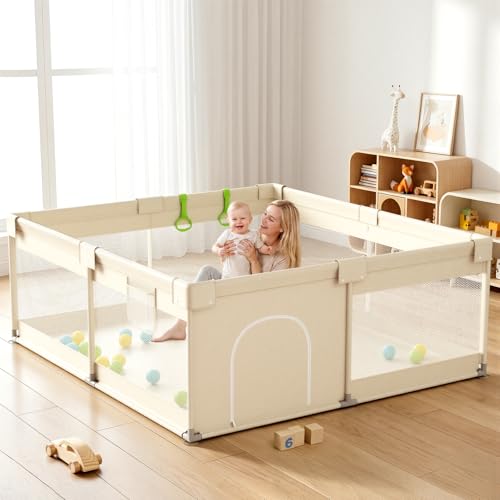
As an Amazon Associate we earn from qualifying purchases at no extra cost to you. Ratings are shown as listed on Amazon.
Best baby playpens by situation
| Situation | Best fit | What to prioritize | Main compromise |
|---|---|---|---|
| Small apartment or occasional overnight use | Compact travel play yard, such as BabyBjörn Travel Crib Light | Small folded footprint, low weight, quick locking frame | Less interior width and usually a higher price |
| Daily indoor play for one baby | Full-size square playpen, such as Joovy Room2 | Usable floor area, stable base, washable mesh | Heavier and harder to store |
| Lowest-cost occasional containment | Basic six-panel or rectangular mesh playpen | Firm floor, reliable panel connectors, replacement availability | Bulkier folding and less refined locking hardware |
| Frequent car or air travel | Lightweight travel crib or play yard | Carry weight under about 15 lb, compact carry bag, one-piece fold | Small sleeping or playing area |
Top choices for different homes
Best compact travel option: BabyBjörn Travel Crib Light
This is a strong choice when storage space and carrying weight matter more than maximum play area. Its approximately 41-by-32-inch interior is suitable for a baby or young toddler, while its roughly 13-pound weight is easier to carry than many full-size playpens. The mesh sides improve visibility and airflow, and the folding design is simpler than multi-panel systems.
For an apartment, measure the open footprint rather than the folded bag alone. A 41-by-32-inch play yard needs additional clearance for an adult to reach in, remove the mattress, and walk around it safely. Its limitation is capacity: it is not the right pick if two children need to play inside or if you want room for substantial toys.
Best spacious everyday option: Joovy Room2
The Joovy Room2 provides an approximately 39-by-39-inch play area, giving a baby more room to turn, sit, crawl, and play than a narrow travel crib. It is better suited to a dedicated living-room corner or nursery than to frequent public transport. At around 29 to 30 pounds before accessories, it is stable but not especially convenient for stairs or repeated car trips.
Choose this type when the playpen will be opened most days. The additional floor area can be more useful than a lower purchase price, but only if you can leave it assembled. Folding a large square playpen after every use quickly becomes an ownership nuisance.
Best budget category: rectangular or six-panel mesh playpen
Budget playpens can work well when their frame connectors lock positively and the base does not flex excessively. Common rectangular models measure about 48 by 26 inches, while modular six-panel designs often create a larger area of roughly 5 to 6 square feet, depending on the panel arrangement. They are worth considering for grandparents’ homes or occasional daytime use.
Inspect the hinges and corner joints before buying. Some inexpensive designs use several separate locking points, which creates more opportunities for a panel to be incompletely latched. A lower price is less attractive if replacement connectors, floor mats, or fitted sheets are unavailable.
Size: calculate the real space before choosing
Start with the usable interior dimensions, not the advertised outside dimensions. For example, a 39-by-39-inch playpen offers:
39 × 39 = 1,521 square inches, or about 10.6 square feet.
A 41-by-32-inch travel crib offers:
41 × 32 = 1,312 square inches, or about 9.1 square feet.
The difference is only about 1.5 square feet, but it can determine whether a baby can move around a few toys comfortably. Leave at least 18 to 24 inches of clear space around the accessible sides where possible. Keep the playpen away from heaters, blind cords, furniture that can be pulled against the mesh, and walkways where adults could trip.
Mesh breathability and visibility
Fine mesh should provide an unobstructed view of the child and allow air movement through multiple sides. Mesh is preferable to solid fabric walls for a playpen because it reduces visual blind spots and makes it easier to notice a child’s position. However, mesh is not a substitute for supervision or ventilation in a hot room.
- Look for mesh on at least two long sides and preferably all four sides.
- Check that the fabric is taut rather than sagging toward the interior.
- Reject models with loose threads, torn seams, exposed staples, or gaps at the frame.
- Do not hang blankets, bumpers, toys, or organizers over the mesh.
- Keep the playpen out of direct sunlight, since heat can build up inside even when the fabric is breathable.
Large mesh windows are useful in an apartment because they let a caregiver monitor the child from another part of the room. A solid or heavily padded wall may look cozy but can reduce visibility and airflow.
Foldability and lock durability
A good fold should be deliberate rather than effortless to the point of feeling loose. The frame should open fully, each rail should click or otherwise indicate that it is locked, and the base should remain level when light pressure is applied to the corners.
Test the lock sequence every time the playpen is opened:
- Open the long rails before pressing the center floor mechanism, if the instructions specify that order.
- Listen and feel for every rail to engage.
- Press down gently on each top rail and pull upward at each corner.
- Confirm that the floor is flat and that no hinge is partly folded.
- Keep the playpen folded only with the supplied straps or bag; do not improvise a tie that could become accessible to a child.
The first parts that commonly show wear are hinge covers, plastic corner joints, carry-bag zippers, and the fabric around repeated fold points. Sand, food crumbs, and dried spills can prevent a latch from moving completely. Never lubricate a child-accessible lock with an unapproved household product, and stop using the playpen if a rail no longer locks securely.
Safety features that matter more than accessories
Prioritize a stable frame, a firm fitted floor or mattress, smooth seams, and locks that cannot be released by a child inside. The base should sit flat without rocking. If the product is intended for sleep, use only the manufacturer’s supplied or approved mattress and fitted sheet; a soft or improvised mattress can create an unsafe gap or unstable surface.
Do not add pillows, quilts, stuffed animals, bumper pads, or extra padding to create a softer play space. Follow the manufacturer’s age, weight, and developmental limits, and stop using the product when the child can climb out or use the sides to pull up in a way the instructions prohibit.
Cleaning and ownership costs
For regular use, wipe plastic and metal parts with a mild, child-safe detergent and dry them completely. Mesh should be cleaned according to its care label; aggressive scrubbing can enlarge holes or weaken stitching. Let every part dry before folding, since trapped moisture can create odors and mildew.
Budget for a fitted sheet or washable play-yard cover only when it is specifically compatible with the model. A replacement sheet may cost roughly $15 to $40, while replacement mattresses, panels, or proprietary frame parts can cost considerably more—or may not be available. This is why warranty terms and spare-part support are important when comparing a cheap playpen with a better-known travel system.
Bottom line
Choose a lightweight travel crib for frequent transport and limited apartment storage, a roughly 39-by-39-inch square playpen for everyday indoor use, or a basic modular model when price matters most and use will be occasional. Whatever the style, the deciding checks are the same: measure the open footprint, inspect the mesh and seams, verify every lock after setup, and avoid any model that wobbles, sags, or has hard-to-source replacement parts.







Write Your Review
No reviews yet. Be the first to share your experience!