

Key takeaways
- Sensor reheat: useful for common leftovers because it estimates moisture release and adjusts the cycle.
- Sensor cook: convenient for foods such as vegetables, potatoes, and popcorn, though results still depend on portion size and container shape.
- Multiple power levels: important for defrosting, softening butter, warming delicate foods, and reducing edge overcooking.
- Keep warm: helpful when several dishes finish at different times, but it is not intended for indefinite food storage.
- Control lock: valuable in households with children or when cleaning the touch panel.
- Large-dish clearance: more important than a long feature list if you regularly use square casserole dishes or wide serving bowls.
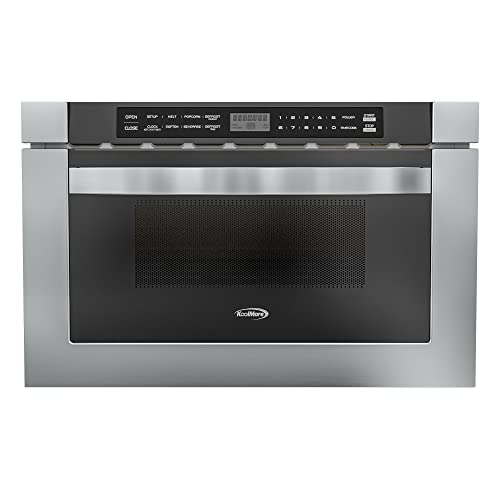
The best microwave drawers in 2026 are the Sharp SMD2440GS for most 24-inch kitchens, the Sharp SMD3070AS when you need a wider 30-inch opening, and the Bosch 800 Series HMD8453UC when matching a Bosch appliance suite matters most.
Microwave drawers are not simply countertop microwaves placed in a cabinet. They require a purpose-built opening, front ventilation, a correctly supported cabinet floor, and enough clearance for the drawer to extend without striking an island, handle, or adjacent appliance. Choose by the rough-in dimensions first; cooking power and capacity come second.
Our top picks


As an Amazon Associate we earn from qualifying purchases at no extra cost to you. Ratings are shown as listed on Amazon.
Best microwave drawers by situation
| Situation | Best fit | Why it makes sense | Typical market range |
|---|---|---|---|
| Standard 24-inch remodel | Sharp SMD2440GS | Compact exterior, 1.2 cu. ft. capacity, 1,000 W cooking power, strong feature set | $1,200–$1,700 |
| Large family or wide island | Sharp SMD3070AS | 30-inch format provides a broader drawer opening and easier access to large dishes | $1,500–$2,000 |
| Coordinated premium appliance suite | Bosch 800 Series HMD8453UC | 24-inch built-in design, 1.2 cu. ft. capacity, 950 W output, matching Bosch styling | $1,500–$2,100 |
| Lowest-cost built-in approach | 24-inch microwave drawer from a value brand | Usually offers 1.0–1.2 cu. ft. capacity and 1,000 W output, but with less polished controls and support | $900–$1,300 |
Prices are broad 2026 market ranges rather than fixed quotes. Installation, cabinet modification, trim, and electrical work can add several hundred dollars.
Head-to-head: Sharp SMD2440GS versus Bosch HMD8453UC
Both are 24-inch microwave drawers intended for under-counter or island installation. Their cooking capacity is similar, but the ownership decision is different.
Sharp SMD2440GS
The Sharp SMD2440GS is the practical all-rounder. It provides approximately 1.2 cubic feet of interior space and 1,000 watts of microwave power. Its drawer opens toward the user, which makes it easier to place a casserole or remove a hot bowl without reaching over a counter. The controls are positioned above the drawer, so they remain visible while standing in front of the appliance.
Sharp’s microwave-drawer interface typically includes sensor cooking, sensor reheating, keep-warm functionality, multiple power levels, a kitchen timer, and a control lock. Sensor programs are useful for ordinary reheating, but they do not eliminate the need to stir food or allow standing time. A microwave still heats unevenly, especially when food is densely packed.
Bosch 800 Series HMD8453UC
The Bosch HMD8453UC is a strong choice when the microwave must visually coordinate with Bosch wall ovens, cooktops, or dishwashers. Its published specifications include a 1.2-cubic-foot cavity and approximately 950 watts of cooking power. That is slightly less output than the Sharp, so a heating task may take a little longer at the same setting, although the difference is modest in everyday use.
The Bosch’s advantage is less about raw speed than design consistency and integration. Its touch controls and stainless-steel appearance suit a premium kitchen, while the drawer format keeps the appliance below the main work surface. If your cabinetry is already designed around Bosch cut sheets, staying within the same brand can reduce visual and installation surprises.
Which wins?
Choose the Sharp when cooking power, broad availability, and value are priorities. Choose the Bosch when coordinated appearance, dealer support, and an existing Bosch kitchen justify the extra cost. Neither should be selected solely by exterior width: both require the exact model installation manual because rough-in dimensions and clearances vary.
Installation dimensions matter more than the advertised width
A “24-inch microwave drawer” usually needs a cabinet opening close to 24 inches wide, but the appliance itself is narrower or wider than the nominal category. The required opening height is commonly around 14 to 16 inches, with a depth of roughly 23 to 24 inches before accounting for the electrical receptacle and cable bend. A 30-inch drawer needs a wider cabinet and a heavier, more generous support structure.
| Planning measurement | Common 24-inch drawer | Common 30-inch drawer | Why it matters |
|---|---|---|---|
| Nominal width | 24 inches | 30 inches | Determines the cabinet bay and trim position |
| Approximate opening height | 14–16 inches | 14–16 inches | Must match the manufacturer’s cutout range |
| Approximate appliance depth | 23–24 inches | 23–24 inches | Countertop depth may not be sufficient after the outlet is installed |
| Typical capacity | 1.0–1.2 cu. ft. | 1.2–1.3 cu. ft. | Determines dish size, not necessarily the outside width |
| Typical cooking output | 950–1,000 W | 950–1,000 W | Higher wattage usually shortens reheating time |
These are planning ranges, not substitute dimensions. Before ordering cabinets, download the installation guide for the exact model and verify width, height, depth, minimum side clearances, anti-tip requirements, electrical location, and support requirements.
Accessibility and control placement
A drawer microwave is often easier to load than an over-the-range model because the cavity slides toward you instead of requiring an overhead reach. That can be helpful for shorter users and for anyone who finds lifting a hot dish out of an elevated oven awkward. However, the drawer is low. A very low installation can require bending, and a child may be able to reach the controls or hot food.
Controls are generally located on the upper front panel, above or beside the drawer. This keeps them reachable with the drawer closed, but the display may be less visible from across the room than a countertop microwave. A control lock is useful in family kitchens, but it is not a substitute for supervision around hot containers.
Leave a clear path in front of the drawer. An island aisle that feels comfortable with cabinet doors closed may become obstructed when the drawer extends approximately 15 to 17 inches. Do not position it where an open dishwasher, oven door, or nearby drawer blocks access.
Venting, electrical, and cabinet requirements
Microwave drawers normally vent through the front or upper front area and do not replace a range hood. They are not designed to capture steam, smoke, grease, or cooking fumes from a cooktop. If the appliance is installed below a cooktop, provide the separate ventilation required by the cooktop and local code.
Most full-size microwave drawers use a dedicated, grounded 120-volt circuit. The exact amperage and receptacle specification vary, so an electrician should follow the installation manual rather than assume that a nearby outlet is acceptable. Avoid placing the receptacle directly behind the appliance where it prevents the unit from sitting fully into the cabinet.
The cabinet floor must support the appliance and its contents. A microwave drawer can weigh roughly 70 to 100 pounds before food is added, depending on width and model. Unsupported particleboard, an improvised shelf, or a cabinet base weakened by plumbing can lead to alignment problems and excessive stress on the drawer mechanism.
Cooking features worth paying for
- Sensor reheat: useful for common leftovers because it estimates moisture release and adjusts the cycle.
- Sensor cook: convenient for foods such as vegetables, potatoes, and popcorn, though results still depend on portion size and container shape.
- Multiple power levels: important for defrosting, softening butter, warming delicate foods, and reducing edge overcooking.
- Keep warm: helpful when several dishes finish at different times, but it is not intended for indefinite food storage.
- Control lock: valuable in households with children or when cleaning the touch panel.
- Large-dish clearance: more important than a long feature list if you regularly use square casserole dishes or wide serving bowls.
Do not assume that a microwave drawer has convection baking, broiling, or air-frying capability. Most are microwave-only appliances. If those functions matter, compare them with a combination wall oven or countertop appliance instead of paying for drawer installation and still needing another cooker.
Cleaning and durability: what wears first
The cooking cavity is usually stainless steel or painted metal, with a removable glass tray or ceramic base depending on the design. Wipe spills promptly with a soft cloth and mild detergent. For dried food, place a microwave-safe bowl of water inside and run a short heating cycle; the steam can loosen residue. Do not flood the drawer tracks, spray cleaner into openings, or use abrasive pads that dull the finish.
The drawer rollers, rails, seals, and control panel are the parts most exposed to long-term wear. Slamming the drawer, overloading it with a heavy casserole, or allowing crumbs to accumulate along the track can cause noise, uneven movement, or alignment problems. Keep the track area clear and close the drawer with light, even pressure.
Do not run the microwave empty, operate it with a damaged door seal, or use metal containers unless the manufacturer specifically permits the accessory. Cover foods that splatter, leave room for steam to escape, and wipe the underside of the drawer front where condensation can collect.
How to check whether a microwave drawer will fit
- Measure the cabinet opening width, height, and depth at several points, not just the front edge.
- Measure from the opening to the back wall and mark where the electrical receptacle will sit.
- Open the drawer fully on a paper template or with the manufacturer’s stated extension distance.
- Check interference with opposite cabinets, stools, dishwasher doors, and adjacent handles.
- Confirm the cabinet floor’s load rating and the required anti-tip hardware.
- Have the electrician and cabinet installer use the exact model’s instructions before the opening is finalized.
For example, if the drawer extends 16 inches and the opposite counter projects 24 inches into a 42-inch aisle, the remaining passage is only 2 inches while the drawer is open: 42 − 24 − 16 = 2 inches. That is an impractical layout even though the microwave technically fits its cabinet.
Bottom line
The Sharp SMD2440GS is the best general-purpose choice for a 24-inch installation, while the Sharp SMD3070AS is preferable when a wider opening and larger dish access justify the added cabinet space. The Bosch HMD8453UC is the better head-to-head choice for a coordinated Bosch kitchen. In every case, prioritize the exact cutout, front clearance, electrical plan, and cabinet support before comparing automatic programs or exterior finishes.





Write Your Review
No reviews yet. Be the first to share your experience!