

Key takeaways
- Compare dedicated nut milk makers with the blender and strain bag method for almond, oat, soy and cashew milk, covering cleanup, filtering and batch size.
- Top Pick: Almond Cow Nut Milk Maker Machine
- Runner-up: ChefWave Milkmade Soy Milk Maker, 6-in-1
- Also consider: MioMat 8in1 Plant Based Milk Maker
Making plant milk at home usually comes down to two routes. A dedicated nut milk maker blends, filters and, on heated models, cooks in one appliance, while the blender route relies on a countertop blender plus a strainer bag or fine sieve and a separate pan if the milk needs heating. Both can produce almond, oat, cashew and soy milk, but they differ in effort, cleanup and batch size.
This comparison looks at five dedicated machines, from a simple one-button cold maker to heated multi-program models, weighed against the blender-plus-straining method.
As an Amazon Associate, we earn from qualifying purchases.
Quick answer
Choose a dedicated nut milk maker if you want blending and filtering handled in one machine with less straining and simpler cleanup. Choose the blender route if you already own a good blender, make milk only occasionally, or want the largest possible batches. Heated programs matter most for soy and rice milk.
Almond Cow Nut Milk Maker Machine

The Almond Cow is the simplest design in this group. It makes 5 to 6 cups per batch, the largest single batch here, and its listing gives a capacity of 6 cups. All food-contact surfaces are stainless steel, and operation is one-button, with no straining needed because ingredients sit in a filter basket while the blade works.
Against the blender method, there is no separate bag to squeeze and no blender jar plus strainer plus bowl to wash. The trade-offs are that it is a single-purpose appliance, it runs on 120V, and it is hand wash only. The listing opened for this comparison did not state a heating or self-cleaning function, so treat it as a cold-milk machine for drinks that do not require cooking.
| Spec | Detail |
|---|---|
| Type | Dedicated nut milk maker |
| Batch size | Makes 5-6 cups |
| Capacity as listed | 6 cups |
| Food-contact surfaces | Stainless steel |
| Operation | One-button |
| Straining | No straining needed |
| Power | 120V |
| Care | Hand wash only |
Tribest SB-130 Soyabella Automatic Soy Milk and Nut Milk Maker
The Tribest Soyabella, model SB-130, is the long-running heated design in this comparison. Its carafe holds 1.3 liters, with a stainless steel carafe, screens and grinding blade and a BPA-free motor head. Programs control temperature and grinding time, and a hidden heating element handles the cooking side of the cycle.
That heating element separates it from a blender for soy milk. Raw nut and seed milks finish in under 1 minute with no heat, while heated soy, rice and bean milks, soups and porridges take about 15 minutes, all in the same vessel. A blender route means blending, straining, then simmering in a pan, with three items to wash instead of one carafe and screen set.
The built-in filter screen handles straining inside the machine, and the grinder also handles coffee beans, seeds and spices. Self-cleaning is not stated, so expect to rinse the screen and carafe yourself.
| Spec | Detail |
|---|---|
| Type | Automatic soy milk and nut milk maker |
| Model | SB-130 |
| Capacity | 1.3 L |
| Construction | Stainless steel carafe, screens and grinding blade; BPA-free motor head |
| Heating | Hidden heating element; programs control temperature and grinding time |
| Raw milk cycle | Under 1 minute, no heat |
| Heated cycle | About 15 minutes for soy, rice and bean milks, soups and porridges |
| Filtering | Built-in filter screen |
| Power | 120V |
ChefWave Milkmade Soy Milk Maker, 6-in-1
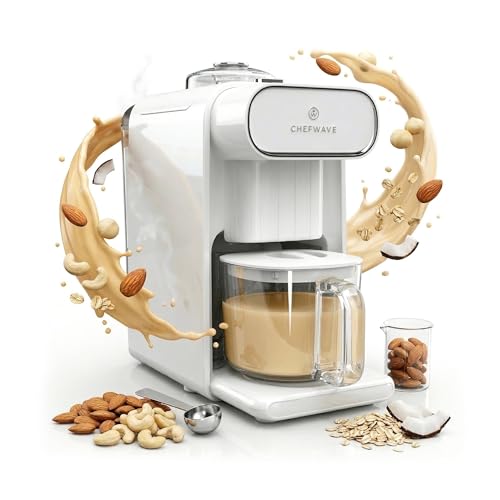
The ChefWave Milkmade takes the opposite approach to batch size. It makes 10 fl oz or 20 fl oz at a time, suiting single servings and small households rather than family-size batches. Six programs cover almond, soy, cashew, oat, macadamia and coconut, in hot or cold versions, each finishing in under 16 minutes.
Its heating element heats, blends and dispenses, so cooked soy milk needs no pan, and an auto-clean function reduces scrubbing. A delay start lets you load ingredients ahead, and the glass pitcher makes the finished amount easy to see. No soaking and no straining bags are required.
The limit is the small batch: if two or more people drink plant milk daily, you will run it often. Power is listed at 1000 watts, the highest draw in this group.
| Spec | Detail |
|---|---|
| Type | 6-in-1 plant-based milk machine |
| Batch sizes | 10 fl oz or 20 fl oz |
| Programs | Almond, soy, cashew, oat, macadamia, coconut |
| Cycle time | Under 16 minutes, hot or cold |
| Heating | Heating element heats, blends and dispenses |
| Cleaning | Auto-clean function |
| Extra feature | Delay start |
| Pitcher | Glass |
| Soaking or straining bags | Not required |
| Power | 1000 watts |
MioMat 8in1 Plant Based Milk Maker

The MioMat is an 8-in-1 machine covering plant milks such as almond, soy, oat and coconut, plus soups, porridges, smoothies and purées, all run automatically at the touch of a button with blending and heating cycles and a built-in grinder. Its stainless steel build and 750 watt rating put it in the heated, multi-use camp alongside the Soyabella and SoyaJoy G5.
One point needs care. The product title states 40 oz of plant milk, while the same listing’s Features and Specs section lists a bowl capacity of 1.3 liters. Those figures come from different parts of the listing and do not line up neatly, so check the current listing against the batch size you need.
Care is hand wash, and self-cleaning is not stated for this model on the US listing. A 2-year warranty is listed, and the model is described as the 8th Generation version.
| Spec | Detail |
|---|---|
| Type | 8-in-1 plant based milk maker |
| Capacity as listed | Title states 40 oz; Features and Specs lists bowl capacity of 1.3 liters |
| Functions | Plant milks, soups, porridges, smoothies, purées |
| Cycles | Automatic blending and heating cycles |
| Grinder | Built-in |
| Construction | Stainless steel |
| Power | 750 watts |
| Model | 8th Generation |
| Care | Hand wash |
| Warranty | 2-year |
SoyaJoy G5 8in1 Milk Maker

The SoyaJoy G5 is the largest heated option in this comparison. Its description gives 1.7 liters, while the manual describes a 1.6 L stainless cooking chamber, so treat the two figures as coming from different sources in the listing materials. Eight functions include Soaked Beans, Dry Beans, Raw Milk, Soup, Hot Cocoa and Re-heat, the broadest program list here.
Bottom heating cooks soy milk from soaked or dry beans inside the machine, the step the blender method handles least gracefully, since raw soy milk must be strained then simmered separately. The Raw Milk program covers unheated nut and oat milks, and self-cleaning is included.
For a household that rotates between soy milk, nut milk and hot drinks like cocoa, the G5 replaces several blender, bag and saucepan steps with one chamber. The trade-off is size: it takes more counter space than the compact ChefWave, and only earns it if the heated programs get regular use.
| Spec | Detail |
|---|---|
| Type | 8-in-1 milk maker |
| Capacity as listed | 1.7 liters per description; 1.6 L stainless cooking chamber per manual |
| Functions | 8, including Soaked Beans, Dry Beans, Raw Milk, Soup, Hot Cocoa, Re-heat |
| Heating | Bottom heating |
| Cleaning | Self-cleaning function |
| Chamber | Stainless steel cooking chamber |
How to choose
Start with the milk you actually drink. Raw almond, cashew and oat milks need only blending and filtering, so a cold machine like the Almond Cow or the raw program on a heated model both work. Soy and rice milks need cooking, pushing the choice toward the Soyabella, ChefWave, MioMat or SoyaJoy G5, unless you are happy simmering a strained batch on the stove.
Cleanup is the biggest day-to-day difference. The blender route leaves a jar, a lid, a strainer bag or sieve and often a pan, and pulp clings to mesh bags. Dedicated machines keep pulp in a basket, screen or chamber; models with auto-clean or self-cleaning, the ChefWave and the SoyaJoy G5, reduce that further, while hand-wash designs still need prompt rinsing.
Filtering differs too. A strainer bag lets you squeeze for a smoother or pulpier result to taste, but it is manual and messy. Built-in baskets and screens give a consistent result with no squeezing, though texture is fixed by the screen design.
Batch size and counter space pull in opposite directions. The Almond Cow makes 5 to 6 cups at once, the Soyabella holds 1.3 liters, and the ChefWave makes just 10 or 20 fl oz, while a large blender jar can out-batch all of them. A blender you already own costs no extra storage, whereas a dedicated maker earns its footprint only if plant milk is a weekly habit.
Who should skip
Skip a dedicated maker if you make plant milk only a few times a year, since a blender and a strainer bag cover that easily. Skip one if kitchen storage is already full.
Also skip small-batch models if your household drinks several cups a day, and skip cold-only designs if soy milk is your main goal, since uncooked soy milk needs a separate heating step.
FAQ
Does a nut milk maker taste better than the blender method?
The ingredients decide most of the flavor, since both routes start with the same nuts, oats or beans and water. Machines give a more consistent texture because the filtering is fixed, while the blender method lets you adjust thickness by how much you strain.
Can these machines make soy milk safely without a stove?
The heated models here, the Soyabella, ChefWave, MioMat and SoyaJoy G5, heat soy milk as part of the cycle, replacing the separate simmering step. Follow the program instructions for beans, and use a cold-only machine like the Almond Cow for milks that do not need cooking.
What happens to the pulp?
In a dedicated maker, pulp stays in the filter basket, screen or chamber and can be tipped out after the cycle, and many cooks stir it into baking or oatmeal. With the blender method, pulp collects in the strainer bag and is squeezed out by hand.
How long does homemade plant milk keep?
Fresh plant milk without preservatives keeps for a few days in a sealed container in the refrigerator, whichever method makes it. Smaller, frequent batches, like the ChefWave’s 10 or 20 fl oz cycles, suit households that prefer milk made fresh more often.
Final verdict
For most regular plant milk drinkers, a dedicated maker is the easier routine: the Almond Cow suits larger cold batches, the Tribest Soyabella and SoyaJoy G5 suit households that cook soy milk, the ChefWave Milkmade suits small, frequent servings, and the MioMat suits buyers who want soups and porridges from the same machine. The blender and strainer bag remain the sensible choice for occasional batches.
More from Amazon
Programs that pair well with the guide above. Offers and eligibility are set by Amazon and may change.
Set up recurring deliveries of everyday items on eligible products. Terms and savings are set by Amazon.
Explore Subscribe & SaveCollect the home and kitchen items you want in one registry that guests can shop from.
Create a wedding registryFree shipping on eligible items, Prime Video and more. Eligible new members can start with a free trial.
Start a Prime free trialAudiobooks and podcasts to listen to on the go. Eligible new members can start with a free trial.
Try Audible freeAs an Amazon Associate we earn from qualifying purchases.


Write Your Review
No reviews yet. Be the first to share your experience!