

Key takeaways
- Choose the Breville Bambino Plus when speed, small dimensions and approachable milk steaming matter most. Choose the Barista Express or Barista Pro when an integrated grinder is worth the counter-space trade-off. Choose the Gaggia Classic Evo Pro for an accessible 58 mm-style platform, and the…
Best Semi Automatic Espresso Machines
The best semi automatic espresso machines for most home users are a compact thermoblock model with a separate grinder, such as the Breville Bambino Plus, while experienced drinkers who want more control should consider a single-boiler machine with a standard 58 mm portafilter, such as the Gaggia Classic Evo Pro or Rancilio Silvia.
A semi automatic machine requires you to grind, dose, tamp, start and stop the shot, then steam milk separately. That extra work is the point: compared with a fully automatic machine, it gives you more control over flavor and texture. The right choice depends less on maximum pump pressure than on boiler design, grinder quality, workflow and available counter space.
Our top picks



As an Amazon Associate we earn from qualifying purchases at no extra cost to you. Ratings are shown as listed on Amazon.
Best choices by situation
| Situation | Best machine type | Example | Why it fits |
|---|---|---|---|
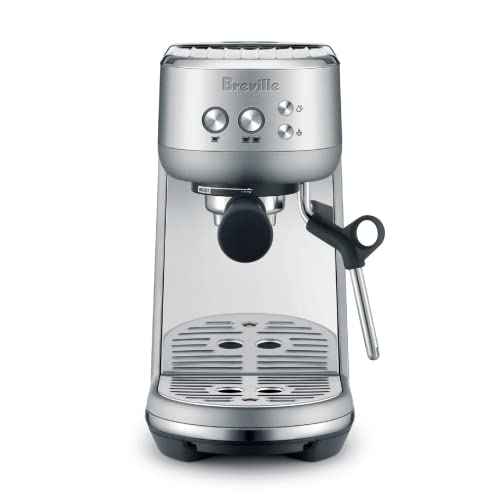
| Small kitchen or quick morning drinks | Thermoblock, 54 mm portafilter | Breville Bambino Plus | Very short heat-up, compact footprint and assisted milk steaming |
| Beginner wanting one appliance | Integrated grinder and thermocoil | Breville Barista Express | Includes a built-in conical burr grinder and familiar manual workflow |
| Frequent milk drinks for two people | Single boiler with strong steam capability | Rancilio Silvia | Durable traditional design and a full-size 58 mm portafilter |
| Learning espresso seriously | Single boiler, 58 mm commercial-style group | Gaggia Classic Evo Pro | Widely available accessories and a more standard-sized basket system |
| Maximum convenience with fresh coffee | Integrated grinder with programmable dosing | Breville Barista Pro | Faster interface and integrated grinding without moving to a fully automatic machine |
Boiler type determines the daily workflow
Thermoblock and thermocoil systems
Compact machines such as the Bambino Plus use rapid-heating systems rather than a large traditional boiler. They can be ready in roughly 3 seconds for brewing, although the portafilter and cup still benefit from warming. These machines are efficient for one or two drinks at a time and usually take less space than a conventional boiler machine.
The compromise is steam capacity. A small heating system may need a brief recovery between pulling a shot and steaming milk, and temperature stability can be more dependent on the machine’s electronic controls. This is usually a sensible trade-off for a single user who wants a cappuccino before work rather than a long series of drinks.
Single boilers
A single-boiler machine uses one boiler for both brewing and steam. It cannot brew and steam at the same time, so the sequence matters: pull the espresso, switch to steam mode, wait for the boiler to reach steam temperature, then texture the milk. Depending on the design, the changeover can take about 30 to 90 seconds.
Single boilers are often easier to repair and can offer a more traditional feel. The Gaggia Classic Evo Pro and Rancilio Silvia are typical examples. Their 58 mm or commercial-style components also make it easier to find replacement baskets, tampers and bottomless portafilters. They are less convenient when several people want milk drinks consecutively.
Heat-exchange and dual-boiler machines
Heat-exchange machines keep a steam boiler hot while brewing water passes through a separate path. Dual-boiler machines use separate boilers for brewing and steam. Both designs can brew and steam simultaneously, making them better for entertaining or preparing several milk drinks in succession.
They are also larger, heavier and more expensive. A heat-exchange or dual-boiler upgrade makes sense when workflow matters more than minimal counter space; it is not automatically the best choice for better espresso. A good grinder and properly adjusted dose usually produce a larger improvement than moving from a capable single boiler to a premium machine.
Portafilter size: 54 mm versus 58 mm
A 58 mm portafilter is the common commercial size. It gives you a broad puck, extensive accessory compatibility and more room to experiment with precision baskets. The Rancilio Silvia and Gaggia Classic line are attractive partly because accessories are easy to source.
A 54 mm portafilter, used by several Breville home machines, is not inherently inferior. It can make excellent espresso, but compatible baskets, tampers and dosing funnels must match the smaller diameter. Some 54 mm machines also use baskets with different depths, so do not assume that every 54 mm accessory will fit.
For a beginner, the practical question is whether you plan to buy specialist accessories and study extraction. If yes, 58 mm gives you a broader upgrade path. If you value compactness and speed, 54 mm is rarely a meaningful disadvantage.
Do not overlook the grinder
Espresso requires fine, consistent particles and small grind adjustments. A basic blade grinder is unsuitable because it produces an uneven mixture of dust and large pieces. Choose a dedicated espresso-capable burr grinder with stepless or very fine adjustment.
An integrated grinder saves counter space and simplifies the purchase. The Barista Express and Barista Pro are convenient examples, but an integrated grinder also creates a single point of failure: if it needs repair, both grinding and brewing convenience are affected. A separate grinder is easier to replace and lets you upgrade either component independently.
Budget for the grinder before choosing the machine. A modest espresso machine paired with a capable burr grinder is usually easier to tune than an expensive machine paired with an inconsistent grinder. If you use pre-ground coffee, select a machine with a pressurized basket, but expect less control than you would get from freshly ground coffee in a non-pressurized basket.
Steam control and milk-drink performance
There are two different kinds of “automatic” steaming. A manual steam wand gives you control over air intake and vortex formation, which is useful for smooth latte milk and learning pouring techniques. An assisted system, such as the temperature-sensing steam function on the Bambino Plus, reduces the learning curve and can stop near a selected temperature.
Manual steaming generally offers a higher skill ceiling. Assisted steaming is more repeatable for beginners, but the wand still needs wiping immediately after every use and purging for several seconds. Dried milk is one of the most common causes of blocked steam tips.
For frequent milk drinks, look for a machine with a strong dedicated steam system, adequate recovery and a wand with at least two or three holes. A small thermoblock is fine for occasional cappuccinos but may feel slow when making four or more drinks.
Warm-up time is not the whole story
| Machine class | Typical electronic heat-up | Practical ready time | Best use |
|---|---|---|---|
| Compact thermoblock | 3–10 seconds | 2–5 minutes if warming the portafilter and cup | One or two quick drinks |
| Single boiler | 5–15 minutes | 15–30 minutes for a thoroughly heated group and portafilter | Careful preparation and moderate use |
| Heat exchanger | 15–30 minutes | 20–35 minutes, depending on design | Repeated brewing and steaming |
| Dual boiler | 10–30 minutes | 15–30 minutes for stable brewing components | High-volume milk drinks and entertaining |
Manufacturers’ heat-up figures commonly describe when water can flow, not when every metal component has reached a stable operating temperature. Run a small amount of water through the group, lock in the portafilter while heating and pre-warm the cup if your machine has a longer startup period.
Counter-space requirements and fit
Measure more than the machine’s advertised width. Leave room for the portafilter handle, grinder, knock box and a container for rinsing. Also check overhead clearance: machines with a top-loading water tank may need to be pulled forward before refilling.
| Machine | Approximate footprint | Water tank | Approximate weight |
|---|---|---|---|
| Breville Bambino Plus | 19.5 × 32 cm | 1.9 L | About 5.5 kg |
| Breville Barista Express | 31.8 × 35.1 cm | 2.0 L | About 10 kg |
| Gaggia Classic Evo Pro | 23 × 38 cm | 2.1 L | About 8 kg |
| Rancilio Silvia | 29 × 34 cm | 2.0 L | About 14 kg |
Dimensions vary by market and revision, so confirm the current specification before ordering. The grinder can add another 13 to 20 cm of width, while a separate dosing cup and knock box may require a similar amount of usable workspace.
Ownership costs and maintenance realities
Espresso machines do not end their costs at the purchase price. Expect to replace water filters where supported, buy detergent for backflushing, and periodically replace group gaskets and shower screens. Grinder burrs eventually wear, especially with daily use. Steam-wand tips, silicone tubing and pump components are also service items rather than lifetime parts.
After every use, knock out the puck, rinse the basket and wipe and purge the wand. At the end of the day, rinse the group and empty the drip tray. Backflush with the manufacturer’s cleaning product at the recommended interval, descale according to water hardness and avoid delaying maintenance until flow becomes weak.
A common mistake is changing grind size, dose and tamp pressure simultaneously. Instead, keep the dose stable, adjust the grind first and weigh both the coffee dose and espresso output. For example, a 18 g dose yielding 36 g of espresso is a 1:2 brew ratio. If the shot runs much too quickly, use a finer grind; if it drips excessively slowly, use a coarser setting.
Bottom line
Choose the Breville Bambino Plus when speed, small dimensions and approachable milk steaming matter most. Choose the Barista Express or Barista Pro when an integrated grinder is worth the counter-space trade-off. Choose the Gaggia Classic Evo Pro for an accessible 58 mm-style platform, and the Rancilio Silvia when you prioritize robust traditional construction and manual steam control. Whichever machine you select, reserve enough budget and workspace for a proper burr grinder, because that decision will influence daily espresso quality more than the machine’s headline pressure rating.





Write Your Review
No reviews yet. Be the first to share your experience!