

Key takeaways
- An induction range does not heat the pot with flame or a glowing coil. It heats the pot itself.
An induction range does not heat the pot with flame or a glowing coil. It heats the pot itself, using a magnetic field that only works if the cookware base contains iron. That single fact turns a simple purchase into a compatibility question: a beautiful pot that fails the magnet test will sit cold on the glass while the burner flashes an error. Anyone shopping for the best pots for an induction range is really asking two things, in order. Will it work on this cooktop, and is it the right size and build for the food I cook most?
This guide is written for households that just switched to induction, renters who inherited one, and cooks replacing a worn-out stockpot that no longer sits flat. Every pot below was chosen because its listing explicitly names induction in the title, so there is no guesswork about whether it will heat. The five picks cover a mid-size pasta pot, a large soup pot, a giant batch-cooking pot, a three-pan saucepan set, and one small ceramic saucepan. Everything here is judged from the listed specs only, and the rest of the 2026 market is wide enough that you can use the criteria below to compare other options too.
Quick Picks
Our top picks


As an Amazon Associate we earn from qualifying purchases at no extra cost to you.
| Product | Best for | Key spec from the title |
|---|---|---|
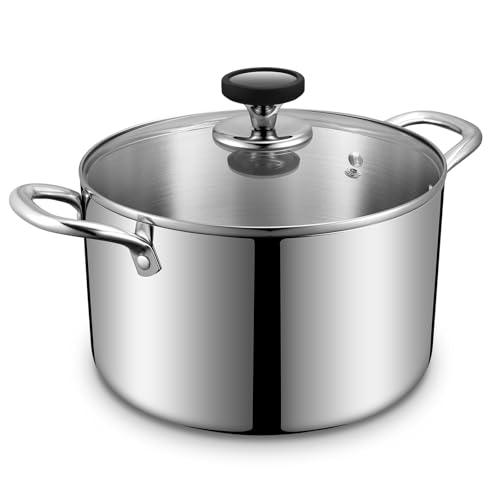
| Tri-Ply 6.5-Quart Stock Pot | Weeknight pasta and soup | 6.5 quart, tri-ply stainless steel, visible lid |
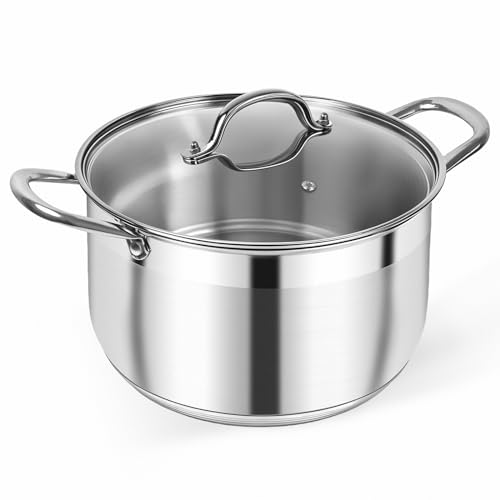
| Kirecoo 8-Quart Stock Pot | Family-size soups and spaghetti | 8 quart stainless steel, thick nonstick base |
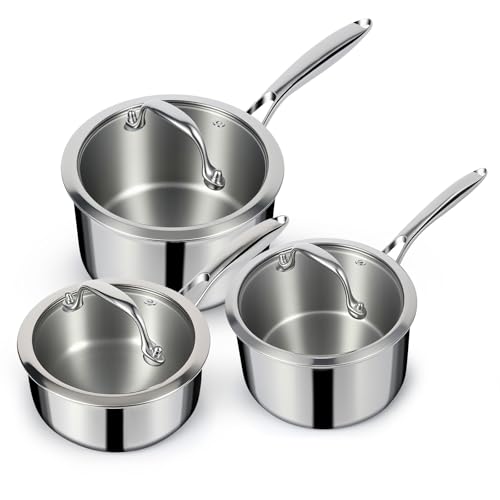
| EWFEN 3-Ply Sauce Pan Set | Everyday sauces, grains, reheating | 1, 2 and 3 quart pans with lids, stay-cool handle |
| VEVOR 21-Quart Stock Pot | Stock, canning-style batches, crowd cooking | 21 quart stainless steel, glass lid, PFOA-free and PFAS-free |
| LISOS 2.5-Quart Ceramic Saucepan | Milk, gravy, small soups | 2.5 quart ceramic nonstick, pour spout, lid |
How to Choose
Begin with the magnet and the base
Hold a refrigerator magnet to the bottom of any pot you are considering. If it grabs firmly, the pot will work on induction. If it only clings weakly, expect slow, uneven heating. Beyond that, the base should be flat; a base that rocks on a countertop will rock on a glass-ceramic surface and lose contact with the coil. As a rule of thumb, pick a base diameter within about an inch of the burner ring you plan to use. A small pot on a large ring wastes power, and an oversized pot on a small ring leaves a cold outer edge.
Match the capacity to what you actually cook
A 6-quart pot is enough for a pound of pasta with room for a rolling boil. Families that cook two pounds or double soup batches usually want 8 quarts. Anything past 12 quarts is a specialty tool for stock, large tamales, or party chili, and it is heavy once full. For sauces, rice, and reheating, a 1-quart to 3-quart saucepan is the workhorse size. Buyers who own only one big pot tend to use it for everything and burn sauces in it, so a small saucepan alongside it is a practical pairing. If your induction range has a bridge or flex zone, a wider, rectangular piece can use it, but most round pots simply need a burner that matches their base.
Understand the layers behind the labels
Terms like tri-ply and 3-ply describe a stack of metals, typically stainless steel on the outside with an aluminum core for heat spreading. That structure helps prevent hot spots on a cooktop that heats fast. A single thin layer of magnetic stainless can still work on induction, but it scorches food more readily. Ceramic nonstick pots add a slick interior over an aluminum body with a magnetic plate bonded to the bottom. The coating is convenient but is the part that wears first, so metal utensils are best left out of the drawer.
Check lids, handles, and where budget models cut corners
A glass lid lets you watch a boil without releasing steam, while a stay-cool handle protects your grip during a long simmer. Look at how the handles attach, since riveted handles tend to outlast thin welded ones on heavy pots. The usual corner cut at the low end is a thin base that warps after repeated heating and cooling, which creates a buzz and uneven browning on induction. Ignore marketing about the number of layers if the listing never states the base design. Also ignore vague claims such as “works on all stoves” unless induction is named, because the word all is often applied loosely to gas and electric coil only. Oven-safe ratings matter only if you plan to finish dishes in the oven.
The 5 Best Options
Tri-Ply 6.5-Quart Stock Pot
This pot suits cooks who want one dependable mid-size vessel for pasta, soup, and spaghetti without paying for oversized capacity. The title calls out tri-ply stainless steel construction, a heavy-duty build, and induction cooking, which covers the compatibility question directly. Cooks who like to keep an eye on a simmer without lifting the lid will appreciate the visible lid, and the double handle gives a secure two-hand grip when the pot is full of water.
- Strength: the 6.5-quart capacity fits a standard pound of pasta with room to boil.
- Strength: the visible lid and double handle make it easy to monitor and carry.
- Trade-off: the title does not name a brand or an oven-safe temperature, so confirm those details before relying on it for oven finishing.
Skip it if your household regularly cooks for more than six people or makes stock in bulk.
Kirecoo 8-Quart Stock Pot
The Kirecoo is aimed at families that want extra headroom for soup, pasta, and spaghetti. Its title lists stainless steel, a visible lid, even heat, and a thick nonstick base designed for induction use. It makes sense for households that cook soup in large batches for lunches during the week, or that boil spaghetti for several people at once and want the water to recover its boil quickly.
- Strength: 8 quarts leaves room for double batches and foaming pasta water.
- Strength: the heavy-duty, thick base is described as spreading heat evenly.
- Trade-off: a nonstick base means avoiding abrasive pads and metal tools on the bottom surface.
Skip it if cabinet space is tight, since deep pots of this size are awkward to store.
EWFEN 3-Ply Sauce Pan Set
This is the pick for people who spend more time simmering sauces, cooking grains, and reheating leftovers than boiling pasta. The set includes one-, two-, and three-quart pots with lids, and the title lists a 3-ply stainless build, a stay-cool handle, and induction, oven, and dishwasher compatibility. For a small apartment kitchen, this kind of set can replace three mismatched pans, and the lids help when you hold a sauce warm while the main dish finishes.
- Strength: three graduated sizes cover almost every small-batch task.
- Strength: the title states induction, oven, and dishwasher use, which offers flexibility.
- Trade-off: none of the pots is large enough for pasta for a crowd, so you will still want a stockpot.
Skip it if you already own a full cookware set with similar saucepans.
VEVOR 21-Quart Stock Pot
The VEVOR is a specialist for batch cooking: stock, large pots of chili, or cooking for gatherings. The title lists stainless steel, a glass lid, PFOA-free and PFAS-free construction, and compatibility with gas stoves and induction cooktops. Think of it as a seasonal or occasional tool for people who host holidays, run a church kitchen, or freeze stock in quantity, rather than a daily pot.
- Strength: 21 quarts is roughly triple the size of a typical family pot.
- Strength: it is labeled for both gas and induction, so it travels with you if you change stoves.
- Trade-off: a pot this large can overhang a single induction ring and heat unevenly across the base, and it is heavy to lift when full.
Skip it if you cook for one to four people and rarely make more than a few quarts at a time.
LISOS 2.5-Quart Ceramic Saucepan
Best for small jobs: warming milk, making gravy, or heating soup for one or two. The title mentions a ceramic nonstick interior, a pour spout, a lid, a curved handle, and an induction stove listing. The compact size suits a single person or a couple, and it pairs naturally with a larger stainless pot for the heavier work.
- Strength: the pour spout makes it easy to transfer sauces and milk without drips.
- Strength: the ceramic nonstick surface releases small-batch foods cleanly.
- Trade-off: coated pots generally last fewer years than bare stainless, and the listing offers no capacity beyond 2.5 quarts.
Skip it if you want one pot to do pasta, soup, and everything else.
Which One Fits Your Situation
You just switched from gas and want one pot to begin with
The Tri-Ply 6.5-Quart Stock Pot is the safest first pot. It handles pasta and soup, and a saucepan set can join it later once you learn which jobs your cooktop does best. Induction boils water quickly, so a mid-size pot like this often becomes the most-used piece in the kitchen.
You cook big family meals every weekend
Choose the Kirecoo 8-Quart Stock Pot for the extra capacity and the heavy base. It leaves comfortable room for double batches.
You mostly make sauces, rice, and reheated leftovers
The EWFEN 3-Ply Sauce Pan Set covers those jobs with three sizes and lids, and the induction, oven, and dishwasher listing keeps cleanup simple.
You make stock or cook for large gatherings
The VEVOR 21-Quart Stock Pot is built for volume. Pair it with the LISOS 2.5-Quart Ceramic Saucepan if you also want a gentle small pot for milk and gravy.
Common Mistakes
- Assuming that “all stoves” in a listing always includes induction; look for the word induction itself.
- Buying a pot with a rounded or warped base that rocks on the glass surface.
- Using a huge pot on a small burner ring and wondering why the edges stay cold.
- Skipping the magnet test on cookware that has no clear induction wording.
- Scrubbing nonstick or ceramic-coated bases with steel wool or metal tools.
Specs and Terms Explained
Quarts and what they hold
A quart is four cups. The LISOS 2.5-Quart Ceramic Saucepan suits rice, sauces, and leftovers. The Tri-Ply 6.5-Quart Stock Pot and the Kirecoo 8-Quart Stock Pot cover pasta, soup, and chili for a family. The VEVOR 21-Quart Stock Pot is a batch-cooking size, so confirm it fits on your burner and in your sink before you buy.
Tri-ply and 3-ply
Both refer to three bonded layers, which on induction cookware typically means a magnetic steel exterior with an aluminum core. The EWFEN 3-Ply Sauce Pan Set follows this approach. The core spreads heat; the outer steel is what the induction coil actually reacts to.
Ceramic on an induction range
A ceramic coating does not make a pot induction compatible. The coating sits on the cooking side, while the base underneath still needs magnetic metal. Check the base, not the coating, for the induction claim.
Which One Should You Buy?
| If you… | Choose… |
|---|---|
| Are new to induction and want one versatile pot | Tri-Ply 6.5-Quart Stock Pot |
| Cook for a large family on weekends | Kirecoo 8-Quart Stock Pot |
| Make sauces, rice, and reheats daily | EWFEN 3-Ply Sauce Pan Set |
| Need a very large pot for stock or gatherings | VEVOR 21-Quart Stock Pot |
| Want a small coated saucepan for light cooking | LISOS 2.5-Quart Ceramic Saucepan |
Setup and Care Tips
- Choose a burner ring close to the pot’s base size for the quickest heating.
- Fill large pots before placing them on the cooktop, then lift them off rather than dragging.
- Cover the pot when bringing water to a boil; induction is fast, and the lid saves further energy.
- Keep a large pot’s handles from overhanging the front edge of the range.
- Clean stainless with a non-abrasive cleaner and dry it to avoid water spots.
Who Should Skip These
- Cooks who only need one small pot for reheating; the 21-quart stock pot would be far too large.
- Anyone with a small sink or cabinet who cannot store or wash an oversized pot.
- Shoppers who expect a ceramic-coated saucepan to last as long as clad stainless; coatings wear sooner.
- Households that never cook for groups, where a smaller stock pot is easier to handle.
Sizing and Compatibility Checklist
- Hold a magnet to the pot bottom.
- Compare the capacity with the largest batch you cook.
- Check the handles for a firm, riveted or welded attachment.
One more point on fit: weigh the pot when full, not empty. A 21-quart pot of liquid is heavy enough to strain wrists and a lightweight cooktop, so make sure you can lift it safely and that your range is meant to carry that load.
Related guides
- Black Friday And Cyber Monday Kitchen Deals
- All Clad D3 Stainless Steel Cookware Set
- Cuisinart Air Fryer Toaster Oven Review
Frequently Asked Questions
Do all stainless steel pots work on induction?
No. Some stainless alloys are not magnetic enough to trigger the coil. Check the listing for induction wording, or hold a magnet to the base.
Why does my induction pot buzz?
A faint hum can come from layered metal vibrating in the magnetic field, especially at high power. Thin or warped bases tend to be louder, so lowering the heat setting often helps.
What size pot do I need for pasta?
Six quarts is typically enough for a pound of dried pasta. If you regularly cook for a crowd, look at 8 quarts so the water stays at a full boil when the pasta goes in.
Is a ceramic nonstick saucepan worth having alongside stainless?
For milk, gravy, and delicate sauces, a small coated pan reduces sticking and scrubbing. Keep it for gentle tasks and use stainless for high-heat searing and boiling.
Write Your Review
No reviews yet. Be the first to share your experience!