
Our Short List of 3
All 5 Picks at a Glance
| Product | Specs | Action |
|---|---|---|
 JAYVAR Onion Holder for Slicing | Check price on Amazon | |
 JAYVAR Extra-Large Onion Holder, 16 Long Needles | Check price on Amazon | |
 2 PCS Onion Holder for Slicing | Check price on Amazon | |
 304 Stainless Steel Onion Slicer Holder | Check price on Amazon | |
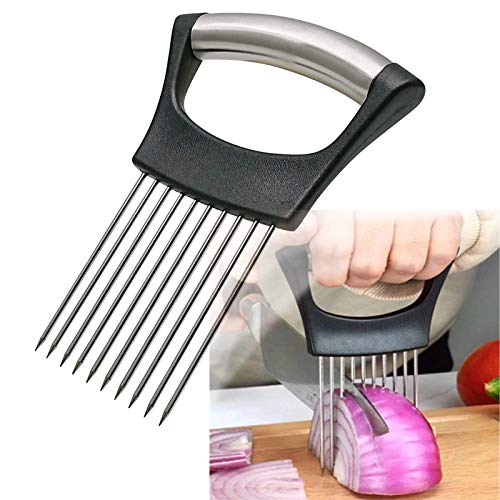 Stainless Steel Onion Holder for Slicing | Check price on Amazon |
Key takeaways
- Compare the best onion holders for slicing even rounds and dices, with stainless prongs, wide handles and covers that keep prep steady and fingers back.
Slicing an onion by hand sounds simple until the last third, when the bulb starts to roll, the layers separate, and the final slice is too thick, too thin, or ends up in the bin. A pronged onion holder solves that small problem: steel prongs pin the onion to the board, the handle keeps your fingers back from the blade path, and the knife passes between the prongs to produce even rounds or a neat dice.
The holders in this guide are all the same basic tool, a handle with stainless steel prongs, but they differ in the details that matter at the board: how many prongs they carry, how long those prongs are, how wide the handle feels in the hand, and whether you get one holder or a pair. Two picks come from the same JAYVAR family in different sizes, one is a two-piece set with a second job, one states its steel grade outright, and one is an unbranded stainless holder.
As an Amazon Associate, we earn from qualifying purchases.
Quick Answer
The JAYVAR Onion Holder for Slicing is the straightforward first choice: stainless steel prongs, a standard format that suits everyday onions, and a listing that covers everything from tomatoes to meat. The rest of the lineup adds an extra-large 16-needle JAYVAR, a two-piece set, a holder that states 304 steel, and a plain unbranded option.
JAYVAR Onion Holder for Slicing
This is the standard-format holder in the lineup, and for most kitchens it is the one to start with. The prongs are stainless steel, and the listing positions the tool well beyond onions: tomatoes, potatoes, avocados, eggs, lemons and meat are all named, which makes it a general slicing guide rather than a single-vegetable gadget. A second title variant on the same listing describes the holder as having 10 long needles, so treat the prong count as ten long stainless needles set into the handle.
In practice, ten prongs is the classic spacing for onion work. The gaps guide the knife into rounds of a fairly consistent thickness, and because the prongs run deep into the bulb, the holder keeps its grip right down to the last slice, the part that normally gets thrown away or cut dangerously thick. The stainless construction suits a tool that lives in a wet prep environment and goes through the wash after every use. If you slice onions a few times a week and want one holder that also steadies a tomato or a lemon, this is the balanced pick.
JAYVAR Extra-Large Onion Holder, 16 Long Needles
The second JAYVAR is a different tool, not a restyle of the first: it is an extra-large holder with 16 long needles, in stainless steel per the listing title. The extra size and the higher needle count change what the holder does well. Sixteen prongs spread across a wider head suit large onions, the kind that dwarf a standard holder and leave the outer rings unpinned, and the closer prong spacing supports thinner, more uniform slices.
This is the pick for cooks who buy big yellow or Spanish onions, prep in quantity, or slice onions for burgers and sandwiches where a wide, even round matters. The trade-off is storage and handling: an extra-large holder takes more drawer space and can feel like more tool than a small red onion needs. If your onions are usually medium-sized, the standard JAYVAR above is the easier everyday fit; if they are usually large, this one earns its place.
2 PCS Onion Holder for Slicing
This pick is sold as a two-piece set, and no brand name is attached to the listing, so judge it on the format rather than a label. Two holders in the box is genuinely useful: one can pin an onion while the other handles a tomato, or a second cook can work alongside you during a big prep session. The listing describes the set as a pronged holder for slicing onions, tomatoes, potatoes and lemons.
The listing also describes a meat tenderizer function, which makes this the multitasker of the group. That second role will not matter to everyone, and a dedicated single-purpose holder may feel cleaner if all you ever slice is onions, but for a small kitchen where every tool has to justify its drawer space, a set of two holders that also tenderizes is a practical combination. As with any unbranded listing, check the prongs are firmly set and evenly spaced when it arrives.
304 Stainless Steel Onion Slicer Holder
Most holders in this category say stainless steel. This listing goes one step further and states the grade in its title: 304 stainless steel, paired with an ergonomic handle. The grade matters because 304 is the food-grade stainless most commonly used in kitchen equipment, known for holding up well against the moisture and acidity that onion prep involves. If you read specifications closely before buying, this is the pick that gives you a concrete material claim to go on.
The ergonomic handle is the other half of the appeal. A holder is only useful while you can keep a firm, comfortable grip on it through a whole onion, and a shaped handle helps when hands are wet from rinsing layers. The listing positions the holder for onions, tomatoes, potatoes and other vegetables, so it covers the usual prep rotation. No brand name is attached to this listing either; the stated steel grade and handle design are the reasons to choose it.
Stainless Steel Onion Holder for Slicing
The last pick is the simplest entry in the group: an unbranded stainless steel pronged holder, positioned in its listing for vegetables and fruit. There is no needle count or steel grade stated to quote, and that plainness is the point. If you want to try the pronged-holder format without paying for extra size, extra pieces or stated grades, this is the low-commitment way in.
A basic holder still does the core job: the prongs pin the produce, the knife travels between them, and slices come out more even than freehand work, especially near the end of the onion. It also makes a sensible second holder for a household that already owns one and keeps reaching for another during shared cooking. Because the listing is unbranded, give the prongs a firm tug and check the spacing when it arrives, and confirm the handle feels secure in a wet hand before the first prep session.
How to Choose
Start with prong count and length, because they decide the slices you get. A standard holder with around ten long needles gives spacing that suits everyday onion rounds and general vegetable work. More needles, like the 16 on the extra-large JAYVAR, tighten the spacing for thinner slices and pin a wider area, which helps with large onions. Longer prongs hold grip deeper into the bulb, so the final slice stays steady instead of tipping away from the knife.
Handle width and grip come next. You hold this tool under light pressure for the whole cut, often with wet hands, so a handle that fills the palm and does not twist is worth more than a slim, elegant one. An ergonomic or shaped handle, like the one on the 304 steel pick, helps during longer prep sessions. If your hands are smaller, a standard-format holder may feel more controlled than an extra-large one.
Then decide between a single holder and a set. One holder is enough for a solo cook working through a single onion at a time. A two-piece set earns its keep when two people prep together, when you move between ingredients without washing up in between, or when a second function, such as the tenderizer role described on the two-piece listing, replaces another tool in the drawer.
Finally, look at the steel. Every pick here is stainless, which suits a tool that is constantly wet and acidic. Only one listing states a grade, 304, so if a named grade matters to you, that pick is the clear choice; the others ask you to accept a general stainless claim. Whichever you choose, remember the prongs are sharp: wash the holder carefully, dry it before storing, and keep it somewhere the prongs are covered or pointed safely away from reaching fingers.
Who Should Skip
Skip this category if you are already fast and accurate with a knife and a claw grip, and your onion slices come out even without help. A holder adds a washing and storage step to every prep session, and confident knife users find it slows them down rather than helping.
Also skip it if you rarely slice whole onions. If most of your onion use is a quick rough chop for soups and sauces, evenness does not matter and the holder will sit in the drawer. And if your problem is onion fumes and watery eyes rather than uneven slices or a rolling bulb, a holder does nothing for that; it is a slicing guide, not a fume solution. Finally, anyone expecting a holder to make knife work risk-free should skip the purchase and work on technique instead: a holder keeps fingers back from the blade path, but the knife and the prongs still demand attention.
FAQ
How does a pronged onion holder work?
Push the prongs down through the onion so the bulb is pinned between the holder and the board, then slice with the knife passing between the prongs. The prong spacing guides each cut, so rounds come out more even, and the holder keeps its grip on the last slice instead of letting it roll or collapse.
Can I use an onion holder for other foods?
Yes, within reason. The listings in this guide position their holders for foods such as tomatoes, potatoes, lemons, avocados and eggs, and the same pinning action helps with any firm produce that tends to roll or slip. Very hard vegetables need more force than the prongs are meant to take, so stay with produce a knife can enter easily.
Does an onion holder make slicing completely safe?
No. A holder keeps your fingers back from the blade path and steadies the onion, which removes the rolling and slipping behind many awkward cuts, but the knife can still cut, and no holder guarantees safety. The prongs themselves are sharp, so wash and store the holder carefully and keep a normal respect for the knife.
How do I clean and store an onion holder?
Rinse it straight after use so onion juice does not dry between the prongs, then wash it with care, keeping your fingers clear of the prong tips, and dry it fully before putting it away. Store it where the prongs are covered or lying flat and pointed away from where hands reach into the drawer.
Final Verdict
For most kitchens, the standard JAYVAR holder is the right first buy: stainless prongs, a proven format, and a listing that covers the full range of everyday slicing. Move up to the extra-large 16-needle JAYVAR if your onions run large or you prep in quantity. The two-piece set suits shared cooking and small drawers that reward double-duty tools, the 304 steel pick is the one for buyers who want a stated material grade and an ergonomic handle, and the plain unbranded holder is the inexpensive way to test the format. Whichever you pick, the gain is the same: even slices, a usable last round, and fingers kept back while the knife does its work.
Product and ASIN Reference
| Product | ASIN |
|---|---|
| JAYVAR Onion Holder for Slicing | B0C9ZGMN9D |
| JAYVAR Extra-Large Onion Holder, 16 Long Needles | B0FBVL74F5 |
| 2 PCS Onion Holder for Slicing | B0F4YTGRWL |
| 304 Stainless Steel Onion Slicer Holder | B0FFGNB7FR |
| Stainless Steel Onion Holder for Slicing | B08TWN43G4 |
More from Amazon
Programs that pair well with the guide above. Offers and eligibility are set by Amazon and may change.
Set up recurring deliveries of everyday items on eligible products. Terms and savings are set by Amazon.
Explore Subscribe & SaveCollect the home and kitchen items you want in one registry that guests can shop from.
Create a wedding registryFree shipping on eligible items, Prime Video and more. Eligible new members can start with a free trial.
Start a Prime free trialAudiobooks and podcasts to listen to on the go. Eligible new members can start with a free trial.
Try Audible freeAs an Amazon Associate we earn from qualifying purchases.




Write Your Review
No reviews yet. Be the first to share your experience!