

Key takeaways
- Compare five juicers for leafy greens, from a horizontal Omega to self-feeding Nama, Hurom and Kuvings models, with speed, chute and cleanup notes.
Leafy greens are the awkward load for a juicer. Kale, spinach, chard and wheatgrass are light, flat and fibrous, so they can slide past a fast spinning basket or pass through with much of their liquid still in the pulp. A slow auger machine handles that shape differently: it grabs the leaves, folds and crushes them against a screen, and then presses the mash in a second stage.
The five machines below are all single-auger slow juicers, split into two layouts. One is a horizontal model with an adjustable end cap and a long pressing chamber. The other four are vertical models that differ in feeding: a self-feeding hopper, a dual chute with an auto-cutting auger, a strainer-free chamber, and a classic vertical design with a mincer.
As an Amazon Associate, we earn from qualifying purchases.
Quick answer
For leafy greens, start with the layout. The horizontal Omega NC900HDC gives you an adjustable end cap and a long pressing path for kale and wheatgrass. If you want to load a whole recipe at once, the Nama J2 and Hurom H400 use self-feeding hoppers. The Kuvings REVO830 cuts long produce in its chute, and the Tribest Slowstar is the established vertical option.
Omega NC900HDC Juicer Extractor and Nutrition System

The NC900HDC is the only horizontal machine here, and that layout is the point for greens. Produce travels sideways through a long chamber while the auger crushes and presses it, and the adjustable end cap changes back pressure at the pulp outlet. The listing describes five settings on that cap and automatic pulp ejection, so you can keep feeding kale or chard without stopping to clear the outlet.
The same nozzle set is also listed for pasta, grinding and sorbet tasks, but for a greens buyer the core value is the pressing path and cap adjustment. The trade-offs are footprint and feeding: a horizontal body takes more counter depth than a vertical tower, and the smaller chute means large fruit needs cutting and leaves are best fed in small bunches, often followed by a firmer piece to push them through.
Specs
- Type: horizontal single-auger masticating juicer
- Auger speed: 80 RPM per listing
- Power: 150 watts, 120 volts
- Model: NC900HDC
- Item weight: 13 pounds per listing
- End cap: adjustable, five settings per listing
- Pulp handling: automatic pulp ejection
- Care: confirm on the listing
Nama J2 Cold Press Juicer

The Nama J2 changes the feeding job rather than the pressing job. Instead of pushing pieces into a chute one by one, you load the self-feeding hopper with a whole recipe and the machine feeds the chamber itself. For greens, a full bundle of spinach or kale can be loaded with the rest of the recipe instead of being fed leaf by leaf. The listing describes this as hands-free operation with a wide mouth hopper, and lists a single-speed model with a capacity of 30 fluid ounces.
Cleanup is listed as hand wash only. The J2 is a large, heavy option and its hopper needs vertical clearance, so measure under cabinets first. If your routine is a large greens batch several times a week and you dislike feeding a chute, this is the design built for that routine.
Specs
- Type: vertical single-auger cold press juicer with self-feeding hopper
- Power: 200 watts, 120 volts per listing
- Speeds: 1
- Capacity: 30 fluid ounces per listing
- Materials per listing: stainless steel and Tritan
- Model name: J2; item model number SJ200
- Care: hand wash only per listing
- Item weight: confirm on the listing
Kuvings Whole Slow Juicer REVO830

The REVO830 is a vertical machine built around two feed openings. The listing names an extra wide 88 millimeter chute and a second 48 millimeter chute, so whole or long produce can use one opening while smaller or leafy pieces use the other. An auto-cutting auger cuts produce as it enters, reducing the need to pre-cut long carrots, celery and leaf bundles. For greens, leaves can be rolled or bunched and fed steadily, while firmer produce in the same recipe helps keep the chamber moving.
The listing also names a smoothie and sorbet attachment. It is a full-size vertical unit, so height and weight are the main checks, along with how many parts you will rinse after a greens session, since fibrous pulp collects around the screen.
Specs
- Type: vertical whole slow juicer
- Feed chutes: 88 millimeter and 48 millimeter per listing
- Model: REVO830; item model number REVO830B for the matte black version
- Auger feature: auto-cutting mechanism per listing
- Attachments per listing: smoothie and sorbet attachment; confirm included strainers on the listing
- Power: confirm on the listing
- Color in this listing: matte black
- Care: confirm on the listing
Hurom H400 Easy Clean Slow Juicer

The H400 is another self-feeding design, but its distinguishing feature is the chamber. Instead of a fine mesh strainer that needs scrubbing to clear leaf fiber, it uses a strainer-free Easy Clean chamber built around a two-part auger, so the parts separate for rinsing. You load the wide mouth hopper, the machine feeds itself, and juice collects in a 550 milliliter chamber.
The listing gives a 150 watt motor and lists the auger comparison speed for this model at 90 RPM, with a single speed and button control. Materials are listed as ABS, Tritan and Ultem. Size is the caution: it is a tall tower, and listing dimensions and weights vary by color, so confirm both for the color you choose. Pick the H400 if easy rinsing after greens matters more than a fine mesh strainer, and accept that a strainer-free chamber can leave more fine pulp in the juice.
Specs
- Type: vertical self-feeding slow juicer, strainer-free chamber
- Power: 150 watts
- Chamber capacity: 550 milliliters per listing
- Auger speed: 90 RPM in the listing comparison table; confirm on the listing
- Speeds: 1; button control
- Materials per listing: ABS, Tritan and Ultem
- Model: H400; color in this listing: matte black
- Care, weight and dimensions: confirm on the listing
Tribest Slowstar SW-2000 Vertical Masticating Juicer
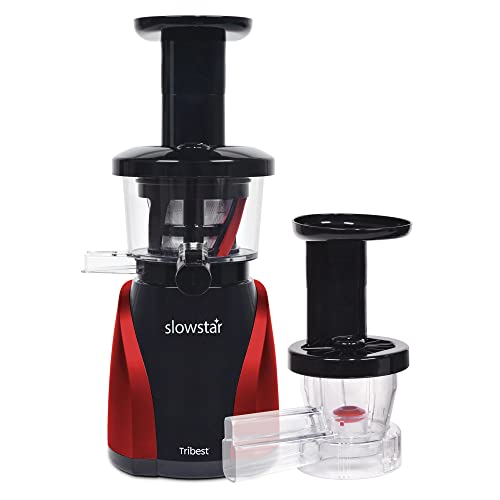
The Slowstar is the longest-running design here: a vertical single-auger machine that turns slowly and doubles as a mincer with the included attachment. Maker and retailer descriptions put the auger at 47 RPM with a 200 watt motor and a multi-stage reduction gear system, a low and steady pace for working through bunches of greens. The vertical body also keeps the footprint narrower than the horizontal Omega, and the mincer extends the machine beyond juice into mincing and homogenizing tasks, in the makers description.
For leafy produce the routine is traditional: feed leaves in small amounts, alternate with firmer produce, and use the pusher as needed. There is no self-feeding hopper, so prep takes more attention than on the models above. The listing here is the red version; confirm color and included parts on the listing you choose.
Specs
- Type: vertical single-auger masticating juicer with mincer
- Auger speed: 47 RPM per maker and retailer descriptions
- Power: 200 watts per maker and retailer descriptions
- Model: SW-2000; item model number SW-2000-B per listing
- Color in this listing: red
- Feed style: manual feeding with pusher; chute size confirm on the listing
- Care and item weight: confirm on the listing
How to choose
Start with the greens themselves. Loose, stringy leaves such as wheatgrass and spinach behave differently from stiff kale and chard. A horizontal machine with an adjustable end cap, like the Omega, lets you increase pressure for that fibrous load. Vertical machines rely more on bunching and rolling leaves and alternating them with firmer produce so the auger can grab the bundle. If your recipes are mostly leaves, layout and pressure control matter most; if leaves are one ingredient among carrots, celery and apples, chute size and feeding style matter more.
Next, decide how you want to feed the machine. Self-feeding hoppers on the Nama J2 and Hurom H400 suit large batches. The Kuvings REVO830 keeps manual feeding but cuts long produce in the chute, reducing prep. The Slowstar asks the most of the cook and gives the simplest part set in return. Then check cleanup: greens leave fiber in screens, so a strainer-free chamber or a screen you can rinse quickly will decide whether the machine gets used daily. Finally, measure height under cabinets, match chamber capacity to batch size, and confirm voltage, care and included strainers on the listing.
Who should skip
Skip this category if you only juice citrus. A dedicated citrus juicer or a simple reamer will be faster and easier to clean for that job, and slow auger machines are not built around halved citrus. Skip them, too, if you want juice in under a minute every morning and dislike prep or part washing; a high-speed centrifugal model, covered in a separate guide on this site, trades different compromises for raw speed.
Also skip a self-feeding hopper model if your counter has low cabinets or you store the juicer in a cupboard, since tall bodies are awkward to move. Skip the horizontal Omega if counter depth is tight, and skip premium vertical models if you juice greens only occasionally; a smaller, simpler machine will cover a weekly bunch of kale without the size and cleanup of a batch-oriented press.
Frequently Asked Questions
Why do leafy greens need a different juicer layout?
Leaves are flat and fibrous, so they can pass through a fast or wide mechanism without being fully crushed. Slow auger machines fold, grind and then press leaves against a screen or chamber wall, and horizontal models add an adjustable outlet that changes pressure.
Should I choose a horizontal or vertical juicer for greens?
Choose horizontal if greens and wheatgrass are the main load and you want end cap pressure adjustment, and accept the larger counter depth and smaller chute. Choose vertical if you also juice a lot of fruit and hard vegetables, want a narrower footprint, or prefer a self-feeding hopper or wide chute.
How should leafy greens be prepared before juicing?
Wash the leaves, shake off excess water, and cut very long stems only if your model listing calls for it. Roll or bunch leaves into a compact bundle so the auger can grab them, and alternate a bundle of greens with a firmer piece such as carrot, celery or apple.
How do I clean fiber from greens out of the juicer?
Disassemble the machine soon after juicing, before pulp dries. Rinse each part under running water, use the brush supplied with the machine for any mesh strainer, and check the pulp outlet and auger grooves where leaf fiber collects. Confirm care instructions on the listing, because they differ by model and by part.
Final verdict
For a greens-first kitchen, the Omega NC900HDC is the most direct pick: a horizontal pressing path and an adjustable end cap aimed at fibrous leaves and wheatgrass. For batch juicing with the least feeding work, choose between the Nama J2, with its whole-recipe hopper, and the Hurom H400, which trades the mesh strainer for a chamber that rinses more easily. The Kuvings REVO830 suits mixed recipes where long produce and prep time are the pain points, while the Tribest Slowstar is the steady vertical choice for cooks who prefer a traditional feeding routine and a mincer attachment.
Product and ASIN Reference
| Product | ASIN |
|---|---|
| Omega NC900HDC Juicer Extractor and Nutrition System | B00CIU92S6 |
| Nama J2 Cold Press Juicer | B0DSWVDS1W |
| Kuvings Whole Slow Juicer REVO830, Matte Black | B0BZRH41TH |
| Hurom H400 Easy Clean Slow Juicer, Matte Black | B0BN28HV73 |
| Tribest Slowstar SW-2000 Vertical Masticating Juicer, Red | B00DYIKXUC |
More from Amazon
Programs that pair well with the guide above. Offers and eligibility are set by Amazon and may change.
Set up recurring deliveries of everyday items on eligible products. Terms and savings are set by Amazon.
Explore Subscribe & SaveCollect the home and kitchen items you want in one registry that guests can shop from.
Create a wedding registryFree shipping on eligible items, Prime Video and more. Eligible new members can start with a free trial.
Start a Prime free trialAudiobooks and podcasts to listen to on the go. Eligible new members can start with a free trial.
Try Audible freeAs an Amazon Associate we earn from qualifying purchases.


Write Your Review
No reviews yet. Be the first to share your experience!