

Key takeaways
- Compare five Japanese chef knives for home cooking, from Shun and Global gyuto picks to Mac workhorses, with specs, care notes and buying FAQs.
Japanese chef knives take a different approach from the heavier Western blades most home cooks start with. The blades tend to be thinner, the steels harder, and the edges ground at a finer angle, which adds up to cleaner cuts through vegetables, herbs, fish, and boneless proteins. If your cooking leans on fresh produce and careful prep, that precision makes daily chopping feel lighter and more controlled.
This guide compares five Japanese chef knives across the two shapes that cover most home cooking: the gyuto, Japan’s answer to the Western chef’s knife, and the shorter, flatter santoku. The picks come from long-established Japanese makers and span one-piece stainless designs, layered Damascus blades, and plain, hard-working everyday knives, so you can match the knife to your grip, your board, and the way you like to cook.
As an Amazon Associate, we earn from qualifying purchases.
Quick Answer
For most home cooks, the Shun Classic 8-inch chef’s knife is the safest first Japanese knife: a VG-MAX core, a fine 16-degree edge, and a familiar Western-style length. Choose the Global G-2 if you want the lightest one-piece option, the Shun Classic santoku for vegetable-heavy prep, and either Mac knife for a plain, durable workhorse.
Shun Classic 8-Inch Chef’s Knife
The Shun Classic 8-inch is the gyuto most cooks picture when they think of a Japanese chef’s knife. Its cutting core is VG-MAX, a hard stainless steel wrapped in layers of Damascus cladding that give the blade its flowing, wood-grain pattern. The edge is hand-sharpened to 16 degrees on each side, finer than a typical Western knife, so it moves through onions, carrots, and chicken breast with very little wedging.
The D-shaped Pakkawood handle is shaped to sit in the palm and suits both right- and left-handed cooks according to the listing. At 8 inches, the blade is long enough for a whole cabbage or a small melon, yet the knife stays light and nimble compared with forged German knives of the same size. It is a good fit for cooks who want one main knife for nearly everything and are willing to hand wash it and keep it off bones and frozen food. Shun also lists free lifetime sharpening for its knives, which softens the upkeep question for first-time owners.
Specs
- Blade length: 8 inches
- Steel: VG-MAX core with Damascus stainless steel cladding
- Edge: 16 degrees per side, plain edge
- Handle: D-shaped Pakkawood
- Model: DM0706
- Origin: handcrafted in Japan
Global G-2 8-Inch Chef’s Knife
The Global G-2 takes the opposite route from layered tradition: blade and handle are a single seamless piece of CROMOVA 18 stainless steel, Global’s own molybdenum and vanadium alloy. There are no rivets, seams, or joints to trap food, and the hollow handle is filled to balance the blade, so a quick rinse and wipe is all the cleanup it asks for. The dimpled grip looks unusual, but it keeps the handle from feeling slippery.
This is one of the lightest full-size chef’s knives in this guide, and the thin, flat-ground blade suits a push-cutting style through vegetables, herbs, and fish. Cooks who rock-chop heavily or prefer a chunky handle to fill the hand may find it slim, and the all-metal grip can feel cold in winter. For smaller hands, fast prep, and anyone who wants a Japanese knife with almost no maintenance rituals beyond hand washing and regular honing, the G-2 is the easiest pick here to live with.
Specs
- Blade length: 8 inches
- Steel: CROMOVA 18 stainless steel
- Construction: one-piece stamped stainless, hollow weighted handle
- Handle: stainless steel with dimpled grip
- Model: G-2
- Listed item weight: 7.84 ounces
Shun Classic 7-Inch Hollow-Ground Santoku
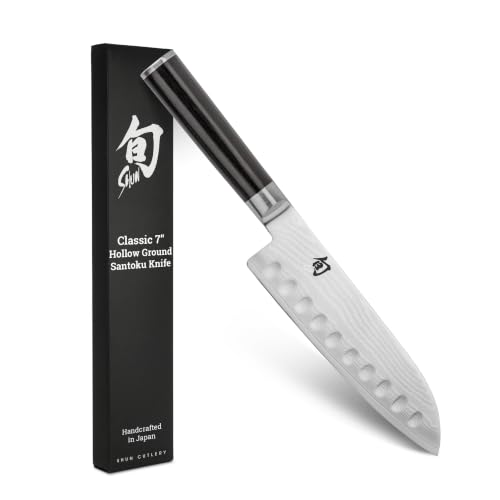
A santoku is shorter and flatter than a gyuto, with a blade profile made for up-and-down chopping rather than rocking. The Shun Classic santoku pairs that shape with the same VG-MAX core and 68-layer Damascus cladding as the Classic chef’s knife, plus a hollow-ground edge: a row of shallow indentations along the blade face that helps slices of potato, cucumber, and apple release instead of sticking.
At 7 inches, it is the natural pick for vegetable-forward cooking, smaller cutting boards, and cooks who find an 8-inch blade more than they need. The wide blade also works as a bench scraper for moving a pile of diced onion from board to pan. It shares the line’s D-shaped Pakkawood handle and 16-degree edge, and the same care rules apply: hand wash, dry promptly, and keep it away from bones, shells, and frozen ingredients. If most of your prep is produce with the occasional portion of fish or chicken, this shape may suit you better than a gyuto.
Specs
- Blade length: 7 inches
- Steel: VG-MAX core with Damascus stainless steel cladding
- Edge: hollow ground, 16 degrees per side
- Handle: D-shaped Pakkawood
- Model: DM0718
- Origin: handcrafted in Japan
Mac Knife Superior Chef’s Knife, 8-Inch
Mac knives, made in Seki, Japan, have a quiet following among working cooks because they focus on a thin, hard, sharp blade and skip the decoration. The Superior series chef’s knife follows that formula: an 8-inch blade in Mac’s high-carbon, stain-resistant alloy steel, ground thin so it slices rather than splits, with a simple wood handle and a rounded tip shape the maker describes as easy to use on the board.
There is no Damascus pattern and no bolster, which keeps the knife light and easy to sharpen along its full length. The listing notes a 25-year limited warranty, unusual at this level. This is the pick for cooks who chop a lot of vegetables and want a Japanese edge without paying for layered steel looks. The trade-off is presentation: it is a plain-looking tool, and like every knife here it is hand wash only, with whetstone sharpening recommended once the edge eventually dulls.
Specs
- Blade length: 8 inches
- Steel: high-carbon, stain-resistant alloy steel
- Handle: wood
- Construction: forged, per the listing
- Warranty: 25-year limited warranty, per the listing
- Weight: confirm on the listing
Mac Knife Chef Series Chef’s Knife, 7-1/4-Inch
The Mac Chef Series 7-1/4-inch is shaped like a scaled-down chef’s knife, and that smaller footprint is exactly its appeal. It handles the jobs a big gyuto feels clumsy at: slicing fruit, trimming vegetables, breaking down a chicken, and working on a small board in a crowded kitchen. Mac describes the series as having a razor-like edge that holds well because the steel is hard, and the Pakkawood handle keeps the familiar riveted Western shape.
For cooks with smaller hands, or anyone adding a second Japanese knife beside an 8-inch main blade, this size is easier to control for detail work. It is not the knife for a whole winter squash or a large melon, and it shares the family rules of hand washing and whetstone care. Think of it as the compact option in this guide: a genuine Japanese-made chef’s knife profile for tight spaces and lighter prep days.
Specs
- Blade length: 7.25 inches
- Steel: alloy steel
- Handle: Pakkawood
- Model: HB-70
- Listed item weight: 7.4 ounces
- Dishwasher safe: no, hand wash
How to Choose a Japanese Chef Knife
Start with the shape. A gyuto (the Shun Classic 8-inch, Global G-2, and both Mac knives here) has a curved belly and a pointed tip, so it rocks through herbs and handles both meat and vegetables. A santoku is flatter and shorter, built for push-cutting and up-and-down chopping, and it shines when most of the board is vegetables.
Next, look at the steel. Harder steels such as VG-MAX and VG-10 style cores hold a fine edge longer but ask for gentler handling, while Mac’s alloy steel and Global’s CROMOVA 18 trade a little edge life for toughness and easier sharpening. Handle style matters just as much: a D-shaped or Western Pakkawood handle feels familiar to most home cooks, while the Global’s one-piece metal handle is the easiest to keep clean.
Finally, be honest about care. Every knife in this guide is hand wash only and does best with a whetstone or the maker’s sharpening service rather than a pull-through sharpener. If that routine sounds fine, any pick here will serve you well; match the size to your board, with 8 inches as the all-purpose default and 7 inches or under for small kitchens.
Who Should Skip Japanese Chef Knives
Skip this category if your cooking regularly involves splitting bones, cutting frozen food, or prying lids: the hard, thin edges that make Japanese knives cut so cleanly can chip on that kind of work, and a softer Western knife is the safer tool. Also skip them if every utensil goes in the dishwasher, since heat, detergent, and rattling against other items are hard on fine edges and wood handles.
Cooks who simply prefer a heavy knife with a thick bolster and a pronounced rocking motion may also be happier staying with a German-style chef’s knife. And if you never want to think about sharpening at all, consider that these blades reward a whetstone habit; a knife that is never sharpened, Japanese or not, will disappoint.
FAQ
What is the difference between a gyuto and a santoku?
A gyuto is the Japanese version of a Western chef’s knife, usually 8 inches or longer, with a curved belly and pointed tip for rocking and slicing. A santoku is shorter, commonly around 7 inches, with a flatter edge and a rounded sheep’s-foot tip made for push-cutting vegetables, fish, and boneless meat.
Are Japanese chef knives hard to maintain?
The routine is simple but not optional: hand wash and dry after use, store the edge protected on a magnetic strip or in a guard, and sharpen on a whetstone when the edge dulls. The harder steels hold an edge longer than soft Western steel, so sharpening is less frequent, just more deliberate.
Can I put a Japanese chef knife in the dishwasher?
No. Every knife in this guide is listed as not dishwasher safe. Dishwasher heat and detergent can damage wood and Pakkawood handles, and the edge can chip when the blade knocks against racks and other utensils. A quick hand wash takes under a minute.
What size Japanese chef knife should a home cook start with?
An 8-inch gyuto is the standard starting point because it covers the widest range of ingredients and board sizes. If your kitchen is small, your hands are smaller, or most of your prep is vegetables, a 7-inch santoku or a shorter chef’s knife like the Mac Chef Series can feel more controlled.
Final Verdict
For a single do-everything Japanese chef knife, the Shun Classic 8-inch combines a hard VG-MAX edge, layered Damascus cladding, and a comfortable D-shaped handle in the size most cooks reach for daily. Pick the Global G-2 for the lightest, easiest-cleaning option, the Shun santoku if your board is mostly vegetables, and the two Mac knives if you value a plain, thin, hard-working blade over decoration. Whichever you choose, pair it with hand washing and a simple sharpening plan, and it will handle years of fresh, from-scratch cooking.
More from Amazon
Programs that pair well with the guide above. Offers and eligibility are set by Amazon and may change.
Set up recurring deliveries of everyday items on eligible products. Terms and savings are set by Amazon.
Explore Subscribe & SaveCollect the home and kitchen items you want in one registry that guests can shop from.
Create a wedding registryFree shipping on eligible items, Prime Video and more. Eligible new members can start with a free trial.
Start a Prime free trialAudiobooks and podcasts to listen to on the go. Eligible new members can start with a free trial.
Try Audible freeAs an Amazon Associate we earn from qualifying purchases.



Write Your Review
No reviews yet. Be the first to share your experience!