

Key takeaways
- Occasional hunter: Choose a two-person hub blind in the roughly $80–$180 market range. Prioritize a strong frame, quiet window closures, and a carry bag over extra seats or decorative features.
- Several hunts each season: A better-constructed three- or four-person blind, commonly about $150–$300, can justify its cost through stronger poles, reinforced hubs, and more dependable zippers.
- Frequent or stationary hunter: A heavy-duty enclosed ground blind or permanent box blind may cost roughly $300 to well above $2,000, depending on insulation, windows, flooring, and construction. Confirm permission and local rules before installation.
- Mobile public-land hunter: Keep the complete carry weight below about 20 pounds if you must walk more than a mile. A blind that stays in the truck is not portable in practice.
Best Hunting Blinds for Every Season
The best hunting blinds depend less on brand than on where and when you hunt: a lightweight hub blind suits short walk-ins, a weatherproof tower or box blind wins for long sits, and a compact ground blind is usually the most versatile choice for changing conditions.
Quick picks by hunting situation
| Hunting situation | Best blind type | Why it fits | Main compromise |
|---|---|---|---|
| Run-and-gun turkey hunting | Low-profile two-person hub blind | Fast setup, modest packed length, flexible shooting windows | Less room for standing shots or bulky gear |
| Archery deer hunting | Three- or four-person hub blind | Extra draw clearance and concealment for movement | Heavier to carry and easier to spot |
| Cold, wet late-season hunts | Insulated box blind or enclosed ground blind | Better wind protection, quieter interior, more stable shooting position | Slowest setup and least portable |
| Public land or long walk-ins | Two-person lightweight hub blind | Often 12–20 lb packed and manageable by one hunter | Thinner fabric and less protection from severe weather |
| Family or partner hunts | Four- or five-person hub blind | Room for two hunters, packs, and a camera or child | Large silhouette and longer setup time |
What separates the best hunting blinds
Setup time and packed size
Hub-style blinds are the practical all-season standard because their umbrella-like frames usually open in roughly 60–180 seconds once the location is prepared. A two-person model commonly packs to about 40–50 inches long and weighs 12–20 pounds. Three- and four-person versions often reach 18–30 pounds and may pack to 45–55 inches.
Our top picks


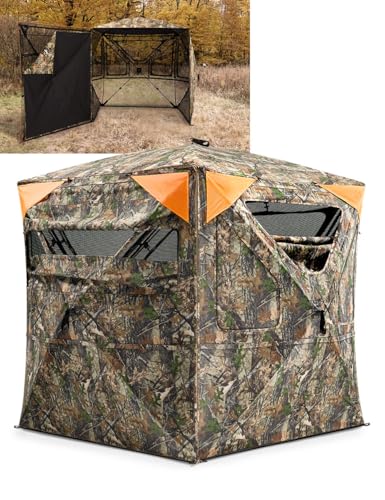
As an Amazon Associate we earn from qualifying purchases at no extra cost to you. Ratings are shown as listed on Amazon.
Spring steel turkey blinds can be even faster to deploy, but they generally offer less interior room and fewer shooting-window choices. Layout blinds pack relatively flat and disappear in crop fields, although they require more careful brushing-in and provide little sitting height. Permanent wooden or metal blinds can take hours or days to install and may require landowner approval, but they are the clear choice when the blind will remain in one place for an entire season.
Check both packed length and packed diameter before buying. A blind that weighs only 15 pounds may still be awkward if its carry bag is too long for your vehicle, kayak, or backpacking setup.
Shooting-window design
For rifle hunting, vertical zip windows with wide openings are useful because they allow a seated hunter to track an animal without exposing the entire blind. Bowhunters need more specific clearance: a window should permit a full draw without the upper limb or cam contacting the roof, sidewall, or window frame. A useful target is at least 40 inches of interior height above the seat and approximately 30 inches of side-to-side elbow room for each archer.
Silent magnetic or overlapping fabric closures are valuable for bowhunting and turkey hunting. Loud hook-and-loop fasteners can ruin a close encounter, particularly when the animal is already inside the effective shooting distance. Zippered windows provide more secure closure in wind and rain, while shoot-through mesh is convenient but can affect arrow flight and should be checked with the exact broadhead and bow setup.
For firearms, confirm that the window ledge can support a rest without forcing the barrel against fabric. Never fire through ordinary blind material unless the manufacturer specifically identifies the material as designed for that use.
Concealment and scent control
Dark interiors reduce the chance that movement will silhouette the hunter, but exterior pattern is only one part of concealment. Brush loops, removable skirts, and a roofline that breaks up the blind’s rectangular shape help more than an attractive camouflage print placed in an open field.
Set the blind several days before a planned hunt when regulations and land access allow it. This gives wildlife time to accept the new object and lets the fabric lose some manufacturing odor. Keep the blind away from bedding areas, avoid walking directly across likely travel routes, and position the entrance downwind or crosswind when possible. No blind eliminates scent, and wind direction remains more important than camouflage pattern.
Weather protection and seasonal comfort
Look for waterproof or water-resistant polyester, taped or reinforced seams, a roof with enough slope to shed rain, and a skirt that reaches the ground. A typical portable blind uses 300D to 600D polyester; heavier fabric usually resists abrasion better but increases packed weight.
For hot early-season hunts, large adjustable windows and roof vents matter more than insulation. A dark, sealed blind can become uncomfortably warm in direct sun. In late fall, a tightly enclosed blind with a solid roof and minimal gaps blocks wind more effectively. Insulated walls improve comfort but add bulk and do not replace appropriate clothing, ventilation, or safe heating practices.
Never use a fuel-burning heater in an enclosed blind unless the equipment and blind are specifically rated for that use and ventilation requirements are followed. Carbon monoxide can accumulate without obvious warning.
Head-to-head comparison of common blind types
| Blind type | Typical setup | Typical packed weight | Usable capacity | Best conditions |
|---|---|---|---|---|
| Spring steel turkey blind | 30–90 seconds | 3–8 lb | 1 hunter | Short sits, dense cover, mobile hunts |
| Two-person hub blind | 1–3 minutes | 12–20 lb | 1 comfortably; 2 closely | Public land, deer, turkey, moderate weather |
| Four-person hub blind | 2–5 minutes | 18–30 lb | 2 comfortably; 3–4 closely | Archery, rifle, partners, gear-heavy hunts |
| Layout blind | 5–15 minutes including brushing-in | 10–25 lb | 1 hunter | Waterfowl and open agricultural ground |
| Permanent box blind | Several hours to multiple days | 150–800+ lb | 1–6 hunters | Fixed stands, severe weather, repeated use |
These are useful planning ranges rather than guarantees. Frame thickness, insulation, chair requirements, windows, and included stakes can change the final weight substantially.
Choosing by budget and frequency of use
- Occasional hunter: Choose a two-person hub blind in the roughly $80–$180 market range. Prioritize a strong frame, quiet window closures, and a carry bag over extra seats or decorative features.
- Several hunts each season: A better-constructed three- or four-person blind, commonly about $150–$300, can justify its cost through stronger poles, reinforced hubs, and more dependable zippers.
- Frequent or stationary hunter: A heavy-duty enclosed ground blind or permanent box blind may cost roughly $300 to well above $2,000, depending on insulation, windows, flooring, and construction. Confirm permission and local rules before installation.
- Mobile public-land hunter: Keep the complete carry weight below about 20 pounds if you must walk more than a mile. A blind that stays in the truck is not portable in practice.
A simple cost-per-use calculation helps prevent overbuying. A $180 hub blind used for 12 hunts costs $15 per hunt before replacement parts. If a $300 heavy-duty blind is used for 30 hunts over three seasons, its equivalent is $10 per hunt. The better value is the one you can transport, set up, and dry reliably enough to keep using.
Setup and maintenance that extend blind life
- Choose level ground: Remove sharp sticks and stones before spreading the blind. Uneven ground puts twisting force on hub joints and can make doors fail to close.
- Stake every corner: Use all supplied stakes, then add guy lines in exposed locations. A lightweight blind can become airborne in a sudden gust.
- Orient the door thoughtfully: Face it away from the prevailing wind when possible, and keep the most-used shooting window toward the expected approach.
- Dry it completely: Never pack wet fabric for storage. Mold, mildew, odor, and weakened coatings can result from even a few damp days.
- Inspect stress points: Check hub joints, pole ends, zipper tracks, window seams, and stake loops after every season. These areas usually wear before the main fabric.
Clean fabric with cool water and mild unscented soap rather than bleach, solvents, or aggressive pressure washing. Lubricate stubborn zippers only with a product suitable for outdoor fabrics, and store the blind loosely in a dry, ventilated place. Replacement stakes, guy lines, hub parts, and window closures are normal ownership items; verify that the manufacturer sells them before choosing an obscure model.
Final verdict
For most hunters, the best hunting blind is a two- or three-person hub blind with a quiet window system, reinforced stress points, a waterproof roof, and a packed weight you can carry without help. Choose a low-profile spring blind when mobility and concealment outweigh comfort, a larger hub blind when bow clearance and seating matter, and a permanent or insulated box blind when repeated hunts and severe weather justify the installation effort. Before purchase, match the blind’s interior dimensions to your weapon, chair, clothing layers, and legal shooting requirements—not just its advertised person count.







Write Your Review
No reviews yet. Be the first to share your experience!