

Key takeaways
- The best honey strainers compared: stainless double sieves and reusable filter bags for 5-gallon buckets, with mesh sizes, bucket fit and cleanup notes.
Freshly extracted honey rarely goes straight into a jar. It carries wax flakes from the cappings, bits of propolis and the odd fragment of comb, and a honey strainer is the simple tool that takes all of that out before bottling. Most strainers made for honey are not kitchen sieves: they are wide, shallow bowls built to sit on top of a 5-gallon bucket, with two mesh screens stacked together so the coarse screen catches the big pieces and the fine screen below polishes what passes through. A smaller group skips the rigid bowl entirely and uses a cloth filter bag that stretches over the bucket rim and strains far finer, at a slower pace.
Disclosure: As an Amazon Associate, I earn from qualifying purchases.
This roundup compares five honey strainers sold for small-scale extraction: four stainless steel double sieves from beekeeping suppliers and one set of reusable filter bags, judged on mesh sizes, bucket fit, steel grade, capacity and cleanup.
How to Choose a Honey Strainer
Start with the format. A double sieve is two nesting screens in a rigid bowl. The top screen has a coarse mesh that stops wax chunks and large debris before they can clog the fine screen underneath, so honey keeps flowing instead of pooling on a blocked layer. The screens usually separate, which lets you run a coarse-only pass for chunky crush-and-strain batches or lift them apart for cleaning. A filter bag works differently: the cloth hangs inside the bucket and honey moves through it slowly. Bags filter much finer than any metal screen here, which suits a final polishing pass, but they clog quickly if raw, waxy honey goes straight in.
Read mesh sizes in microns. A micron figure tells you the size of the openings: smaller numbers catch smaller particles and strain more slowly. Coarse screens in this group run from 1000 to 1875 microns, fine screens from 500 to 710 microns, and the filter bags go down to 125 microns. For most small harvests, a coarse-over-fine pairing in those ranges leaves honey clear enough to bottle without stripping out pollen.
Check the bucket fit before anything else. Double sieves rest on extendable arms that slide out to span the bucket opening, so compare the arm reach with the diameter of your pail. The sieves here reach between 15.5 and 16 inches at full extension, covering a standard 5-gallon bucket with room to spare. Bags solve the same problem with an elastic band that grips the rim, but the bag needs the bucket’s full depth to hang into.
Mind the steel grade. Screens described as 304 stainless steel resist rust better than lower grades and are the safer pick for a tool washed after every use and stored in a shed or honey house. Whatever the grade, every maker here gives the same care instruction in some form: wash the strainer, dry it completely, and store it dry, because a damp screen is where rust starts.
Think about cleanup and volume. A strainer that separates into two screens rinses faster than a fixed stack, and warm water melts wax off mesh without scrubbing. Bowl depth matters too: a deeper basket holds more cappings during a long pour, so you stop less often to clear it.
1. VIVO Stainless Steel Double Sieve Honey Strainer (BEE-V101H)
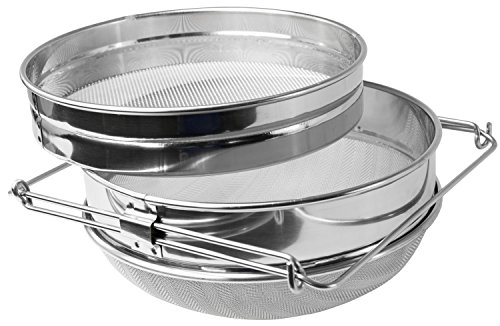
The VIVO BEE-V101H is the reference design for this category: two separate stainless screens in a bowl that sits across a bucket on adjustable arms. Its upper screen is rated at 1875 microns, coarse enough to stop cappings and comb fragments, and the lower screen at 650 microns takes out the finer wax dust that clouds a jar. The arms extend to 15.5 inches, so the same strainer spans a 5-gallon bucket or a wider uncapping tank, and the bowl is about 9 inches across and 4 inches deep. VIVO backs it with a one-year warranty, more cover than most listings in this group state.
Specs
- Model: BEE-V101H
- Design: Double sieve with two separate screens
- Mesh: 1875-micron upper screen, 650-micron lower screen
- Material: Stainless steel
- Bowl: About 9 inches across, 4 inches deep
- Arms: Adjustable, extend to 15.5 inches
- Fit: 5-gallon buckets and uncapping tanks
- Weight: 2.12 pounds
- Warranty: 1 year
Pros:
– Coarse-over-fine pairing handles a full extraction run in one pass
– Arms adjust widely enough for buckets and uncapping tanks
– Stated one-year warranty
Cons:
– Thick, cool honey moves slowly through the fine screen
– Must be dried fully before storage to protect the mesh
Who it suits: Beekeepers with a few hives who want the standard bucket-top setup from an established equipment brand.
2. Honey Keeper Double Sieve Honey Strainer

Honey Keeper builds its double sieve from 304 food-grade stainless steel, the grade that shrugs off rust best in a tool washed after every harvest. The screen pairing is a 1000-micron top over a 710-micron bottom, a slightly gentler spread than the VIVO: the top screen stops cappings and large wax, while the bottom screen finishes the honey without slowing the pour as much as a very fine mesh would. Extendable arms carry the bowl over a 5-gallon bucket, and at 1.7 pounds it is the lightest rigid sieve here, which matters when lifting a wax-loaded screen off a full bucket.
Specs
- Material: 304 food-grade stainless steel
- Design: Double sieve, two screens
- Mesh: 1000-micron top screen, 710-micron bottom screen
- Arms: Extendable, sized for 5-gallon buckets
- Package size: 10 x 10 x 4.5 inches
- Weight: 1.7 pounds
Pros:
– 304 stainless steel for the best rust resistance here
– Lightest double sieve in the group
– Balanced mesh pairing keeps honey moving
Cons:
– Fine screen is coarser than the VIVO’s, so very fine particles can pass
– No warranty term stated in the listing
Who it suits: Anyone who stores equipment in a damp shed or honey house and wants the steel grade that tolerates it best.
3. Goodland Bee Supply Double Sieve Honey Strainer

Goodland Bee Supply is a long-running beekeeping supplier, and its bucket-top strainer is built around a bigger basket: 10 inches across and 5 inches deep, the largest bowl here. That extra depth holds more cappings before the top screen needs clearing, which shortens a long pouring session. The mesh pairing is a 1000-micron top over a 500-micron bottom, the finest rigid finish here, in food-grade 304 stainless steel. The extendable arms reach up to 16 inches, the widest span in the group, so it sits securely on 5-gallon pails and broader containers.
Specs
- Material: Food-grade 304 stainless steel
- Basket: 10 inches across, 5 inches deep
- Mesh: 1000-micron top screen, 500-micron bottom screen
- Arms: Extendable up to 16 inches
- Fit: 5-gallon pails and wider containers
- Weight: About 2 pounds
Pros:
– Largest, deepest basket here for fewer stops to clear cappings
– Finest bottom screen of the rigid sieves
– 304 stainless steel with the widest arm reach
Cons:
– Bigger bowl takes more storage space
– Arms can feel unsteady if not seated squarely on the rim
Who it suits: Beekeepers running an extractor for several supers at a time who want capacity and a fine finish in one pass.
4. Mann Lake Stainless Steel Double Sieve Honey Strainer (HH440)

Mann Lake is one of the biggest names in beekeeping supplies, and the HH440 is its take on the bucket-top double sieve: two nesting stainless screens, a coarse screen over a fine one, on adjustable sliding arms. The arms let the strainer sit over a standard 5-gallon bucket or adjust to other containers. At under two pounds it is easy to lift on and off between pours. The design is deliberately plain: no coatings, no plastic parts in the screens, just stainless mesh.
Specs
- Model: HH440
- Material: Stainless steel
- Design: Double sieve, two nesting screens
- Screens: Coarse screen over a fine screen
- Arms: Adjustable sliding arms
- Fit: Standard 5-gallon buckets and other containers
- Weight: Under 2 pounds
Pros:
– From a major beekeeping supplier with a full equipment catalog
– Adjustable arms fit buckets and other containers
– Simple all-metal screen construction
Cons:
– Listing does not state micron figures for the screens
– Finish needs thorough drying after washing to stay rust-free
Who it suits: Beekeepers who already buy frames and hive parts from Mann Lake and want the matching strainer from the same supplier.
5. SPMKTQK Honey Strainer Filter Bags, 4 Pack

The SPMKTQK set replaces the rigid bowl with cloth: four reusable filter bags with a 125-micron mesh, far finer than any metal screen here. A heavy-duty elastic band stretches over the rim of a 5-gallon bucket and holds the bag open while honey drains through it. Because the mesh is so fine, these bags work best as a second stage after a coarse sieve has taken the cappings out, or for small batches where a slow, clear finish matters more than speed. The bags wash in warm water and are made to be dried, stored and reused. One caution from the listing itself: it describes the fabric as polyester in one place and nylon in another, so judge the bags on mesh size and fit.
Specs
- Format: Cloth filter bags, pack of 4
- Mesh: 125 microns
- Fit: Elastic band stretches over a 5-gallon bucket rim
- Use: Fine filtering and polishing passes
- Care: Wash in warm water, dry fully before storing
- Reusable: Yes
Pros:
– 125-micron mesh filters far finer than a metal screen
– Four bags let you swap a fresh bag in mid-batch
– No arms to adjust; the band grips the bucket rim
Cons:
– Listing describes the fabric inconsistently as polyester and nylon
– Strains slowly, especially with cool honey
– Clogs quickly without a coarse sieve pass first
Who it suits: Small-batch beekeepers who want a final polishing pass for especially clear honey, or a low-cost backup to a rigid sieve.
Comparison Table
| Product | Format | Mesh | Bucket fit | Material |
|---|---|---|---|---|
| VIVO BEE-V101H | Double sieve | 1875 / 650 micron | Arms to 15.5 in | Stainless steel |
| Honey Keeper Double Sieve | Double sieve | 1000 / 710 micron | Extendable arms | 304 stainless steel |
| Goodland Bee Supply Double Sieve | Double sieve | 1000 / 500 micron | Arms to 16 in | 304 stainless steel |
| Mann Lake HH440 | Double sieve | Coarse / fine screens | Adjustable arms | Stainless steel |
| SPMKTQK Filter Bags | Cloth bags, 4 pack | 125 micron | Elastic band on rim | Cloth (see listing) |
FAQ
What is the difference between a honey strainer and a honey filter?
Straining and filtering describe the same job at different fineness. A strainer, like the double sieves above, uses screens in the 500 to 1875 micron range to remove wax and debris while leaving pollen in the honey. Filtering usually means a much finer pass, like the 125-micron bags, which clears the honey further but takes longer.
Will these strainers fit a standard 5-gallon bucket?
Yes. The four double sieves rest on extendable arms that span a 5-gallon bucket opening, with maximum reaches between 15.5 and 16 inches, and the SPMKTQK bags stretch over the rim with an elastic band. Measuring your bucket’s opening first is still a good habit, since pails vary slightly.
How do you clean a honey strainer after a harvest?
Rinse the screens under warm water so the wax softens and lifts off the mesh, clear any cappings caught in the coarse screen, and wash with ordinary dish soap if needed. The important step is the last one: dry the strainer completely before storing it, because a screen put away damp is the one that rusts. Cloth bags should also be fully dry before they go back in a drawer.
Can one strainer handle both extractor runs and crush-and-strain batches?
Yes, with a small adjustment. For extractor runs, use both screens stacked so the coarse screen protects the fine one. For crush-and-strain batches, which carry far more wax, run the coarse screen alone first or empty it more often, then finish with the full stack or a filter bag.
Conclusion
For most small apiaries, a stainless double sieve is the whole straining setup: the VIVO BEE-V101H is the standard pattern with a stated warranty, the Honey Keeper pairs 304 steel with the lightest build, the Goodland Bee Supply strainer adds the biggest basket and the finest rigid screen, and the Mann Lake HH440 brings a major supplier’s catalog behind a plain design. Add the SPMKTQK bags when a batch deserves a slower, finer polish. Match the arm reach to your bucket, keep the screens dry between harvests, and any of these five will turn a cloudy pour into jar-ready honey.
More from Amazon
Programs that pair well with the guide above. Offers and eligibility are set by Amazon and may change.
Set up recurring deliveries of everyday items on eligible products. Terms and savings are set by Amazon.
Explore Subscribe & SaveCollect the home and kitchen items you want in one registry that guests can shop from.
Create a wedding registryFree shipping on eligible items, Prime Video and more. Eligible new members can start with a free trial.
Start a Prime free trialAudiobooks and podcasts to listen to on the go. Eligible new members can start with a free trial.
Try Audible freeAs an Amazon Associate we earn from qualifying purchases.

Write Your Review
No reviews yet. Be the first to share your experience!