

Key takeaways
- Gasket fit: Look for a continuous silicone ring that can be removed for cleaning. A twisted, stretched, or oily gasket is a common cause of vacuum loss.
- Valve construction: A one-way valve should not rattle loosely or rely on a permanently glued membrane that cannot be replaced.
- Rim quality: The sealing rim should be smooth and free of dents. Even a small dent can create a leak.
- Opening size: A wide mouth makes it easier to pour beans into a scale, scoop out the last few beans, and wipe away residue.
- Replacement parts: Confirm that the manufacturer sells or supports replacement gaskets, valves, or complete lids. These parts usually wear before the body.
- Cleaning instructions: Do not assume the lid is dishwasher-safe. Pumps and valves can trap water, detergent, or coffee oils.
- Storage footprint: Measure the shelf height and door clearance. Tall canisters can be inconvenient if the lid must be removed completely.
Best Vacuum Coffee Canisters for Fresh Beans
The best vacuum coffee canister for most home brewers is a manual-pump model with a stainless-steel body, a replaceable silicone seal, and enough capacity for your normal bag of beans—typically the Fellow Atmos in the 0.7-liter or 1.2-liter size.
However, “vacuum” does not automatically mean “best.” A canister must reduce air exchange without making daily dosing awkward, and it should protect beans from light, moisture, odors, and repeated handling. The right choice depends on whether you open the container once a day or several times, buy 8-ounce or 1-pound bags, and value maximum air removal over simple maintenance.
Our top picks



As an Amazon Associate we earn from qualifying purchases at no extra cost to you. Ratings are shown as listed on Amazon.
Quick comparison: the leading designs
| Canister or design | Typical capacity | Seal and valve design | Light protection | Best use |
|---|---|---|---|---|
| Fellow Atmos | 0.4, 0.7, or 1.2 L; roughly 4, 8, or 16 oz of whole beans | Twist-to-pump vacuum lid; silicone gasket and one-way valve | Strongest with the matte or stainless versions; clear versions need a dark cupboard | Frequent home brewing and buyers who want active air removal |
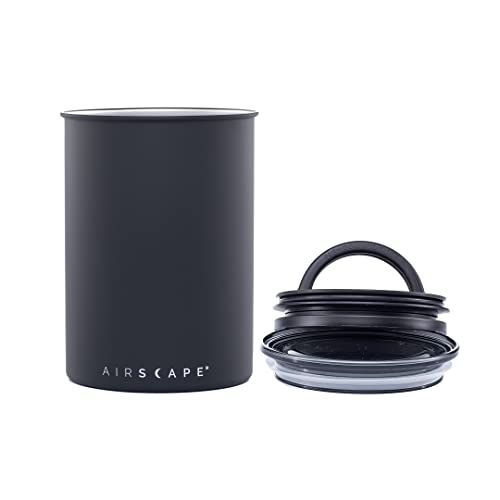
| Airscape Classic or ceramic | Common sizes include about 1.0 L and 1.9 L; capacity varies with bean density | Patented inner lid pushes air away rather than creating a deep vacuum | Metal and ceramic bodies block light well | Simple daily access, larger bags, and low-maintenance storage |
| Generic manual vacuum canister | Usually 0.7–1.8 L | Push-button or twist pump, silicone gasket, and small check valve | Opaque plastic, stainless steel, or tinted glass depending on model | Budget buyers who verify seal and replacement-part support first |
| Vacuum storage jar with electric pump | Often 0.8–1.5 L | Motorized lid with rechargeable battery and one-way valve | Varies; opaque bodies are preferable | Users who want push-button operation and do not mind charging |
The bean capacities in the table are estimates, not fill lines. A dense, dark-roasted bean may occupy less space than a large, light-roasted bean. Leave enough headspace for the lid mechanism and avoid compressing beans against the seal.
Best picks by situation
| Your situation | Best fit | Why |
|---|---|---|
| You use 30–60 g per day and finish a bag within two weeks | 0.7 L manual vacuum canister | Good balance of headspace, footprint, and easy daily dosing |
| You buy 1-pound bags and want one container | 1.2 L vacuum canister or large Airscape | Reduces overflow and avoids splitting one bag across several jars |
| You open the container many times each day | Airscape-style inner-lid design | Quick access without repeatedly pumping a vacuum |
| You have a bright countertop | Opaque stainless steel or ceramic | Blocks light more reliably than clear glass or clear plastic |
| You want the lowest ownership cost | Manual vacuum model with available gasket and valve parts | No batteries, charging cable, or motor to replace |
| You frequently change coffees | Wide-mouth canister with a removable seal | Easier to empty, wipe, and inspect for retained oils and aromas |
Head-to-head: Fellow Atmos versus Airscape
Seal strength and valve behavior
The Fellow Atmos actively removes air when you twist the lid back and forth. Its one-way valve is designed to hold the reduced-pressure state until the lid is opened. This gives it the stronger vacuum-oriented design of the two, although the result depends on a clean gasket, a smooth rim, and a container that is not overfilled.
Airscape uses a movable inner lid. Pressing it down pushes much of the air above the beans out through the valve in that lid. It is better described as an air-displacement system than a deep vacuum. That is not necessarily a disadvantage: the mechanism is quick, quiet, and less dependent on repeated pumping.
Dose access
Atmos is convenient for occasional access, but every opening releases the vacuum and requires repumping. That takes only a few seconds, yet it becomes noticeable if you weigh several doses throughout the day. Airscape’s lid can be lifted and replaced quickly, making it the more practical choice for a busy brew bar or shared household.
Capacity and counter space
Choose capacity by the amount you consume between purchases, not by the advertised volume alone. A 0.7-liter container is usually suitable for an 8-ounce bag of whole beans. A 1.2-liter model is a safer choice for a 1-pound bag, especially with large light-roasted beans. If you normally buy 12 ounces, measure the actual bag volume before choosing; a full container leaves little room for an inner lid or vacuum mechanism.
Materials and light blocking
Opaque stainless steel and ceramic are preferable when the canister will sit in sunlight. Clear glass can be attractive and makes the fill level visible, but it should live in a cupboard. Dark plastic blocks more light than clear plastic, though plastic may retain aroma if it is washed poorly or used for strongly flavored coffees.
What to check before buying
- Gasket fit: Look for a continuous silicone ring that can be removed for cleaning. A twisted, stretched, or oily gasket is a common cause of vacuum loss.
- Valve construction: A one-way valve should not rattle loosely or rely on a permanently glued membrane that cannot be replaced.
- Rim quality: The sealing rim should be smooth and free of dents. Even a small dent can create a leak.
- Opening size: A wide mouth makes it easier to pour beans into a scale, scoop out the last few beans, and wipe away residue.
- Replacement parts: Confirm that the manufacturer sells or supports replacement gaskets, valves, or complete lids. These parts usually wear before the body.
- Cleaning instructions: Do not assume the lid is dishwasher-safe. Pumps and valves can trap water, detergent, or coffee oils.
- Storage footprint: Measure the shelf height and door clearance. Tall canisters can be inconvenient if the lid must be removed completely.
A simple sizing calculation
Suppose you brew two 18-gram doses each day and buy a 340-gram bag. At 36 grams per day, the bag lasts about 9.4 days. A container holding the entire bag is convenient, but it exposes all the remaining beans to repeated opening over that period.
If you prefer to reduce exposure, divide the bag into two airtight containers holding about 170 grams each. Open one container for roughly five days and keep the second closed until needed. This approach may preserve freshness more effectively than buying one oversized canister, particularly when you drink coffee slowly.
Ownership realities: what wears first
The body of a quality canister can last for years. The gasket, valve membrane, and pump interface face more stress. Coffee oils can make the seal slippery, while fine chaff can settle around the valve and prevent it from closing completely. A lid that once held pressure for several days may eventually lose it within hours.
Clean the body with a soft cloth and mild dish soap, then dry it completely. Remove the gasket if the design permits, rinse away oils, and let every part air-dry before reassembly. Do not store beans in a damp canister, and do not use abrasive pads on stainless steel or plastic sealing surfaces.
Common mistakes include filling beyond the manufacturer’s line, leaving the lid partially engaged, pumping a dirty valve, and storing a clear canister beside a sunny window. Another mistake is treating a vacuum as permanent preservation: beans still age, and a canister cannot reverse staling or compensate for poor roasting, excessive heat, or moisture.
Bottom line
Choose the Fellow Atmos if active vacuuming, strong light protection, and a compact daily container matter most. Choose an Airscape if rapid access, large-bag storage, and simpler operation matter more than achieving a deep vacuum. For either design, buy the smallest size that comfortably holds your normal purchase, select an opaque body for countertop storage, and prioritize replacement seals over extra features. The best vacuum coffee canisters are the ones that seal consistently and fit the way you actually measure and drink your beans.








Write Your Review
No reviews yet. Be the first to share your experience!