

Key takeaways
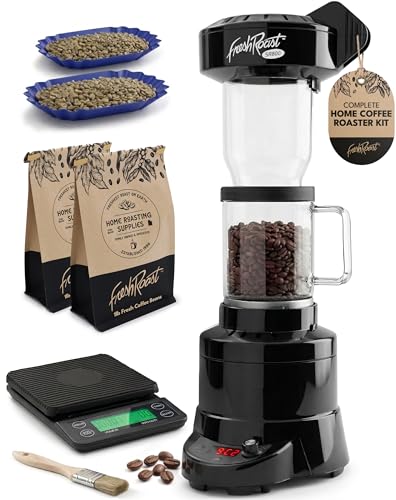
- Best for most beginners: Fresh Roast SR800. Its visible bean movement, quick response to adjustments, and straightforward cleaning make it easier to learn roast stages.
- Best for one-pound batches: Behmor 2000AB Plus. It is more practical when several people drink coffee or when you want to roast less frequently.
- Best for manual drum-roasting control: Gene Cafe CBR-101. The glass roasting chamber lets you observe color changes and listen for roast development, although it requires more active attention.
- Best for repeatable small batches: Kaffelogic Nano 7. Its small capacity is a limitation, but profile-based operation is appealing when consistency matters more than volume.
- Best for app-based control and larger capacity: Sandbox Smart R2. It suits users who want to save and adjust profiles rather than operate every roast entirely by feel.
The best home coffee roaster for most people is a fluid-bed roaster such as the Fresh Roast SR800, while the Behmor 2000AB Plus is the better choice for larger batches and lower operating noise; experienced users who want repeatable profiles should consider the Gene Cafe CBR-101, Kaffelogic Nano 7, or a connected drum roaster.
Choosing among the best home coffee roasters is less about maximum temperature than about matching batch size, control, smoke handling, and ventilation to your kitchen. A compact roaster may produce excellent coffee but still be frustrating if it cools slowly, scatters chaff, or fills the room with smoke.
Our top picks



As an Amazon Associate we earn from qualifying purchases at no extra cost to you. Ratings are shown as listed on Amazon.
Best home coffee roasters at a glance
| Roaster | Rated batch capacity | Roaster type | Profile control | Cooling and chaff | Ventilation expectation |
|---|---|---|---|---|---|
| Fresh Roast SR800 | Up to 226 g / 8 oz | Fluid-bed | Manual fan and heat adjustment; optional extension tube improves control | Fast cooling; chaff collector is easy to remove | Strongly recommended near an open window or outdoor-rated exhaust |
| Gene Cafe CBR-101 | Up to 250 g | Rotating glass drum | Manual temperature and time adjustment | Moderate cooling; chaff collects in a separate section | Required in a well-ventilated area; smoke increases at darker roasts |
| Behmor 2000AB Plus | Up to 454 g / 1 lb | Drum | Preset programs plus manual time and power adjustments | Slower cooling than small fluid-bed machines; chaff tray included | Use under a range hood that vents outdoors or near substantial ventilation |
| Kaffelogic Nano 7 | About 100 g | Small fluid-bed | Detailed profile selection and computer-assisted control | Very rapid cooling; dedicated chaff collection | Ventilation is still necessary, especially beyond light roasts |
| Sandbox Smart R2 | Up to about 550 g | Connected drum | App-based profile creation and monitoring | Integrated chaff collection; cooling takes longer than on small air roasters | Best in a garage, utility room, or kitchen with effective exhaust |
Capacities are manufacturer-rated maximums, not always the most convenient working sizes. Smaller batches generally move more predictably through the roast, while filling a machine to its limit can reduce bean movement and make development less even.
Our picks by situation
- Best for most beginners: Fresh Roast SR800. Its visible bean movement, quick response to adjustments, and straightforward cleaning make it easier to learn roast stages.
- Best for one-pound batches: Behmor 2000AB Plus. It is more practical when several people drink coffee or when you want to roast less frequently.
- Best for manual drum-roasting control: Gene Cafe CBR-101. The glass roasting chamber lets you observe color changes and listen for roast development, although it requires more active attention.
- Best for repeatable small batches: Kaffelogic Nano 7. Its small capacity is a limitation, but profile-based operation is appealing when consistency matters more than volume.
- Best for app-based control and larger capacity: Sandbox Smart R2. It suits users who want to save and adjust profiles rather than operate every roast entirely by feel.
Capacity: calculate the batch size you actually need
Green coffee loses approximately 14% to 20% of its weight during roasting, depending on roast level and bean characteristics. A 226 g green-coffee batch therefore yields roughly 181 to 194 g roasted coffee. At a 16 g dose, that is about 11 to 12 cups.
For example, someone brewing two 16 g cups each day needs around 224 g of roasted coffee per week. An SR800-sized batch may cover most of that demand, but a 100 g roaster would require several cycles. A one-pound drum roaster can produce enough for roughly two weeks in one session, but the longer roast and cooling cycle may be less convenient in a small kitchen.
Do not confuse the hopper or drum capacity with the amount you should roast. If beans barely circulate in a fluid-bed machine, or tumble sluggishly in a drum, reduce the load. A slightly smaller batch often gives better heat transfer and more even color.
Roast-profile control: manual versus programmed
Manual air roasters
Fluid-bed models heat beans with moving hot air. They respond quickly when you change fan speed or heat, which is useful for learning how drying, the first crack, and development affect flavor. The trade-off is that the operator must watch the roast. Fan speed can also influence bean movement, so a heat adjustment is not the only variable.
The Fresh Roast SR800 is especially flexible when paired with its extension tube, which improves visibility and helps support larger or lighter beans. It does not provide the same automatic profile repeatability as a computer-controlled roaster, but it makes cause and effect relatively easy to observe.
Drum roasters
Drum machines rotate beans through a heated chamber. They usually produce a slower, more forgiving roast progression and can handle larger loads. The Gene Cafe offers direct manual control, while the Behmor combines programs with user adjustments. Drum roasting is often quieter than air roasting, but changes in heat may take longer to appear in the beans.
Profile-driven roasters
The Kaffelogic Nano 7 and Sandbox Smart R2 are aimed at users who want saved profiles, repeatable curves, and less manual timing. This can reduce variation between batches, but profiles are not universal recipes. A dense Ethiopian coffee, a low-grown Brazilian coffee, and an aged decaf may need different heat treatment even at the same batch weight.
Cooling speed matters more than many listings explain
Cooling should stop the roast quickly after the desired development point. If beans remain hot for several minutes, they continue roasting internally and can become darker or less balanced than intended.
Small fluid-bed roasters usually have an advantage here because their airflow can cool a modest batch rapidly. Larger drum machines retain heat in the metal chamber and may need a longer cooling cycle. The Behmor 2000AB Plus includes a cooling stage, but users should not assume that the instant the program ends, the beans are ready to package.
Spread cooled beans in a shallow metal colander only after the machine has completed its safe cooling process. Avoid pouring hot beans directly onto a plastic surface. Once cool, remove loose chaff and store the beans in a breathable container for the first day if they are still releasing substantial carbon dioxide; then use an airtight container or valve bag.
Chaff, smoke, and ventilation are separate problems
Chaff is the dry skin that separates from the bean. Fluid-bed roasters often collect it in a visible chamber, while drum roasters use a tray or collector. Empty the collector after every batch. Accumulated chaff can restrict airflow, make cleanup harder, and become a fire risk if it contacts a hot component.
Smoke increases as the roast becomes darker. A chaff collector does not remove smoke, and a built-in filter does not make indoor roasting odor-free. The first crack can produce a noticeable burst of smoke, with darker roasting creating more.
Ventilation should be planned before purchase. A range hood that recirculates air through a filter is not equivalent to a hood that vents outdoors. For frequent roasting, a utility room, garage, balcony where permitted, or dedicated exhaust setup is usually more practical than a closed kitchen. Never obstruct the roaster’s air intake or exhaust, and follow the manufacturer’s clearances and electrical requirements.
Ownership costs and maintenance
Green coffee is the main recurring expense. In general market terms, home roasters range from roughly $200 to $1,000 or more, depending on automation, capacity, and construction. A practical cost calculation should include ventilation equipment, replacement screens or filters, and wasted beans while learning.
Suppose a 226 g batch contains 190 g of finished coffee and the green coffee costs $10 per kilogram. The beans cost about $2.26 per batch, or approximately $0.19 per 16 g dose, before electricity and equipment depreciation. If a $400 machine is used for 200 batches, equipment adds about $2 per batch. The economics improve with regular use, but occasional users may value freshness and control more than savings.
The parts most likely to need attention are airflow screens, chaff collectors, drum seals, filters, and removable glass or metal components. Brush away chaff only when the machine is unplugged and fully cool. Do not wash electrical assemblies, and do not use compressed air where it could force debris into the motor or controls. A common mistake is roasting back-to-back batches without allowing the machine to cool as directed; this can produce inconsistent results and shorten component life.
A simple buying decision
| Your priority | Choose this type | Why | Accept this compromise |
|---|---|---|---|
| Lowest learning barrier and quick cooldown | Small fluid-bed roaster | Fast response, visible beans, simple chaff removal | More noise and smaller batches |
| Several days of coffee per roast | Large drum roaster | Higher capacity and generally calmer bean movement | Longer cooling and greater smoke load |
| Repeatable profiles with less manual timing | Profile-driven roaster | Saved programs and more consistent operation | Higher price and less flexibility if the profile is poorly matched |
| Small apartment with weak exhaust | Do not choose by capacity alone | Smoke and odor may be the deciding constraints | Consider an approved outdoor location or a different brewing routine |
In short, buy the Fresh Roast SR800 for responsive, hands-on learning; the Behmor 2000AB Plus for economical larger batches; the Gene Cafe for visible manual drum control; the Kaffelogic Nano 7 for small, repeatable profile-based roasting; and the Sandbox Smart R2 when app control and higher capacity justify the added cost. Whichever model you choose, prioritize safe ventilation and realistic batch size over headline capacity.








Write Your Review
No reviews yet. Be the first to share your experience!