

Key takeaways
- Forgiving pressure system: Pressurized baskets compensate for inconsistent grinding and are useful when buying pre-ground coffee. Non-pressurized baskets provide better control but expose mistakes more clearly.
- Reliable heat management: Thermoblock machines heat quickly and avoid long warm-up periods. Single-boiler machines can make excellent coffee but require switching between brewing and steaming.
- Accessible controls: A programmable shot button is convenient, while a manual brew switch teaches you how flow changes with grind size and dose.
- Manageable milk steaming: Automatic or assisted steam systems shorten the learning curve. A traditional wand produces better control, but expect several attempts before the milk becomes smooth and glossy.
- Low-effort cleaning: Removable water tanks, accessible drip trays, and replaceable group gaskets reduce ownership friction.
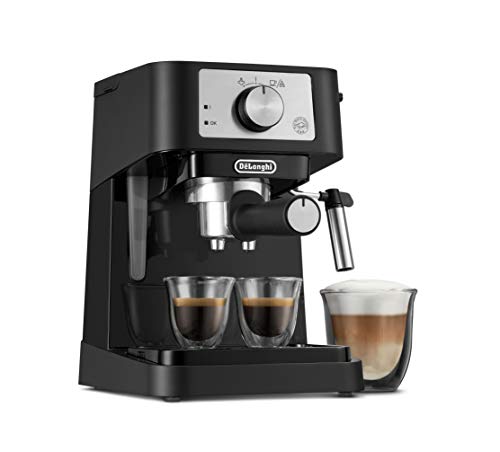
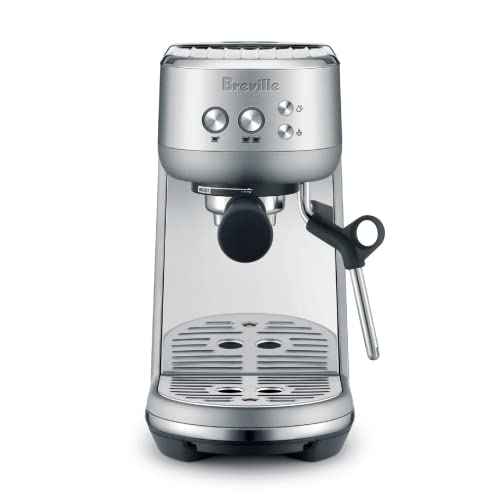
The best espresso machines for beginners are the Breville Bambino for the easiest learning curve, the De’Longhi Stilosa for the lowest-cost entry, and the Gaggia Classic Evo Pro for people who want to learn traditional espresso and keep a machine for years.
Our top picks

As an Amazon Associate we earn from qualifying purchases at no extra cost to you. Ratings are shown as listed on Amazon.
Quick picks by situation
| Best for | Recommended type or model | Why it suits beginners | Typical market range |
|---|---|---|---|
| Fast morning espresso | Breville Bambino | Three-second heat-up, automatic milk texturing, compact footprint | About $300–$400 |
| Lowest purchase cost | De’Longhi Stilosa | Simple buttons, pressurized baskets, small size | About $100–$150 |
| Learning traditional espresso | Gaggia Classic Evo Pro | 58 mm portafilter, commercial-style controls, replaceable parts | About $400–$550 |
| Long-term enthusiast ownership | Rancilio Silvia | Stainless-steel body, brass brewing components, powerful steam wand | About $800–$1,000 |
| No electricity or minimal equipment | Flair Neo Flex | Manual operation and inexpensive upkeep | About $100–$150 |
Prices are broad 2026 market ranges and can vary with bundles, regional taxes, and included accessories.
What makes an espresso machine beginner-friendly?
Simple controls matter, but they are only one part of the decision. A machine can have one large button and still be frustrating if it requires precise grinding, temperature management, or complicated steam timing.
- Forgiving pressure system: Pressurized baskets compensate for inconsistent grinding and are useful when buying pre-ground coffee. Non-pressurized baskets provide better control but expose mistakes more clearly.
- Reliable heat management: Thermoblock machines heat quickly and avoid long warm-up periods. Single-boiler machines can make excellent coffee but require switching between brewing and steaming.
- Accessible controls: A programmable shot button is convenient, while a manual brew switch teaches you how flow changes with grind size and dose.
- Manageable milk steaming: Automatic or assisted steam systems shorten the learning curve. A traditional wand produces better control, but expect several attempts before the milk becomes smooth and glossy.
- Low-effort cleaning: Removable water tanks, accessible drip trays, and replaceable group gaskets reduce ownership friction.
Breville Bambino: best for the easiest start
The Breville Bambino is a strong choice when the priority is making espresso quickly without spending weeks learning temperature and steaming technique. Its thermocoupled heating system reaches brewing temperature in roughly three seconds, and the machine includes automatic milk texturing on the standard Bambino model. The compact body is approximately 6.3 inches wide, so it fits more easily than many traditional machines.
The included pressurized and non-pressurized baskets let you begin with forgiving settings and gradually move toward freshly ground coffee. That flexibility is more useful than a machine that forces beginners into one brewing method.
The main limitation is workflow. The small water tank and drip tray need frequent refilling or emptying in a busy household, and the automatic steam function still benefits from correctly positioned milk and a suitable pitcher. The Bambino is best for one or two drinks at a time rather than entertaining a large group.
De’Longhi Stilosa: best budget option
The De’Longhi Stilosa is appropriate when the purchase price matters more than speed, refinement, or future upgrade potential. It uses straightforward rotary controls and pressurized baskets, which make it relatively tolerant of supermarket pre-ground coffee. Its roughly 1-liter water tank is adequate for occasional drinks, and the machine occupies little counter space.
Its manual steam wand can produce frothy milk, but it has a steeper learning curve than the assisted systems on more expensive machines. Beginners often create large bubbles by holding the wand too high. Keep the wand tip just below the milk surface while introducing air, then lower it slightly to create a circulating whirlpool.
Choose the Stilosa if you drink espresso a few times per week and want to learn without committing several hundred dollars. If you expect daily use for many years, a machine with stronger service support and more durable brewing components may be better value.
Gaggia Classic Evo Pro: best for learning the traditional method
The Gaggia Classic Evo Pro is a good middle ground between beginner accessibility and hands-on control. Its 58 mm portafilter uses the same general size found in many café-style machines, and the machine has a traditional three-way solenoid valve and a manual steam wand. These features make it easier to develop repeatable preparation habits and find compatible accessories.
Unlike a thermoblock machine designed for rapid switching, the Classic is a single-boiler design. You brew first, then wait for the machine to reach steaming temperature before texturing milk. That pause is not a defect, but it makes a latte slower to prepare. Temperature surfing and timing also require more attention than on a beginner-oriented thermoblock.
This is the better pick for someone who enjoys adjusting grind size, weighing coffee, and improving technique. It is less suitable for a household that wants push-button convenience.
Rancilio Silvia: best for durability-focused buyers
The Rancilio Silvia costs more and is less forgiving out of the box, but its metal construction, powerful steam wand, and established repair ecosystem appeal to owners who plan to keep a machine for many years. It uses a single boiler, so brewing and steaming remain separate steps. The steam wand can create excellent microfoam, although it also makes poor technique obvious.
A Silvia usually makes sense when the buyer already owns, or is willing to buy, a capable burr grinder. Spending heavily on the machine while using an inconsistent grinder defeats much of its advantage. It also needs a proper warm-up period; switching it on only when you wake up will not provide the most consistent first shot.
Manual alternative: Flair Neo Flex
The Flair Neo Flex is a manual lever machine rather than an electric pump machine. It requires a kettle, a grinder, and physical pressure from the user, but it has very few parts that can fail. The pressurized brewing attachment makes it more accessible than a fully manual espresso setup.
It is a good choice for small kitchens, travel, or people who make one carefully prepared espresso at a time. It is not ideal for several consecutive milk drinks because there is no integrated steam system. You would need a separate milk frother or steam device.
Decision matrix: which beginner machine fits you?
| Your situation | Best direction | Reason |
|---|---|---|
| Under $150 and occasional use | De’Longhi Stilosa or similar pressurized machine | Low initial risk and uncomplicated operation |
| Daily coffee before work | Breville Bambino or another fast thermoblock | Short heat-up and less temperature management |
| Want to learn café-style technique | Gaggia Classic Evo Pro | Traditional controls and broad accessory compatibility |
| Limited counter width | Breville Bambino or manual lever machine | Approximately 6–7 inches wide for compact electric options |
| Mostly cappuccinos and lattes | Machine with assisted or strong manual steaming | Milk performance will affect satisfaction more than extra brewing programs |
| One espresso and no milk drinks | Flair Neo Flex or compact pump machine | A dedicated steam system may add cost and cleaning without much benefit |
Setup requirements beginners often underestimate
The grinder is the most important accessory. A consistent burr grinder lets you make small, controlled adjustments, while a blade grinder can produce both powder and large chunks in the same dose. A basic espresso-capable burr grinder commonly adds about $100–$250 to the budget.
Start with a 16–18 gram dose if your basket is designed for that range. Aim for roughly 32–36 grams of espresso in the cup, using a kitchen scale and a shot time around 25–35 seconds as an initial reference. These are starting points, not universal rules: darker roasts and different baskets may need different settings.
- Fill the tank with fresh water and flush the group briefly.
- Grind the measured dose and distribute it evenly in the basket.
- Tamp level, without trying to force excessive pressure.
- Lock in the portafilter and start the shot.
- Adjust grind size based on flow and taste: finer if it runs very quickly, coarser if it barely flows.
Maintenance and the real cost of ownership
After every use, knock out the puck, rinse the basket, wipe the steam wand immediately, and purge it for a few seconds. Milk residue becomes much harder to remove once it dries. Emptying the drip tray regularly also prevents stale odors.
At least weekly, wash the removable tray and tank, brush coffee grounds from the group area, and inspect the portafilter gasket. Follow the manufacturer’s instructions for backflushing, because detergent requirements differ between models. Descaling frequency depends on water hardness and usage; filtered water can reduce mineral buildup but does not eliminate the need for descaling.
A simple ownership estimate illustrates the difference between purchase price and running cost. Suppose a daily user buys a $350 machine, a $180 grinder, and spends about $0.45 per 18-gram dose on coffee. Over 300 drinks, the equipment contributes about $530 divided by 300, or $1.77 per drink, before accessories and cleaning supplies. Coffee adds $135, bringing the first-year equipment-and-coffee total to about $665, or $2.22 per drink. In later years, the cost per drink falls substantially because the grinder and machine have already been purchased.
The parts most likely to need attention are the group gasket, shower screen, steam-wand tip, pump, and solenoid valve. Gaskets and screens are relatively inexpensive wear items; pumps and control boards are more significant repairs. Choosing a model with readily available replacement parts can matter more than a small difference in advertised pressure.
Bottom line
Choose the Breville Bambino when speed and forgiving operation matter most. Choose the De’Longhi Stilosa when you want the cheapest practical introduction. Choose the Gaggia Classic Evo Pro when learning technique is part of the appeal, and the Rancilio Silvia when long-term repairability and stronger steaming justify the higher cost. Whichever machine you select, reserve part of the budget for a capable burr grinder, a scale, and regular cleaning; those three factors usually have a larger effect on results than extra buttons or headline pump pressure.







Write Your Review
No reviews yet. Be the first to share your experience!