

Key takeaways
- Use a Python cable lock or security box in public or accessible locations.
- Keep the camera at least a few feet away from swaying branches and tall grass.
- Install a fresh, formatted card and test day and night images before leaving.
- Record the camera’s location, battery type, installation date, and cellular plan.
- Inspect the lens, gasket, mounting strap, and battery compartment every few months.
The best trail cameras in 2026 are the Browning Recon Force Elite HP5 for fast, high-quality non-cellular scouting, the Tactacam REVEAL X-Pro for straightforward cellular monitoring, and the SPYPOINT FLEX-S when built-in solar charging can reduce battery changes.
Your right choice depends less on the highest megapixel number than on four practical questions: how quickly the camera must react, whether you need remote alerts, how often you can visit the site, and whether it will face rain, snow, heat, or tampering. A camera for a deer trail has different priorities from one watching a driveway or shed.
Our top picks
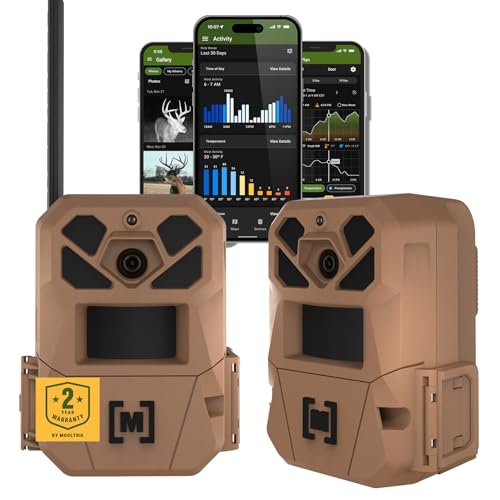


As an Amazon Associate we earn from qualifying purchases at no extra cost to you. Ratings are shown as listed on Amazon.
Best trail cameras by situation
| Situation | Best fit | Why it makes sense | Watch-out |
|---|---|---|---|
| Fast wildlife movement | Browning Recon Force Elite HP5 | Very fast stated trigger, strong still-image detail, no-glow infrared | Requires a site visit to retrieve the SD card |
| Remote property monitoring | Tactacam REVEAL X-Pro | Cellular photo and video transmission, app-based management, GPS support | Requires a compatible cellular plan and dependable signal |
| Low-maintenance remote use | SPYPOINT FLEX-S | Integrated solar panel, rechargeable battery, cellular operation | Solar performance drops in shade and winter weather |
| Budget, occasional use | Basic non-cellular 20–32 MP camera | Lower purchase cost and no monthly fee | Usually slower setup, less refined night images, and no alerts |
| Several cameras on one property | Cellular system with shared app management | Remote status checks and fewer long drives | Monthly data charges multiply with each active camera |
Head-to-head comparison
| Camera | Type | Stated trigger speed | Detection range | Night illumination | Power and storage |
|---|---|---|---|---|---|
| Browning Recon Force Elite HP5 | Non-cellular | About 0.1 second | Up to roughly 80 feet | 940 nm no-glow infrared | AA batteries; SD card, commonly up to 512 GB depending on firmware and card compatibility |
| Tactacam REVEAL X-Pro | Cellular | About 0.3 second | Up to roughly 96 feet | 940 nm no-glow infrared | 12 AA batteries or external power; SD card, commonly up to 32 GB |
| SPYPOINT FLEX-S | Cellular with solar panel | About 0.3 second | Up to roughly 100 feet | No-glow infrared | Rechargeable lithium battery and integrated solar panel; microSD storage, commonly up to 512 GB |
| GardePro A3S | Non-cellular | About 0.1 second | Up to roughly 100 feet | 940 nm no-glow infrared | 8 AA batteries; microSD card, commonly up to 128 GB |
Specifications can vary by firmware, regional version, recording mode, temperature, and memory-card compatibility. Treat advertised detection distances as upper limits rather than guaranteed performance in dense brush or heavy rain.
Browning Recon Force Elite HP5: best for fast, detailed wildlife capture
The Browning Recon Force Elite HP5 is a strong choice where animals cross the frame quickly and you do not need cellular alerts. Its approximately 0.1-second trigger is valuable on narrow trails, especially when a deer, fox, or raccoon is moving across—not directly toward—the camera. The no-glow 940 nm infrared system is less visible to wildlife than a white-flash camera, while its high-resolution still and video modes provide useful detail for identification.
Its main disadvantage is the ownership routine: you must return to the camera, remove the SD card, and replace batteries when needed. A fast trigger also increases the number of empty images if the camera faces moving grass, sun-warmed rocks, or a busy public path. Use a modest sensitivity setting and position the camera away from direct sunrise and sunset.
Tactacam REVEAL X-Pro: best for remote alerts
The Tactacam REVEAL X-Pro is better suited to a cabin, gate, equipment area, or distant wildlife location where checking an SD card is inconvenient. It can send photos and videos through a cellular connection and lets you adjust settings from its app, depending on service availability. Dual-carrier or multi-network capability is particularly useful because a camera that works at home may fail behind a hill or in thick forest.
Cellular operation changes the cost calculation. The camera may cost roughly $100–$200, while a cellular plan can add approximately $5–$20 or more per month depending on image limits, video transmission, and provider. Transmission also consumes substantially more power than simply saving an image to a card. For a site with thousands of triggers, select a plan with rollover or a suitable image allowance rather than assuming the cheapest tier will be adequate.
SPYPOINT FLEX-S: best when battery visits are difficult
The SPYPOINT FLEX-S combines cellular transmission with an integrated solar panel and rechargeable battery. It is appealing for an open, sunny location where climbing a ladder or walking a long distance to change AA batteries is impractical. The solar panel does not make the camera maintenance-free: shade, snow cover, short winter days, and repeated video transmissions can still drain the battery.
Mount the panel toward the strongest available daylight and check the battery trend in the app after several cloudy days. If the level continually falls, reduce video use, shorten transmission activity, reposition the camera, or add an approved external power solution.
What matters more than megapixels
Trigger speed and recovery time
Trigger speed is the delay between detected movement and image capture. Recovery time is how quickly the camera can capture the next image. A 0.1-second trigger is useful, but a long recovery interval can still miss a second animal. For wildlife, look for adjustable trigger intervals, burst shooting, and a recovery time of about one second or less in still-photo mode.
Detection range and placement
A quoted 80–100-foot detection range is not the same as a useful identification range. At the edge of the sensor’s reach, a subject may appear small, partly obscured, or poorly lit. For most trails, place the camera 15–30 feet from the expected crossing point, angled slightly across the path. For a driveway, point it toward the approach rather than straight at a vehicle’s headlights.
Night-image quality
No-glow infrared, usually around 940 nm, is discreet but often produces darker or softer images than low-glow 850 nm illumination. Look for adjustable infrared intensity, a clear lens, and good motion control. Night video may show blur when an animal moves quickly; still photos with a short burst can be more useful for identification.
Battery life and storage
Manufacturers often quote battery life under moderate trigger counts and favorable temperatures. Cold weather, cellular uploads, video, and weak signal can reduce it sharply. Lithium AA batteries generally perform better than alkaline batteries in cold conditions, but do not mix battery chemistries or combine old and new cells.
Use a high-quality, correctly rated SD or microSD card and format it in the camera before deployment. A 32 GB card can hold thousands of compressed photos, but video files consume space quickly. For example, if each transmitted video averages 10 MB and the camera records 150 clips per week, weekly storage use is approximately 1.5 GB before still images and system files.
Weather resistance, security, and long-term ownership
Choose a housing rated at least IP65 for exposed placement. IP65 indicates protection from dust and water jets; it does not mean the camera should be submerged. A gasket can lose effectiveness when the door is closed over a twig, grit, or a damaged seal. Wipe the lens and solar panel with a soft, damp cloth, then dry them before closing the housing.
- Use a Python cable lock or security box in public or accessible locations.
- Keep the camera at least a few feet away from swaying branches and tall grass.
- Install a fresh, formatted card and test day and night images before leaving.
- Record the camera’s location, battery type, installation date, and cellular plan.
- Inspect the lens, gasket, mounting strap, and battery compartment every few months.
The parts most likely to cause trouble are not always the camera sensor. Straps stretch or crack in sunlight, card contacts become unreliable, lens covers collect condensation, and cellular antennas lose performance if the camera is buried behind wet foliage. Replace worn straps before they fail and avoid opening the battery compartment during heavy rain.
A five-step setup that prevents most missed captures
- Scout the scene. Identify tracks, feeding areas, gates, or approaches, then choose a stable mounting point.
- Check the signal first. For cellular models, activate the camera and confirm uploads from the exact installation position.
- Set the angle. Aim across the movement path, keep the horizon level, and leave enough space for the subject to enter the frame.
- Control false triggers. Remove nearby leaves, avoid direct sun, and use a medium sensitivity setting initially.
- Perform a day/night test. Walk through the detection zone, review framing and infrared exposure, and confirm the time and date.
Final buying recommendation
Choose the Browning Recon Force Elite HP5 if capture speed and image quality matter more than remote access. Choose the Tactacam REVEAL X-Pro if you need alerts and status checks from a distance. Choose the SPYPOINT FLEX-S for a sunny, hard-to-reach location where solar assistance can offset battery visits. If you monitor only occasionally and can return to the site, a well-sealed non-cellular camera remains the least expensive option over several years because it avoids recurring cellular fees.








Write Your Review
No reviews yet. Be the first to share your experience!