

Key takeaways
- Padding: Aim for approximately 3–6 cm of firm foam on the seat and leg supports. Very soft foam may feel comfortable initially but can compress unevenly and alter your alignment.
- Height compatibility: For users below 165 cm, prioritize a low seat and short leg-support adjustment. Users above 185 cm should look for sliding supports, telescoping rails, or a stated maximum inseam of at least 86–90 cm.
- Adjustment increments: A handwheel or ratchet with fine steps is safer to control than a support that jumps between only two or three positions.
- Frame stability: Wide feet, rubber end caps, and a low centre of gravity reduce rocking. A lightweight 8 kg frame may be convenient but can move during stronger stretches.
- Storage: Measure the folded dimensions, not just the in-use footprint. Allow extra room for the handle and wheels.
Best Stretching Machines for Flexibility at Home
The best stretching machines for home use are adjustable leg-stretcher chairs for beginners, wheel-operated split machines for controlled progression, and compact calf-and-hamstring stretchers for people with limited floor space.
Choosing between them depends less on the maximum angle printed on the box and more on adjustment range, body fit, padding, storage, and how precisely you can control tension. A machine that allows tiny changes is usually more useful than one that reaches an extreme position but feels unstable or uncomfortable.
Our top picks

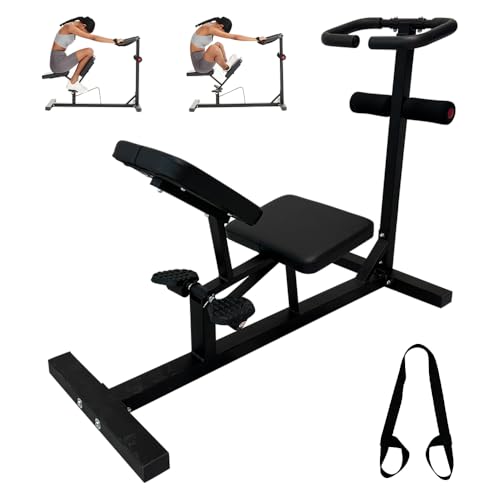


As an Amazon Associate we earn from qualifying purchases at no extra cost to you. Ratings are shown as listed on Amazon.
Quick comparison of the best types
| Machine type | Typical adjustment range | Primary muscle groups | Typical user height | Footprint and weight | Stretching level |
|---|---|---|---|---|---|
| Seated leg-stretcher chair | 90° to 180° leg spread; 20–40 cm seat adjustment | Adductors, hamstrings, inner thighs, hips | 150–193 cm | 90–120 × 55–75 cm; 15–25 kg | Gentle to advanced |
| Wheel-operated split machine | Usually 0° to 180° or a 40–50 cm opening range | Adductors, groin, hamstrings, hip flexors | 155–198 cm, depending on seat and footrest adjustment | 100–140 × 55–80 cm; 18–32 kg | Moderate to advanced |
| Back-and-leg stretching bench | Back extension or recline commonly 20°–90° | Hamstrings, calves, lower back, glutes | 155–193 cm | 100–135 × 55–70 cm; 12–22 kg | Gentle to moderate |
| Doorway or wall-mounted stretcher | About 10–40 cm of strap or rail adjustment | Calves, hamstrings, shoulders, hips | Broad fit range with adjustable straps | Under 20 × 30 cm when stored; 2–8 kg | Gentle to moderate |
The figures above are typical ranges for home equipment, not a promise that every model has identical dimensions. Confirm the manufacturer’s seat height, leg-length range, maximum user weight, and folded size before ordering.
Best choice by situation
| Your situation | Best fit | Why | What to compromise on |
|---|---|---|---|
| New to stretching or easily overdo intensity | Seated chair with a handwheel | Stable posture and small angle changes make gentle sessions easier | It takes more floor space than a strap system |
| Working toward a wider split | Wheel-operated split machine | Offers a broad opening range and controlled progression | More expensive and less convenient to store |
| Small apartment or occasional use | Doorway, wall-mounted, or folding bench design | Low storage demand and quick setup | Usually less stable and less versatile |
| Tall user with long legs | Machine with sliding seat and telescoping leg supports | Reduces cramped knee and hip positioning | Adjustable frames are often heavier |
| Frequent use, three or more times weekly | Steel-frame chair or split machine | Better resistance to repeated loading and adjustment | Higher purchase price, often about $150–$400 |
1. Seated leg-stretcher chairs: the most balanced option
A seated leg-stretcher chair is the strongest all-round choice for most homes. You sit with your back supported while a handwheel, crank, or lever gradually moves the leg supports outward. This design targets the adductors and inner thighs directly, while the position can also lengthen the hamstrings and hips.
Look for at least 180° of advertised opening, although you do not need to use the full range. A handwheel with a fine thread is preferable to a fast lever because it allows smaller changes. Good models commonly use a steel frame, molded leg supports, 3–6 cm of foam padding, and a seat that adjusts forward or backward.
For gentle stretching, begin with the legs only slightly wider than a comfortable seated position. For more advanced work, the wheel allows gradual progression without bouncing. The machine should include a stop or locking mechanism so the leg supports do not move suddenly when you release the handle.
Who should buy one?
Choose this style if you want stability, repeatable positioning, and an easier learning curve. It is also a sensible option for users who find floor splits uncomfortable or difficult to enter safely. Check the maximum user weight and the distance from the seat to each foot support; a machine can support your body weight yet still be too short for your legs.
2. Wheel-operated split machines: best for precise progression
Split machines use a central seat with leg platforms that move apart through a front or rear wheel. They are usually more substantial than compact stretchers and may provide both side-split and front-split positioning, depending on the design.
The main advantage is control. Turning the wheel by a quarter-turn may create only a small change, letting you stop before the stretch becomes too intense. Some machines also adjust the backrest, seat height, or foot angle, which matters because hip position changes which tissues feel the stretch.
These machines generally suit experienced users better than a basic bench. Their broad adjustment range can tempt people to chase the maximum opening too quickly. Advanced range is useful only when you can maintain relaxed breathing, even pressure, and a stable pelvis.
Expect to reserve roughly 1.2 square metres of clear floor space while the machine is in use. A 20–30 kg steel model may be difficult to move after every session, so rolling casters or a foldable frame can be worth paying for.
3. Back-and-leg benches: best for hamstrings and gentle routines
A stretching bench combines a seat, backrest, and leg support. It is not usually the best choice for achieving a full side split, but it can be more versatile for hamstring, calf, glute, and lower-back routines. A reclining backrest and adjustable leg bar allow several positions without requiring you to balance on the floor.
Choose a bench with a backrest that locks at multiple angles, dense foam rather than soft cushion-only padding, and a leg bar that adjusts in increments of about 2–5 cm. The padding should support the sit bones and shoulder blades without allowing your body to sink unevenly.
This category is appropriate for people who want a gentle daily mobility routine rather than a specialized split-training tool. It is also easier to share among users of different heights if both the backrest and leg support move independently.
4. Compact stretchers: best when storage is the deciding factor
Doorway stretchers, wall-mounted rails, and strap-based systems cost less and take up much less room. Some weigh under 5 kg and can fit in a cupboard. They can target calves, hamstrings, shoulders, and hips, but they depend more on your balance, anchor point, and technique.
A strap system should have clearly marked adjustment points, reinforced stitching, a padded ankle loop, and a door anchor that cannot slip when loaded. Avoid using a strap on a door or anchor that has not been confirmed suitable for bodyweight tension. Compact products are best for gentle stretching and travel; they are usually less suitable for aggressive split progression.
Padding, fit, and adjustment details that matter
- Padding: Aim for approximately 3–6 cm of firm foam on the seat and leg supports. Very soft foam may feel comfortable initially but can compress unevenly and alter your alignment.
- Height compatibility: For users below 165 cm, prioritize a low seat and short leg-support adjustment. Users above 185 cm should look for sliding supports, telescoping rails, or a stated maximum inseam of at least 86–90 cm.
- Adjustment increments: A handwheel or ratchet with fine steps is safer to control than a support that jumps between only two or three positions.
- Frame stability: Wide feet, rubber end caps, and a low centre of gravity reduce rocking. A lightweight 8 kg frame may be convenient but can move during stronger stretches.
- Storage: Measure the folded dimensions, not just the in-use footprint. Allow extra room for the handle and wheels.
How to set up and use a stretching machine
- Measure the fit. Adjust the seat and leg supports so your knees remain supported and your pelvis stays centered. Do not compensate for a short machine by twisting your hips.
- Warm up lightly. Five to ten minutes of easy walking or other comfortable movement can make the first position feel less abrupt.
- Start below your limit. Use a position that produces mild, even tension rather than sharp pain, numbness, or joint pressure.
- Hold without bouncing. Start with 15–30 seconds, then return slowly. Two or three repetitions are enough for an initial session.
- Progress gradually. Add only a small wheel turn or one adjustment notch when the current position feels controlled over several sessions.
- Clean and inspect. Wipe contact surfaces after use and check bolts, wheel threads, straps, and welds regularly.
Ownership costs and common wear points
The purchase price for home stretching machines typically ranges from about $60 for a basic strap or compact device to $400 or more for a heavy steel split machine. A useful way to compare value is cost per use. For example, a $240 machine used three times per week for two years provides approximately 312 sessions, or about $0.77 per session before maintenance. If it is used only twice monthly, the same machine costs about $10 per session over two years, making a compact model more sensible.
The first parts to wear are usually foam covers, rubber feet, wheel threads, strap stitching, and adjustment pins. Sweat and floor dust can accelerate wear. Wipe metal surfaces with a slightly damp cloth, dry them promptly, and follow the manufacturer’s guidance before applying lubricant to a threaded wheel. Do not lubricate a locking pin or strap mechanism unless specified, because excess lubricant can reduce grip.
Stop using the machine if the frame rocks, a weld develops a crack, the wheel binds, or a strap shows fraying. Stretching equipment cannot diagnose or treat an injury. If you have persistent pain, a recent injury, significant joint instability, or a condition affecting movement, ask a qualified health professional how to exercise safely.
Final buying recommendation
For most people, a padded seated chair with a steel frame, fine handwheel adjustment, a 90°–180° range, and support for users roughly 150–193 cm tall is the best balance. Choose a wheel-operated split machine when advanced progression is your central goal, a back-and-leg bench when you want broader gentle mobility work, and a compact strap or doorway design when storage matters more than maximum stability.







Write Your Review
No reviews yet. Be the first to share your experience!