

Key takeaways
- Learn how to choose a sprouting kit by format, drainage, seed type and cleaning, with five verified jar, tray and automatic options for home sprouts.
- Top Pick: Masontops Mason Jar Bean Sprouting Jar Starter Set
- Runner-up: KITCHEN CROP VKP Brands 4-Tray Sprouter (VKP1014)
- Also consider: LeJoy Garden Seed Sprouter Tray with Lid
Sprouting at home is one of the simplest kitchen growing projects: seeds, water, air, and a few days of rinsing turn a small jar or tray into fresh sprouts for salads and sandwiches. The kit you choose shapes how much you can grow at once, how much daily attention the sprouts need, and how easy the setup is to keep clean.
The five kits here cover the three main formats, from a Mason jar starter set to stackable trays, wide soil-free trays, and an automatic electric sprouter. Each suits a different seed type, counter space, and routine, so the best choice depends on how you plan to grow and rinse.
As an Amazon Associate, we earn from qualifying purchases.
Quick answer
Choose a jar kit for small batches of bean and leafy sprouts, a stackable tray sprouter for varied harvests in little counter space, a wide single tray for wheatgrass and larger beans, and an automatic sprouter if daily rinsing is hard to keep up. Match the kit to your seeds, drainage, and cleaning routine first.
How to choose a sprouting kit
Start with the format: jar vs tray vs automatic sprouters
Jar kits are the entry point: a wide-mouth jar with a screen lid holds a modest batch and drains by tipping upside down, but grows one batch at a time. Tray sprouters grow more, and flatter. Stackable systems layer several surfaces in a small footprint, so different seeds can run at different stages. Single wide trays spread seeds in one layer, suiting wheatgrass, larger beans, and microgreens. Automatic sprouters add a motor and timed watering, replacing hand rinsing with consistent sprinkling, at the cost of a bigger footprint, a power outlet, and more parts to clean.
Drainage and airflow decide most of your results
Sprouts need to stay moist, never soaked. Standing water is the most common cause of sour smells and failed batches, so look at how a kit drains. Jar lids with standing pegs hold the jar at a draining angle, and trays use grids or irrigation channels that move water away from the seeds. Airflow matters just as much: lids should cover without sealing airtight, trays should not sit in pooled water, and the growing spot should be ventilated rather than a closed cupboard.
Match the kit to your seed types
Small leafy seeds such as alfalfa, clover, and radish sprout well in jars and stackable trays, where a fine screen or grid keeps them contained during rinsing. Larger seeds such as mung beans, soy beans, and peas need wider openings and room to swell, so trays handle them better. Wheatgrass and microgreens grow as a flat mat harvested by cutting, so a wide, shallow tray fits best. Check whether seeds are included: some sets bundle a first packet, while tray-only kits include none.
Cleaning and materials
You will wash this kit constantly, so cleaning effort is a real buying factor. Fewer parts, smooth surfaces, and wide openings a brush can reach make daily washing realistic. Glass jars are easy to scrub and inspect, while the tray kits here use lighter BPA-free plastics that still need a thorough wash between batches. Trays with small grid holes deserve an extra scrub, because seed hulls lodge in them.
Food-safety rinsing guidance
Sprouts grow in warm, moist conditions that also suit bacteria, so handling matters. Always follow the directions supplied with your kit and seed packet. Rinse seeds before soaking, rinse growing sprouts with clean water at the frequency the kit maker recommends, and drain completely after every rinse. Use clean hands and utensils, wash the kit between batches, and refrigerate finished sprouts promptly. Discard any batch that smells off or looks slimy, and buy seed sold specifically for sprouting.
Masontops Mason Jar Bean Sprouting Jar Starter Set
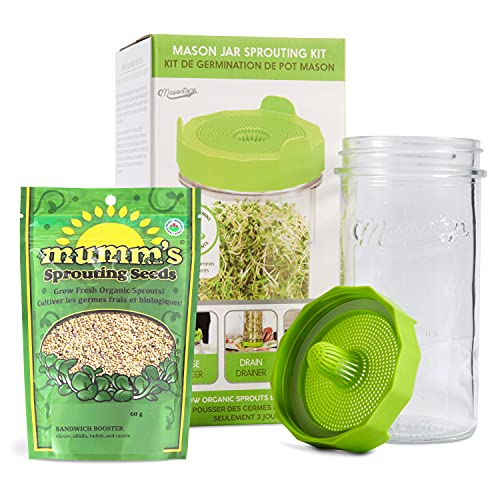
This starter set is the simplest route into sprouting: one 24 oz wide-mouth glass Mason jar and one green Bean Screen lid in BPA-free plastic, with standing pegs that hold the jar upside down for draining. It includes a 60g packet of Mumm’s Organic Sprouting Seeds in the Sandwich Booster blend of clover, alfalfa, radish, and mustard, plus digital guide access, so a first batch can start right away. The jar suits small, frequent batches for one or two people. The limit is capacity: one batch at a time, and larger beans are less convenient through a jar mouth than on a tray.
| Spec | Detail |
|---|---|
| Format | Mason jar sprouting kit |
| Jar | 1 wide-mouth Mason jar, 24 oz, glass |
| Lid | 1 Bean Screen lid, green, BPA-free plastic, standing pegs for draining |
| Seeds included | Yes, 60g Mumm’s Organic Seeds, Sandwich Booster blend (clover, alfalfa, radish, mustard) |
| Extras | Digital guide access |
KITCHEN CROP VKP Brands 4-Tray Sprouter (VKP1014)

The Kitchen Crop sprouter, model VKP1014, stacks four trays in a footprint of just 6 x 6 inches, and the trays can stack up to ten high on the same base. The listing describes a hydrophobic irrigation and drainage system that moves rinse water through the stack, the set totals five pieces, and a sample bag of organic alfalfa sprouting seeds is included. The trays are BPA-free, phthalate-free, food-grade clarified polypropylene, made in the USA. No soil is required, and sprouting takes about 3 to 5 days per the listing. Stacking suits a rolling harvest, though the small trays keep individual batches modest.
| Spec | Detail |
|---|---|
| Format | Stackable tray sprouter |
| Model | VKP1014 |
| Trays | 4 sprouting trays, stackable up to 10, 5 pieces total |
| Material | BPA-free, phthalate-free, food-grade clarified polypropylene |
| Seeds included | Yes, sample bag of organic alfalfa sprouting seeds |
| Dimensions | 6 x 6 x 8 inches |
| Growing notes | Soil-free, 3 to 5 days per listing |
LeJoy Garden Seed Sprouter Tray with Lid

The LeJoy Garden set is a single wide tray system: one white grid sprouter tray, one green water container beneath it, and one lid, all in BPA-free PP. At 13.4 x 9.84 inches and 4.72 inches high, it spreads seeds across a broad flat surface, suiting wheatgrass mats and larger beans that crowd a jar. The listing names soya bean, mung bean, peanut, black bean, and wheat as suitable seeds, grown soil-free over the water container. One point to plan around: this tray does not include seeds, so buy sprouting seed separately. In return, the three-part design is easy to wash, and the lid holds humidity while the grid keeps seeds out of the water.
| Spec | Detail |
|---|---|
| Format | Single tray sprouter with lid |
| Contents | 1 white grid tray, 1 green water container, 1 lid |
| Material | BPA-free PP |
| Dimensions | 13.4 x 9.84 x 4.72 inches |
| Seeds included | No, seeds are not included |
| Suited seeds | Soya bean, mung bean, peanut, black bean, wheat |
Tribest Fresh Life Sprouter FL-3000 Automatic Seed Sprouter

The Tribest Fresh Life FL-3000 is the automatic option: an electric sprouter that waters seeds on a repeating cycle of about 5 minutes on and 25 minutes rest, with adjustable water pressure. It includes a sprouting barrel, two seeding trays, and a lid, runs on 120V AC with a detachable cord and on/off switch, and can expand to three barrels, with extras sold separately. The barrels are BPA-free. Whether seeds are included is not stated, so do not count on a starter packet. At 10 x 10 x 11 inches and 7 lb, it needs permanent counter space and an outlet, and suits growers who want steady harvests without twice-daily rinsing.
| Spec | Detail |
|---|---|
| Format | Automatic electric sprouter |
| Model | FL-3000 |
| Watering | Automatic cycle, about 5 minutes on and 25 minutes rest, adjustable pressure |
| Contents | Sprouting barrel, two seeding trays, lid |
| Expansion | Up to 3 barrels, extra barrels sold separately |
| Dimensions and power | 10 x 10 x 11 inches, 7 lb, 120V AC, detachable cord, on/off switch |
| Seeds included | Not stated |
Gardzen 5-Pack Sprouts Growing Kit

The Gardzen kit, model GST-A-5, is a five-pack of soil-free tray sets: five white grid trays and five green water trays in BPA-free premium plastic, each tray 9.8 x 12.4 x 1.5 inches. Rather than stacking, the trays sit side by side, so you can run five seeds at once or stagger start dates. The listing suits them to mung bean, soy bean, pea, wheatgrass, alfalfa, radish, and other microgreens. Seeds are not stated as included, so treat this as trays only and order seed separately. Measure first: five trays cover a large area.
| Spec | Detail |
|---|---|
| Format | Multi-tray soil-free kit |
| Model | GST-A-5 |
| Contents | 5 white grid trays, 5 green water trays |
| Material | BPA-free plastic |
| Dimensions | 9.8 x 12.4 x 1.5 inches per tray |
| Seeds included | Not stated, trays only |
| Suited seeds | Mung bean, soy bean, pea, wheatgrass, alfalfa, radish, microgreens |
Who should skip these kits
Skip sprouting kits altogether if you will not keep up the rinse-and-drain routine: even the automatic model needs its water refreshed, parts washed, and harvests refrigerated, and manual kits need daily rinsing. If sprouts are an occasional garnish rather than a habit, buying them ready-grown is more realistic. Skip the jar and small stacked trays if you want large wheatgrass flats, and skip wide multi-tray packs if counter space is tight. Skip the automatic sprouter if you sprout only now and then, and skip any kit if you will not follow the food-safety guidance above.
FAQ
How often do sprouts need rinsing?
Follow the directions supplied with your kit and seed packet. Manual sprouting generally involves rinsing with clean water and draining completely on a regular daily schedule, while the automatic Tribest model sprinkles on its built-in cycle. Complete drainage matters as much as the rinsing itself.
Can I use regular grocery store beans and seeds?
Use seed sold specifically for sprouting, since its packaging carries the relevant handling guidance. The Masontops and Kitchen Crop sets include starter seed, but the LeJoy tray includes none, so plan a separate seed order.
How long do sprouts take to grow?
Timing depends on the seed and conditions. The Kitchen Crop listing puts its sprouts at about 3 to 5 days, a useful general guide, but each packet gives its own timing. Harvest at the stage the packet describes, rinse, drain well, and refrigerate promptly.
Do sprouting kits need soil or sunlight?
None of these kits needs soil; all five grow soil-free with water, drainage, and air. Sprouts germinate without strong light, while wheatgrass and microgreens on wide trays are usually finished with some light so the leaves green up.
Final verdict
For most beginners, the choice comes down to routine. Pick the Masontops jar set for the smallest start with seed included, the Kitchen Crop sprouter for compact rolling harvests, the LeJoy tray for wide wheatgrass and bean batches, the Gardzen five-pack for side-by-side trays, and the Tribest FL-3000 if automatic watering will keep you sprouting consistently. Match format, drainage, and cleaning effort to your habits.
More from Amazon
Programs that pair well with the guide above. Offers and eligibility are set by Amazon and may change.
Set up recurring deliveries of everyday items on eligible products. Terms and savings are set by Amazon.
Explore Subscribe & SaveCollect the home and kitchen items you want in one registry that guests can shop from.
Create a wedding registryFree shipping on eligible items, Prime Video and more. Eligible new members can start with a free trial.
Start a Prime free trialAudiobooks and podcasts to listen to on the go. Eligible new members can start with a free trial.
Try Audible freeAs an Amazon Associate we earn from qualifying purchases.


Write Your Review
No reviews yet. Be the first to share your experience!