

Key takeaways
- Open lower shelf: Best for mixing bowls, appliances, or baskets that need quick access. It is inexpensive but shows clutter and collects dust.
- Adjustable shelf: More useful than a fixed shelf if you store tall cereal containers, bottles, or a blender.
- Drawer: Ideal for measuring spoons, wraps, tea, and utensils. A drawer around 3–5 inches high is usually more useful than a shallow decorative drawer.
- Doors: Better for hiding pantry supplies, but hinges reduce the usable interior width and require clearance in front.
- Towel bar or side rail: Handy in a small kitchen, though it can catch on nearby furniture when the cart moves.
The best microwave cart organizers are the ones that match your microwave’s footprint and weight, leave room for ventilation, and use a shelf-and-drawer layout you will actually maintain; for most small kitchens, choose a 24–30-inch-wide rolling cart with a 50–100 lb top capacity, lockable casters, and at least one drawer.
Our top picks


As an Amazon Associate we earn from qualifying purchases at no extra cost to you. Ratings are shown as listed on Amazon.
Quick picks by kitchen situation
| Best for | Recommended cart type | Useful target specifications | Why it fits |
|---|---|---|---|
| Very small kitchen | Narrow microwave stand | 20–24 in. wide, 16–20 in. deep, 28–34 in. high | Uses vertical space without blocking a walkway |
| Most households | Rolling microwave cart with drawer and lower shelf | 24–30 in. wide, 18–24 in. deep, 50–100 lb top capacity | Balances prep space, storage, and mobility |
| Heavy microwave or toaster oven | Steel-frame utility cart | 100–150 lb top capacity, cross-braced frame, 2 locking casters | Reduces flex and remains stable under heavier appliances |
| Maximum hidden storage | Enclosed microwave cabinet cart | 28–36 in. wide, 2 doors, 1–2 adjustable shelves | Conceals cookware and pantry items, but needs more floor space |
| Frequent repositioning | Four-wheel kitchen trolley | Four 2–3 in. casters, at least 2 locking, smooth top | Moves more easily for cleaning or entertaining |
What makes a microwave cart organizer worth buying?
1. Correct dimensions, not just a “fits most” label
Measure the microwave’s width, depth, and height with the door closed. Then add clearance around it. A practical target is 2 inches of side clearance, 3 inches behind the appliance where the venting design requires it, and enough space above the microwave for the door or controls to operate comfortably. Always follow the clearance instructions supplied with your microwave; a cart should not force the appliance tightly against a wall or cabinet.
For example, a microwave measuring 20 inches wide by 17 inches deep should not be placed on a 20-inch square top. A better minimum is approximately 24 inches wide by 20 inches deep. That provides 2 inches on each side and 1.5 inches front-to-back, although the manufacturer’s ventilation requirements take priority.
Check the cart’s usable surface rather than its outside dimensions. A 30-inch-wide cabinet may have only a 25-inch opening at the top because of thick side panels or a rear rail.
2. Weight capacity with a safety margin
Compact microwaves often weigh about 25–40 pounds, while larger countertop models can weigh 45–70 pounds. A cart rated for 50 pounds may technically hold a small microwave, but it leaves little margin for vibration, cookware, or accidental leaning. For everyday use, choose a top rated for at least twice the microwave’s actual weight.
Do not confuse total cart capacity with top-shelf capacity. A listing may claim a 200-pound total rating while allowing only 60 pounds on the upper shelf. Look for a separate top-load figure, a rigid frame, and a surface that does not bow when pressed.
3. Shelf layout that matches the items you store
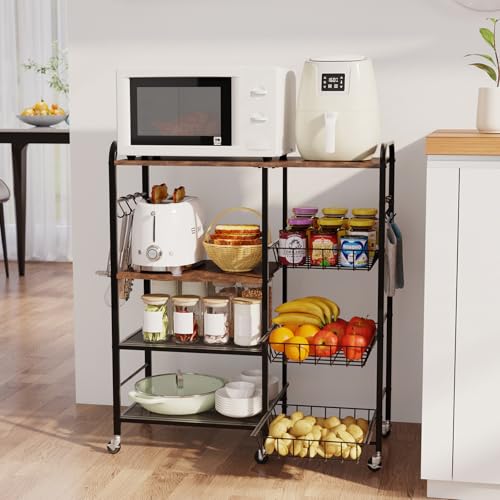
- Open lower shelf: Best for mixing bowls, appliances, or baskets that need quick access. It is inexpensive but shows clutter and collects dust.
- Adjustable shelf: More useful than a fixed shelf if you store tall cereal containers, bottles, or a blender.
- Drawer: Ideal for measuring spoons, wraps, tea, and utensils. A drawer around 3–5 inches high is usually more useful than a shallow decorative drawer.
- Doors: Better for hiding pantry supplies, but hinges reduce the usable interior width and require clearance in front.
- Towel bar or side rail: Handy in a small kitchen, though it can catch on nearby furniture when the cart moves.
For most homes, the most flexible arrangement is a microwave top, one shallow drawer, and one open or adjustable lower shelf. Two deep shelves can look efficient but often turn into inaccessible stacks of cookware.
Head-to-head: the main cart designs
Rolling open cart
This is usually the best value and the easiest design to assemble. It provides ventilation on every side and can be moved away from a backsplash for cleaning. Choose a steel frame or a thick engineered-wood top, plus two locking casters. Open carts are less suitable if children or pets can reach hot cookware, or if you dislike visible countertop clutter.
Rolling cabinet cart
A cabinet-style cart gives the neatest appearance and protects supplies from light and dust. It is often 28–36 inches wide and may weigh 40–70 pounds before loading. That extra mass improves stability but makes assembly and repositioning harder. Confirm that the back has ventilation space or an open panel; enclosing a microwave too tightly can interfere with heat dissipation.
Metal utility cart
A metal cart is a strong choice for a heavy microwave, toaster oven, or frequent movement. Powder-coated steel resists ordinary kitchen splashes, but thin tubing can still wobble if the fasteners are loose. Metal shelves may transmit more vibration and sound than a wood composite top, so rubber appliance feet or a thin non-slip mat can help.
Wood-look kitchen island cart
These carts usually offer the best drawer and cabinet capacity and can look like permanent furniture. They are less forgiving of water leaks, steam, and uneven floors. Inspect the top coating, edge banding, and caster mounting points. A sealed surface is easier to maintain than unfinished wood or porous particleboard.
Decision matrix: which specification matters most?
| Your situation | Prioritize | Avoid | Practical choice |
|---|---|---|---|
| Under 24 inches of available width | Outside width, usable top depth, vertical storage | Wide side rails and protruding handles | 20–24-inch narrow cart with one upper drawer |
| Microwave used several times daily | Rigid top, easy-clean finish, locking wheels | Thin wire shelves and loose swivel casters | Steel-frame cart with a solid top |
| Limited assembly experience | Numbered parts, pre-drilled panels, accessible fasteners | Cabinets requiring door alignment from scratch | Open two-shelf cart or partially assembled trolley |
| Need to hide pantry goods | Adjustable interior shelf and full-height doors | Decorative shallow drawers | Enclosed cabinet cart 28–36 inches wide |
| Uneven floor or frequent movement | Two locking casters, wide wheelbase, low center of gravity | Tall, narrow carts with tiny wheels | Four-wheel cart with 2–3-inch casters |
Assembly and stability checks
Assembly quality can matter as much as the advertised load rating. Before loading the microwave:
- Assemble the frame on a flat floor and leave every fastener slightly loose until the frame is square.
- Install crossbars and shelves before fully tightening the screws; this prevents a leaning rectangle.
- Check that each caster is seated evenly. A loose caster plate can make the entire cart wobble.
- Tighten fasteners gradually in alternating corners rather than forcing one corner tight first.
- Apply gentle pressure to each corner. If it rocks, re-square the frame or adjust the feet before placing the microwave on top.
- Put the heaviest stored items on the lowest shelf and engage the wheel locks whenever the microwave is in use.
For a cabinet cart, door alignment is a useful quality test. Doors should close without rubbing, and hinges should remain firmly attached after repeated opening. If the cabinet twists when moved, reduce the load and inspect the back panel or fasteners.
Ownership realities: what wears out first?
Casters and drawer hardware usually show wear before the shelf material does. Small plastic wheels can flatten or collect grease, while low-cost drawer slides may begin sticking under heavy loads. Choose replaceable caster sizes when possible, and avoid dragging a loaded cart sideways across the floor.
Engineered-wood edges are vulnerable to standing water. Wipe spills promptly, especially around the sink-side edge and beneath the microwave. Use a damp cloth rather than soaking the surface, and avoid abrasive cleaners that can dull powder coating or laminate.
A non-slip mat can protect the cart top, but it should not cover vents or trap moisture. Lift it occasionally to clean underneath. Do not use the cart as a step stool, and do not place a hot pan directly beside a microwave on a surface not rated for heat.
Bottom line
For most small kitchens in 2026, the best microwave cart organizer is a 24–30-inch rolling model with a solid top, a minimum 50–100-pound top rating, two locking casters, one useful drawer, and either an adjustable or open lower shelf. Choose a narrow open cart when floor space is the constraint, a steel utility cart when strength and movement matter most, and an enclosed cabinet cart when concealed storage is worth the added size and assembly. Measure the actual usable top, keep a safety margin above the microwave’s weight, and treat ventilation and wheel stability as non-negotiable.








Write Your Review
No reviews yet. Be the first to share your experience!