

Key takeaways
- Manual pump-espresso format with a water reservoir rather than a direct plumbing connection.
- Dedicated steam wand for frothing milk rather than an automatic milk container.
- Compact footprint that is easier to place under cabinets than a large boiler machine.
- Typically used with pre-ground coffee or a separate espresso grinder, depending on the supplied basket and workflow.
The best prosumer espresso machine for most serious home baristas is the Breville Barista Pro: it combines a built-in grinder, fast thermoblock heating, programmable control, and a capable steam wand without taking up the space or demanding the maintenance of a dual-boiler machine. Choose the Bambino instead if you already own a grinder and want the smallest route to good espresso; choose the Gaggia E24 if long-term serviceability, a traditional boiler, and a more repair-friendly design matter more than rapid heat-up. The Barista Express remains a sensible all-in-one alternative, while the compact CASABREWS, De’Longhi, AERCANA, SECPOEDR, AIRMSEN, and Stilosa machines are better understood as entry-level or convenience-focused machines rather than true prosumer equipment.
For this comparison, “prosumer” means a home machine that gives the operator meaningful control over grinding, dosing, extraction, milk texturing, and workflow. No machine in this group is a commercial café machine, and several use thermoblock or compact single-heating systems rather than a large boiler. That distinction matters: a machine can advertise 15 or 20 bar pump pressure while still having modest steam capacity, limited temperature adjustment, and a light chassis. The right choice depends less on the largest pressure number and more on your grinder, daily drink count, counter space, water quality, and willingness to clean and repair the machine.
Top 3 Picks
Best overall: Breville Barista Pro
The Barista Pro is the strongest all-round choice for a household that wants an integrated grinder, quicker heat-up than traditional boiler machines, digital guidance, and stronger workflow control than basic compact espresso makers. It is particularly suitable for one to four milk drinks at a time, provided you accept that an integrated grinder is less convenient to upgrade or replace than a separate grinder.
Best compact choice: Breville Bambino
The Bambino is the better buy for a serious beginner who already has, or plans to purchase, a capable espresso grinder. Its compact thermoblock format reduces waiting and counter use, but it does not provide the built-in grinder, large boiler reserve, or extensive interface of the Barista Pro and Barista Express.
Best for traditional repairability: Gaggia E24
The Gaggia E24 is the most traditional option here, using a manual espresso workflow and a boiler-based design associated with the classic Gaggia home-machine format. It rewards owners who care about accessible mechanical components and long ownership, but it heats more slowly and requires more technique than the thermoblock alternatives.
Quick Comparison
| Product | Best for | Key specifications and design class | Price tier |
|---|---|---|---|
| CASABREWS CM5418 | Compact beginner milk drinks | Compact manual espresso machine; steam wand; pressurized-style entry workflow; water reservoir | Mid-range |
| Breville Bambino | Fast compact brewing with a separate grinder | ThermoJet-style rapid heating; 54 mm portafilter; automatic milk-temperature assistance; water reservoir | Mid-range |
| Breville Barista Pro | Best all-in-one prosumer workflow | Integrated conical burr grinder; thermoblock heating; digital interface; manual steam wand; 54 mm portafilter | Premium |
| Breville Barista Express, stainless | Hands-on all-in-one espresso | Integrated conical burr grinder; thermocoil heating; pressure display; manual steam wand; 54 mm portafilter | Premium |
| CASABREWS 3700 Essential | Low-cost manual espresso | Stainless-steel compact body; steam wand; reservoir-fed pump machine; manual controls | Budget |
| Gaggia E24 | Traditional boiler-based ownership | Single-boiler manual machine; 58 mm commercial-style portafilter; brass boiler; three-way solenoid; manual steam wand | Premium |
| Breville Barista Express, Black Truffle | Barista Express buyers who prefer the finish | Same Barista Express platform class; integrated grinder; thermocoil heating; pressure display; manual steam wand | Premium |
| AERCANA 20 Bar | Basic compact milk drinks | Compact pump espresso machine; listed 20-bar pump class; milk-frothing wand; stainless-steel exterior elements | Budget |
| De’Longhi Classic Signature | Accessible manual milk frothing | Manual espresso machine; adjustable milk frother; reservoir-fed design; conventional compact heating system | Mid-range |
| SECPOEDR 20 Bar | Feature-focused entry use | Listed 20-bar pump class; touchscreen interface; milk frother; cold-brew function as listed; reservoir-fed design | Budget |
| AIRMSEN Espresso Machine with Grinder | All-in-one convenience on a budget | Integrated grinder; listed 20-bar pump class; milk-frothing wand; compact reservoir-fed format | Mid-range |
| De’Longhi Stilosa | Smallest low-cost learning platform | Compact manual pump machine; manual milk frother; separate grinder required; reservoir-fed design | Budget |
How We Chose
This roundup separates genuine workflow differences from marketing numbers. The comparison considers heating architecture, temperature consistency, steam capability, portafilter format, grinder integration, physical footprint, reservoir access, likely repair path, and how much control the operator receives over dose and extraction. A 20-bar label is not treated as proof of better espresso: espresso is normally brewed at a much lower pressure at the coffee puck, and pump maximum pressure says little about thermal stability or steam recovery.
Selection also reflects category fit. The Breville Barista Pro, Barista Express, Bambino, and Gaggia E24 are the most relevant choices for a barista who wants to learn repeatable espresso preparation. The other machines can be reasonable entry points, especially for occasional cappuccinos, but their listings provide less evidence of advanced temperature adjustment, commercial-style serviceability, or a clear upgrade path. Where an exact specification can vary by market or revision, the description stays at the specification class rather than presenting an uncertain figure as fact. Prices are treated as changing market tiers, not fixed quotations.
1. CASABREWS CM5418 – Best for compact beginner milk drinks
As an Amazon Associate we earn from qualifying purchases at no extra cost to you.

The CASABREWS CM5418 is a compact manual espresso machine with a milk-frothing steam wand, aimed at people who want espresso-style drinks without moving into the size and cost of a traditional prosumer setup. It suits occasional cappuccino and latte preparation, small kitchens, offices, and beginners who value a relatively simple control panel. It is not the strongest choice for a household making many consecutive drinks or for an enthusiast who wants extensive temperature and pressure adjustment.
What the design offers
- Manual pump-espresso format with a water reservoir rather than a direct plumbing connection.
- Dedicated steam wand for frothing milk rather than an automatic milk container.
- Compact footprint that is easier to place under cabinets than a large boiler machine.
- Typically used with pre-ground coffee or a separate espresso grinder, depending on the supplied basket and workflow.
The main practical question is whether the CM5418 gives you enough control as your skills develop. A machine in this class can make enjoyable drinks, but the supplied accessories and smaller heating system generally prioritize convenience over café-style repeatability. Steam output is usually adequate for one drink at a time, yet the wand may take longer to produce a smooth microfoam than the wand on a larger machine.
Temperature management also deserves realistic expectations. Compact entry machines often heat water quickly enough for casual use, but their small thermal systems can require a pause between brewing and steaming. Flush the group and purge the wand according to the manual, because stale milk residue is both a hygiene issue and a cause of poor steam performance. A separate burr grinder is the most useful upgrade; changing beans or tamp pressure cannot compensate for inconsistent grinding.
Pros
- Compact and approachable for a first manual machine.
- Includes a steam wand for cappuccinos and lattes.
- Less expensive and less demanding than a traditional boiler-based setup.
- Separate grinder compatibility allows a better grinder later.
Cons
- Not a true dual-boiler or temperature-programmable prosumer machine.
- Likely to need a pause between brewing and steaming during repeated use.
- Small machines in this class offer less information about pressure and extraction than enthusiast models.
- Service and parts availability may be less predictable than with established traditional platforms.
Compared with the CASABREWS 3700 Essential, the CM5418 is the more appealing choice when compact convenience and a slightly more polished entry workflow matter. Compared with the Bambino, it is less compelling for someone who already owns a good grinder and prioritizes fast, repeatable heating. The CM5418 is best bought as an economical starting point, not as a final machine for a household planning frequent back-to-back milk drinks.
2. Breville Bambino – Best for fast compact brewing
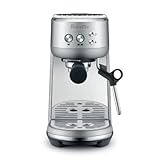
The Breville Bambino is the best compact machine in this list for an owner who is serious about espresso but does not need an integrated grinder. Its rapid-heating thermoblock approach minimizes the waiting associated with a traditional boiler, and its 54 mm portafilter and manual steam wand support a more deliberate workflow than inexpensive pod-like machines. The essential catch is that grinder quality becomes your responsibility.
Key specifications and use
- Compact thermoblock heating system designed for quick start-up.
- 54 mm portafilter format, with single- and double-shot brewing accessories depending on configuration.
- Manual steam wand with automatic milk-temperature assistance in the Bambino platform.
- Reservoir-fed operation; no household plumbing installation.
Heat-up time is the Bambino’s clearest advantage. It can be ready far sooner than a conventional single boiler, making it suitable for weekday use when the machine is switched on shortly before brewing. Rapid heating does not mean unlimited steam capacity: the thermoblock can produce useful steam, but the experience is still different from a large commercial boiler that can steam continuously.
Temperature control is primarily managed through the machine’s programmed brewing system rather than a full enthusiast menu. That is enough for a repeatable starting point, but advanced users may eventually want more control over pre-infusion, brew temperature, and pressure. The machine is at its best when paired with a capable espresso grinder, a scale, and fresh beans.
Pros
- Very small footprint compared with boiler-based prosumer machines.
- Fast start-up and convenient transition between brewing and steaming.
- Well suited to owners who want to choose their own grinder.
- Established brand support and a familiar accessory ecosystem.
Cons
- No built-in grinder, so the complete setup costs more than the machine alone suggests.
- Less thermal reserve than a substantial single boiler or dual boiler.
- Limited direct control compared with advanced enthusiast machines.
- 54 mm accessories are less interchangeable with the 58 mm commercial standard.
The nearest alternatives are the Barista Pro and Gaggia E24. The Barista Pro occupies more counter space but adds a grinder, display, and a more developed all-in-one workflow. The Gaggia is slower to heat but more traditional and potentially more appealing to owners who prioritize mechanical serviceability. Choose the Bambino when speed, size, and a separate grinder matter more than boiler mass.
3. Breville Barista Pro – Best all-in-one prosumer workflow
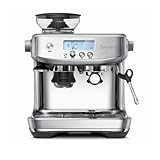
The Breville Barista Pro is the strongest overall recommendation for a serious home barista who wants one machine to cover grinding, brewing, and milk steaming. Its integrated conical burr grinder, thermoblock heating, digital interface, and manual steam wand create a more guided workflow than the Barista Express while retaining meaningful control over dose and extraction. It is especially suitable for one to four drinks per session rather than a large brunch crowd.
Key specifications
- Integrated conical burr grinder with adjustable grind settings.
- Thermoblock heating architecture designed for faster readiness than a traditional boiler.
- Digital interface for selecting and adjusting brewing functions.
- 54 mm portafilter and manual steam wand.
- Reservoir-fed design rather than plumb-in operation.
The Barista Pro’s compromise is deliberate: it gives up the water reserve and separate heating circuits of a dual boiler to reduce heat-up time and footprint. For a household making two lattes in the morning, that is often an excellent trade. For six drinks in rapid succession, steam recovery and workflow pauses become more noticeable, particularly if every drink requires a large pitcher of milk.
Temperature control is more practical than on basic machines because the interface provides clearer programming and feedback, but it is not the same as having independently adjustable brew and steam boilers. The grinder is convenient and keeps the counter tidy, although a separate grinder remains easier to upgrade. Once the built-in grinder becomes the limiting factor, replacing the whole machine is less economical than upgrading a standalone grinder.
Pros
- Best balance of convenience, control, and counter efficiency in this group.
- Integrated grinder reduces equipment count and simplifies the morning routine.
- Fast heating is useful for everyday use.
- Manual steam wand allows better texture than automatic frothing systems.
Cons
- Integrated grinder limits upgrade flexibility.
- Not plumbable and not a dual-boiler machine.
- 54 mm accessories are less universal than 58 mm commercial accessories.
- More electronics and moving parts can make diagnosis more involved than on a basic traditional machine.
Compared with the Barista Express, the Barista Pro is the more modern and quicker-feeling platform, with a more informative interface. The Express may appeal to someone who prefers an analog pressure display and a more tactile routine. Compared with the Bambino, the Pro costs more and occupies more space but avoids the need to buy a separate grinder. It is the best single-box answer for most aspiring home baristas.
4. Breville Barista Express – Best for hands-on all-in-one control

The Breville Barista Express remains a popular all-in-one format because it combines a conical burr grinder, manual espresso preparation, a pressure display, and a steam wand in one countertop appliance. It suits an owner who wants to learn dosing, tamping, extraction timing, and milk texturing without assembling a separate grinder-and-machine system. It is less attractive if your priority is the shortest possible heat-up time.
Key specifications
- Integrated conical burr grinder with adjustable grind selection.
- Thermocoil-style heating system and reservoir-fed water circuit.
- Pressure gauge for observing extraction pressure.
- 54 mm portafilter and manual steam wand.
- Hot-water outlet for Americanos and rinsing.
The pressure gauge is useful as a diagnostic aid, but it should not be treated as a complete measure of espresso quality. Grind size, dose, distribution, tamping, coffee freshness, and temperature all influence the result. The gauge can reveal that a shot is flowing unusually quickly or choking, yet it cannot tell you whether the coffee tastes balanced.
The Express has more physical controls than an ultra-compact machine, but it still uses an integrated heating system rather than separate brew and steam boilers. Allow time for the group, portafilter, and cup to warm, especially if the machine has just been switched on. A short warm-up may produce hot water while the metal brewing path remains less stable than it will be after a longer preheat.
Pros
- Complete grinder-to-cup workflow in one machine.
- Pressure gauge encourages useful observation while learning.
- Manual wand supports real milk-texturing practice.
- Established platform with broad familiarity among home baristas.
Cons
- Slower and less streamlined than the Barista Pro for some daily routines.
- Integrated grinder is difficult to upgrade independently.
- Not a dual boiler and not designed for continuous entertaining.
- Requires regular cleaning of both the grinder area and brewing system.
The stainless Barista Express and Black Truffle Barista Express are finish variants of the same general product platform, so choose between them primarily by availability, price tier, and kitchen appearance. The Barista Pro is the closest functional alternative and has the advantage in interface and speed. The Gaggia E24 is the better alternative if a 58 mm portafilter and more traditional boiler architecture matter more than an integrated grinder.
5. CASABREWS 3700 Essential – Best for low-cost manual espresso

The CASABREWS 3700 Essential is a budget manual espresso machine with a stainless-steel exterior element and a steam wand. It is aimed at the first-time buyer who wants espresso-style drinks and manual milk frothing at a low entry cost. It can be a sensible learning platform when expectations are modest, but it does not offer the heating reserve, advanced temperature control, or repair ecosystem associated with higher-end prosumer machines.
Key specifications and ownership considerations
- Compact reservoir-fed pump machine.
- Stainless-steel construction or exterior detailing as identified in the product name.
- Manual steam wand for milk frothing.
- Requires ground coffee; a separate espresso grinder is the quality upgrade to plan for.
The 3700 Essential is more dependent on coffee preparation than a casual buyer may expect. Pre-ground coffee can work for convenience, but espresso loses aroma quickly after grinding. A burr grinder capable of fine adjustment gives you control over flow rate, while a small digital scale helps keep dose and yield consistent.
Steam performance should be viewed as one-cup-at-a-time capability. Purge the wand before and after steaming, wipe it immediately, and avoid allowing milk to dry inside the tip. A clogged steam tip can look like a failed pump or weak heater when the real problem is residue.
Pros
- Low-cost route into manual espresso.
- Compact footprint for apartments and small counters.
- Includes a wand instead of restricting the user to black coffee.
- Separate grinder compatibility leaves room for improvement.
Cons
- Limited information about advanced temperature regulation and pressure control.
- Small heating system is less suitable for consecutive drinks.
- Accessories and replacement parts may be less standardized than Gaggia or Breville parts.
- “Essential” controls require more trial and error from the operator.
Compared with the De’Longhi Stilosa, the CASABREWS offers a similar budget manual category with a more stainless-oriented presentation. The De’Longhi has the advantage of a long-established brand and simple conventional controls. The 3700 is preferable when initial price and a compact stainless appearance lead the decision; choose the Stilosa when basic simplicity and brand familiarity are more important.
6. Gaggia E24 – Best for traditional repairability
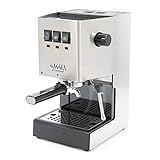
The Gaggia E24 is the most traditionally prosumer-oriented machine in this group. Its single-boiler design, brass boiler, commercial-style 58 mm portafilter, three-way solenoid, and manual steam wand give it a familiar structure for enthusiasts who want to learn classic espresso technique and keep a machine for years. It is not the fast convenience choice: the boiler needs time to heat, and brewing and steaming are sequential tasks.
Key specifications
- Single boiler with brass construction.
- 58 mm portafilter, the common commercial accessory size.
- Three-way solenoid valve for managing pressure at the group after brewing.
- Manual steam wand.
- Reservoir-fed operation; no built-in grinder.
The 58 mm format is a major ownership advantage. It gives access to a wide range of baskets, tampers, dosing tools, and bottomless portafilters. A 58 mm portafilter does not automatically make better espresso, but it makes accessories easier to source and gives the user a more conventional platform for experimentation.
Single-boiler operation requires planning. Brew the shot, wait for the boiler to reach steam temperature, texture the milk, then return the machine to brew temperature. That sequence is slower than a thermoblock machine for one drink, but it can feel more predictable once the owner learns the routine. A good separate grinder is essential because the E24 does not provide one.
Pros
- Traditional architecture is easier for many technicians to understand and service.
- 58 mm accessories support a broad upgrade path.
- Brass boiler offers more thermal mass than the smallest compact systems.
- Three-way solenoid improves post-shot puck handling and group management.
Cons
- Slower heat-up than the Bambino or other rapid thermoblock machines.
- Cannot brew and steam simultaneously.
- Requires a separate grinder and more counter space.
- Needs attention to descaling, gasket replacement, and boiler maintenance.
Compared with the Barista Pro, the Gaggia is slower and less convenient but more open to traditional accessory and service approaches. Compared with the Barista Express, it lacks an integrated grinder but provides the more universal 58 mm format. Select the E24 when repairability, tactile control, and long-term platform flexibility outweigh start-up speed.
7. Breville Barista Express Black Truffle – Best for an all-in-one dark finish

The Black Truffle version of the Breville Barista Express is the same general all-in-one category as the brushed-stainless Barista Express, with its dark finish serving as the main visible distinction. It is suited to someone who wants integrated grinding, a pressure gauge, a manual steam wand, and a familiar learning workflow in a finish that fits a darker kitchen.
Key specifications and use
- Integrated conical burr grinder.
- Thermocoil-style heating and reservoir-fed water supply.
- Pressure gauge and manual brewing controls.
- 54 mm portafilter and manual steam wand.
- Hot-water function for Americanos and rinsing.
The same ownership realities apply as with the stainless Barista Express. The grinder makes the machine space-efficient but prevents the owner from choosing a different grinder without maintaining two separate workflows. The steam wand is appropriate for learning milk texture, but the machine is best used in short household sessions rather than continuous service.
Finish should not be confused with construction class. A darker exterior may show fingerprints, water spots, or milk splashes differently from brushed stainless steel, and any painted or coated surface should be cleaned with a soft damp cloth rather than abrasive powder. Keep the grinder hopper, dosing area, group gasket, and steam tip clean; appearance cannot compensate for neglected coffee oils and milk residue.
Pros
- Integrated workflow saves counter space.
- Manual controls and pressure feedback suit learners.
- Manual steaming is more flexible than automatic frothing.
- Dark finish can coordinate with a modern kitchen.
Cons
- Same integrated-grinder upgrade limitation as other Barista Express versions.
- Sequential heating is not ideal for large groups.
- 54 mm accessories are less universal than 58 mm equipment.
- Finish may require more careful cleaning to retain its appearance.
The nearest alternative is the stainless Barista Express, and the practical choice is whichever finish is better priced and easier to keep clean. The Barista Pro is the meaningful performance alternative, offering a faster-feeling interface and newer workflow. The Black Truffle model is a style-led selection within a proven all-in-one platform, not a different boiler class.
8. AERCANA 20 Bar – Best for basic compact convenience

The AERCANA Espresso Machine is a compact pump machine with a listed 20-bar pump class, milk frother, and stainless-steel exterior elements. It targets beginners who want occasional espresso-style beverages and a small appliance footprint. It should be judged as a budget convenience machine rather than by the 20-bar figure alone.
Key specifications and practical meaning
- Compact countertop form.
- Listed 20-bar pump class.
- Milk-frothing wand.
- Stainless-steel exterior or stainless-steel components as identified in the name.
- Reservoir-fed, manual espresso workflow.
Pump ratings are commonly misunderstood. A maximum pump rating is not the pressure that should be forced through a coffee puck, and it does not describe temperature stability, flow regulation, steam power, or the quality of the included baskets. The operator should focus on a steady extraction, fresh coffee, correct grind, and clean equipment rather than chasing the largest printed pressure number.
For a household using the machine once or twice a day, the AERCANA may be adequate, particularly if milk drinks are more important than precise espresso tasting. For frequent use, investigate replacement seals, baskets, and steam-tip availability before buying. A machine is easier to own when wear parts can be found without replacing the whole appliance.
Pros
- Compact budget-oriented format.
- Steam wand enables cappuccino-style drinks.
- Stainless elements may be easier to wipe clean than textured plastic.
- Simple controls can be approachable for new users.
Cons
- 20-bar labeling does not establish superior extraction.
- Less evidence of advanced temperature adjustment or thermal reserve.
- Not suitable for plumb-in installation or commercial-volume use.
- Long-term parts and service support should be checked before purchase.
The AERCANA is closest to the CASABREWS 3700 Essential and De’Longhi Stilosa. The CASABREWS offers a similar manual budget approach, while the Stilosa benefits from De’Longhi’s established category presence. Choose AERCANA when compactness and listed features are the priority, but choose Gaggia or Breville when repairability and repeatable enthusiast workflow matter more.
9. De’Longhi Classic Signature – Best for accessible manual frothing

The De’Longhi Classic Signature is a manual espresso machine with an adjustable milk frother, designed for users who want more flexibility than an automatic milk system while keeping the controls approachable. It fits occasional espresso and milk-drink preparation, especially for people who prefer a recognized appliance brand and a conventional reservoir-fed format.
Key specifications
- Manual espresso machine with a compact countertop design.
- Adjustable milk frother for changing the character of the milk foam.
- Water reservoir rather than direct plumbing.
- Manual workflow with a separate grinder recommended for serious espresso.
An adjustable frother is useful because cappuccino foam and latte microfoam are not identical targets. The setting alone does not create café-quality texture: milk temperature, pitcher position, air incorporation, and the final swirling motion matter more. Beginners should learn to introduce air briefly, then keep the milk circulating until it becomes glossy.
The Classic Signature is not the obvious choice for someone seeking pressure profiling, a large boiler, or simultaneous brewing and steaming. Its value is ease of entry and a more controllable milk process than a one-button frother. As with other compact machines, water quality and cleaning have an outsized effect on reliability.
Pros
- Adjustable frother supports different milk-drink styles.
- Accessible manual format for beginners.
- Established brand familiarity and broad general appliance support.
- Suitable for small kitchens and moderate use.
Cons
- Not designed as a high-volume prosumer machine.
- Separate grinder is needed for serious control over extraction.
- Exact heating and pressure features are less advanced than on enthusiast models.
- Manual cleaning remains necessary despite the approachable interface.
Compared with the De’Longhi Stilosa, the Classic Signature is the more feature-oriented option because of its adjustable frother. Compared with the Bambino, it is less attractive for a user who values the fastest heat-up and already owns a good grinder. It is a middle path for approachable milk preparation rather than a final machine for advanced espresso experimentation.
10. SECPOEDR 20 Bar – Best for feature-focused entry use

The SECPOEDR machine combines a listed 20-bar pump class with a touchscreen, milk frother, and a cold-brew function as stated in its product name. It is aimed at a buyer who values a broad menu and modern interface more than traditional espresso-machine architecture. The interface may make routine selection simple, but a touchscreen does not by itself provide better temperature stability or steam pressure.
Key specifications and use case
- Listed 20-bar pump class.
- Touchscreen control interface.
- Milk-frothing function.
- Cold-brew function as identified in the listing.
- Compact reservoir-fed appliance category.
This is a sensible choice when household members want different beverages and convenience matters more than deep manual control. It is less suitable for a barista who wants to change every extraction variable, fit commercial accessories, or service a conventional boiler. Confirm the cleaning instructions for the cold-brew and milk pathways, because additional beverage functions can create more places for residue to accumulate.
The 20-bar specification should be interpreted cautiously, just as with the AERCANA. The relevant questions are whether the machine provides a stable brew temperature, whether the basket is forgiving or requires a very precise grind, and whether steam power remains consistent after brewing. Those details often matter more than the pump’s maximum rating.
Pros
- Touchscreen may simplify drink selection.
- Includes milk preparation and a listed cold-brew mode.
- Compact format can suit occasional use.
- Broad feature list may appeal to mixed households.
Cons
- Feature breadth does not guarantee prosumer-level espresso control.
- Touchscreen electronics may be harder to repair than simple switches.
- 20-bar labeling is not a reliable quality metric.
- Additional beverage pathways require careful cleaning.
The nearest alternatives are the AERCANA and AIRMSEN. AERCANA is simpler and does not add a touchscreen-oriented beverage menu, while AIRMSEN adds an integrated grinder. Choose SECPOEDR for menu flexibility; choose a Breville or Gaggia when the goal is to learn and refine espresso itself.
11. AIRMSEN Espresso Machine with Grinder – Best for budget all-in-one convenience

The AIRMSEN machine combines an integrated grinder, a listed 20-bar pump class, and a milk-frothing steam wand in a compact format. It is intended for buyers who want a single appliance rather than a separate grinder and espresso machine. That convenience is its central strength and its principal limitation: when your grinder preferences become more demanding, the integrated design offers less independent upgrade flexibility.
Key specifications
- Integrated grinder for a grinder-to-cup workflow.
- Listed 20-bar pump class.
- Milk-frothing steam wand.
- Compact reservoir-fed machine format.
Integrated grinders reduce equipment count and simplify dosing, but they must be adjusted and cleaned more carefully than many owners expect. Old grounds can remain around the burrs and chute, changing the dose or flavor of the next shot. Brush loose coffee away regularly, avoid adding wet or oily beans, and follow the manual’s instructions before removing any grinder parts.
The AIRMSEN is most appropriate for low-to-moderate daily use and milk-based drinks. A serious enthusiast should ask whether replacement burrs, grinder calibration information, portafilter accessories, and seals are available. If those items are difficult to obtain, a separate grinder paired with a simple machine may be easier to keep running over time.
Pros
- Single-appliance convenience.
- Includes grinding and milk frothing.
- Compact alternative to buying two large appliances.
- Suitable for beginners who value a guided routine.
Cons
- Integrated grinder cannot be upgraded independently.
- 20-bar pump labeling does not establish extraction quality.
- Smaller heating systems are less suited to repeated milk drinks.
- Serviceability may be more complex than a basic manual machine.
Compared with the Barista Express, AIRMSEN offers the same broad all-in-one concept but with less established evidence of prosumer-oriented control and accessory support. Compared with the SECPOEDR, it gives up touchscreen and cold-brew features in favor of integrated grinding. It makes sense for convenience-focused beginners, not for someone who already owns a preferred espresso grinder.
12. De’Longhi Stilosa – Best for the smallest budget learning platform
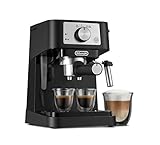
The De’Longhi Stilosa is a compact manual espresso machine with a manual milk frother. It is one of the simplest ways to begin making espresso-style drinks at home, especially for a buyer who has limited counter space and is willing to use a separate grinder or pre-ground coffee. It is not a prosumer machine in the strict sense, but it belongs in this comparison because it clarifies how much extra cost buys you in control and ownership flexibility.
Key specifications and use
- Compact manual pump-machine format.
- Manual milk frother rather than an automatic milk system.
- Reservoir-fed operation.
- Separate grinder recommended for fresh, adjustable espresso preparation.
The Stilosa’s simplicity can be an advantage. There are fewer menu decisions and fewer advanced settings to misunderstand, so a beginner can focus on grind, dose, tamp, extraction time, and milk technique. The trade-off is that the machine offers less feedback and less thermal reserve than the Barista Pro, Barista Express, or Gaggia E24.
Plan for a short, single-drink workflow. After brewing, wipe and purge the frother immediately, rinse the portafilter, and run a brief water flush through the group. These habits cost less than a minute but prevent milk residue, coffee oils, and blocked passages from becoming the reason an inexpensive machine appears to have failed.
Pros
- Small footprint and approachable manual controls.
- Low-cost entry to espresso-style brewing.
- Manual frother allows the user to learn basic milk texture.
- Separate grinder can improve results over time.
Cons
- Limited temperature, pressure, and workflow information.
- Not intended for high-volume or advanced prosumer use.
- Requires a separate grinder for the best control.
- Small heating system may require pauses between functions.
The Stilosa is closest to the CASABREWS 3700 Essential and AERCANA. It is a good choice when price, size, and brand familiarity dominate the decision. If you expect to become deeply involved in espresso, the Bambino with a separate grinder is a more expandable compact route, while the Gaggia E24 is the more serviceable traditional platform.
How to Choose
Start with the grinder, not the pump label
For espresso, the grinder is often the first limiting component. A grinder must produce fine particles with enough adjustment range to slow or speed the shot, and it should do so consistently enough that changing one variable produces a recognizable result. If you already own a suitable espresso grinder, the Bambino or Gaggia E24 makes more sense than paying again for an integrated grinder. If you want one appliance and do not want to learn two devices, the Barista Pro or Barista Express is more practical.
A listed 15-bar or 20-bar maximum pump rating is not a direct quality score. The pump can be capable of more pressure than the coffee puck should receive, while the machine’s valve, flow path, basket, and regulation determine what happens during extraction. Prioritize temperature behavior, repeatable dosing, a useful portafilter, and a grinder with a workable adjustment range.
Choose heating architecture according to your mornings
Thermoblock and thermocoil machines heat a smaller water path quickly, making them attractive when the machine is switched on just before use. The Bambino and Barista Pro are the clearest examples here. Their compact systems can be excellent for one or two drinks, but they do not have the same steam reserve as a large boiler. A pause may be needed between brewing and steaming, and a large pitcher of milk can expose the limit sooner than a small latte.
A single boiler, such as the Gaggia E24’s traditional arrangement, takes longer to heat but provides more thermal mass than the smallest compact machines. Brewing and steaming occur at different temperatures, so the machine must switch modes. This is slower, but many enthusiasts appreciate the predictable, mechanical workflow. For one person who values repairability and does not mind waiting, it can be the better long-term fit.
Dual boilers are not represented among the listed products. If you need simultaneous brewing and steaming for a large family breakfast, none of these should be presented as a true commercial-volume solution. A thermoblock machine can still be fast for a few drinks, but “fast heat-up” and “continuous steam” are separate characteristics.
Think in drinks per session
For one espresso or one milk drink a day, nearly every machine here can be workable if it is cleaned and paired with appropriate coffee. For two to four drinks, the Barista Pro, Barista Express, Bambino, and Gaggia become more attractive because their workflow and accessories are better defined. For six or more milk drinks in a short period, look beyond this list toward a machine with a larger boiler or dual boilers.
Steam power is affected by pitcher size, milk volume, wand design, and technique. A machine that can texture 150 to 200 milliliters of milk comfortably may feel slow with a large 350 to 500 milliliter pitcher. Beginners often overfill the pitcher, which increases steaming time and makes it harder to create a controlled vortex. Fill only to around the lower part of the pitcher’s spout or to the level recommended by the machine’s instructions.
Measure the counter before buying
Do not measure only the machine’s width. Leave room to remove the water reservoir, lift the grinder hopper lid, insert the portafilter, and position a milk pitcher. A machine that fits between cabinets may be unusable if the reservoir can only be lifted from above. Also measure the distance from the drip tray to the cabinet above: a tall cup may fit under the spout while the hopper lid cannot open.
Compact machines such as the Stilosa, Bambino, AERCANA, and CASABREWS models are easier to accommodate, but a separate grinder adds another footprint. An all-in-one Barista Pro or Barista Express may occupy more width but use less total counter length than two separate appliances. The Gaggia requires space for the machine, grinder, tamper, scale, and accessories, yet its 58 mm ecosystem can make those accessories easier to standardize.
Decide whether plumbing matters
Every product in this list is best treated as a reservoir-fed machine, not a direct-plumb model. Reservoir operation is easier for renters and avoids installing a filter, shutoff valve, and drain arrangement. It also means carrying water, refilling the tank, and managing the quality of the water that enters the machine.
Use filtered water when appropriate for your local supply, but do not assume that completely mineral-free water is ideal for every machine. Water chemistry affects taste, scale formation, sensors, and heating components. Follow the manufacturer’s water and descaling guidance rather than using vinegar automatically; vinegar can leave odor and may not be the recommended treatment for all internal materials.
Temperature control is more than a number
Temperature stability depends on the heater, sensor placement, control software, water path, group, portafilter, and preheating routine. A machine with a displayed temperature setting may still need a warm-up period for the portafilter and group. Conversely, a compact machine with fewer settings may produce a repeatable drink if it is used consistently.
Use a repeatable recipe as your baseline. For example, weigh the dose, weigh the brewed beverage, and time the extraction. A common starting point is a ratio near 1:2 by weight, but coffee, basket size, roast level, and taste determine the final recipe. If a shot runs too quickly, adjust the grinder finer; if it chokes, adjust coarser. Change one variable at a time rather than responding to a bitter shot by changing dose, tamping, temperature, and yield simultaneously.
Understand portafilter size and upgrade paths
The Breville machines in this list use a 54 mm format, while the Gaggia E24 uses the more widely standardized 58 mm format. Both can make excellent coffee. The practical difference is accessory availability: 58 mm tampers, baskets, dosing funnels, and bottomless portafilters are especially easy to find because commercial machines commonly use that size.
A 54 mm system is not a reason to reject a Breville machine if its heating and workflow suit you. It does mean you should buy compatible accessories rather than assuming every commercial accessory will fit. For a buyer who expects to experiment extensively and keep the same machine for many years, the Gaggia’s traditional format offers a clearer upgrade path.
Compare integrated and separate grinders
An integrated grinder is valuable when counter space, simplicity, and a single purchase matter. It also reduces the number of settings a beginner must understand. The disadvantages appear later: grinder burr wear, retention, calibration, and repair affect the machine, and changing to a different grinder means leaving the all-in-one workflow.
A separate grinder costs more at the beginning but gives you a modular system. You can replace the grinder while keeping the espresso machine, or choose a brew grinder and espresso grinder for different coffees. The Bambino is the clearest choice for this path. The Gaggia also benefits from it, particularly because the machine itself has no grinder and uses a widely supported portafilter size.
Evaluate repairability before purchase
The parts most likely to need attention are not mysterious: group gaskets flatten, shower screens collect coffee oils, steam-tip holes clog, water filters expire, grinder burrs wear, and pumps or valves can eventually lose performance. A machine used daily may need gasket and cleaning attention sooner than one used weekly. These are ownership tasks, not evidence that a machine is defective.
Traditional machines with mechanical switches, replaceable gaskets, accessible valves, and common portafilter sizes are often easier for independent technicians to understand. Machines with touchscreens, integrated grinders, proprietary sensors, and compact sealed assemblies can still be reliable, but diagnosis and parts access may be more specialized. Before choosing a budget model, search for its manual, cleaning procedure, replacement basket, group gasket, steam tip, and water tank availability. A low purchase price is less attractive if a small failed seal requires discarding the appliance.
Use a simple ownership calculation
Suppose a household makes two drinks a day, five days a week. That is 520 drink preparations per year. If a machine costs 400 units of currency in your market, the first-year machine cost is roughly 0.77 per drink before beans, milk, electricity, water, and cleaning supplies. At four drinks per day on the same schedule, it falls to about 0.38 per drink. This does not prove that the more expensive machine is economical, because repair and grinder costs still matter, but it shows why frequent users may rationally pay for faster workflow and better serviceability.
For a once-a-week user, the calculation reverses: convenience features and a large boiler may sit unused while seals and water pathways still require care. A small manual machine can be the more sensible choice. Heavy daily users should spend more attention on cleaning access, parts availability, steam recovery, and grinder replacement than on decorative finishes.
Match the choice to your situation
| Your situation | Best fit from this list | Why |
|---|---|---|
| Very little counter space; separate grinder available | Breville Bambino | Compact thermoblock workflow and fast readiness. |
| Want one appliance and are learning espresso | Breville Barista Pro | Integrated grinder, display, and manual steam wand. |
| Want one appliance with more tactile feedback | Barista Express | Integrated grinder, pressure gauge, and manual controls. |
| Prioritize traditional service and accessories | Gaggia E24 | Single boiler, brass construction, 58 mm portafilter, and conventional layout. |
| Occasional cappuccinos on a low budget | De’Longhi Stilosa or CASABREWS 3700 | Simple manual brewing and milk frothing without advanced features. |
| Want an integrated grinder at a lower tier | AIRMSEN | Combines grinding, pumping, and frothing in one compact appliance. |
| Want a touchscreen and multiple listed beverage functions | SECPOEDR | Feature-focused interface with milk and cold-brew functions. |
Frequently Asked Questions
What is the best prosumer espresso machine in this comparison?
The Breville Barista Pro is the best overall balance of integrated grinding, fast heating, guided control, and manual steaming. The Gaggia E24 is a better fit if traditional serviceability and a 58 mm accessory ecosystem matter more than heat-up speed.
Are 20-bar espresso machines better?
No. A maximum pump rating is not the same as the pressure delivered at the coffee puck during a well-prepared shot. Grind consistency, temperature stability, flow regulation, coffee freshness, and basket design matter more than the largest printed pressure number.
Is a single boiler better than a thermoblock?
Neither is universally better. A thermoblock usually offers faster readiness and a smaller footprint, while a single boiler can provide a more traditional workflow and more thermal mass. Choose based on whether you value speed and convenience or repairability and classic operation.
Do I need a separate espresso grinder?
Yes, if you choose the Bambino, Gaggia E24, Stilosa, or a similar machine without an integrated grinder. Even with an integrated-grinder machine, a separate grinder can become a worthwhile upgrade when you want more consistency, lower retention, or independent replacement.
Can these machines be plumbed into a water line?
They should be treated as reservoir-fed machines. Do not modify a machine for plumbing unless the manufacturer explicitly supports it and the installation includes the required filtration, pressure control, shutoff, and drain arrangements.
How often should an espresso machine be cleaned?
Wipe and purge the steam wand after every milk use, rinse the portafilter after each shot, and empty the drip tray before it becomes stagnant. Backflushing, group cleaning, grinder cleaning, water-filter replacement, and descaling should follow the machine’s manual and your water conditions.
What wears out first on a home espresso machine?
Group gaskets, shower screens, steam-tip openings, water filters, and grinder burrs are common maintenance items. Pumps, valves, switches, sensors, and heating components can last much longer but may eventually need service, especially when scale and coffee residue are allowed to accumulate.
Is the Gaggia E24 worth the slower heat-up?
It can be, if you value a traditional single-boiler design, a 58 mm portafilter, and a clearer long-term accessory and service path. It is less suitable if you need a drink immediately after switching on or regularly prepare many milk drinks in quick succession.
For the best all-in-one balance, choose the Breville Barista Pro. For the smallest serious setup, choose the Bambino with a capable separate grinder. For hands-on traditional ownership, choose the Gaggia E24. For occasional low-cost milk drinks, the Stilosa, CASABREWS 3700, or CM5418 is sufficient; choose the AIRMSEN or SECPOEDR only when integrated grinding or extra interface features matter more than repairability and advanced espresso control.





Write Your Review
No reviews yet. Be the first to share your experience!