

Key takeaways
- Pressure control: “15-bar” or “20-bar” pump labels describe maximum pump capability, not the pressure at the coffee puck. Espresso is commonly brewed near 9 bar, and a pressure-regulating valve is more meaningful than a high headline number.
- Temperature stability: Thermoblock systems heat quickly but may vary more during a shot than a heavier boiler or thermally stable brew group.
- Milk texture: Small machines often make airy foam rather than smooth microfoam, especially when using an automatic frothing attachment.
- Durability: Plastic panels are not necessarily a problem, but lightweight portafilter parts, steam valves, pumps, and seals may wear sooner with daily heavy use.
Best Espresso Machines Under Any Budget
The best espresso machines under each budget are a simple manual lever or entry-level pod-free machine under $300, a compact semi-automatic machine around $300–$700, a prosumer single-boiler machine around $700–$1,500, and a dual-boiler or super-automatic machine above $1,500.
Price changes what you can control. The least expensive machines can make enjoyable espresso, but they usually compromise on temperature stability, grinder quality, milk steaming, construction, or repairability. Spending more does not automatically produce better coffee; it mainly buys consistency, speed, stronger steam performance, and fewer workarounds.
Our top picks

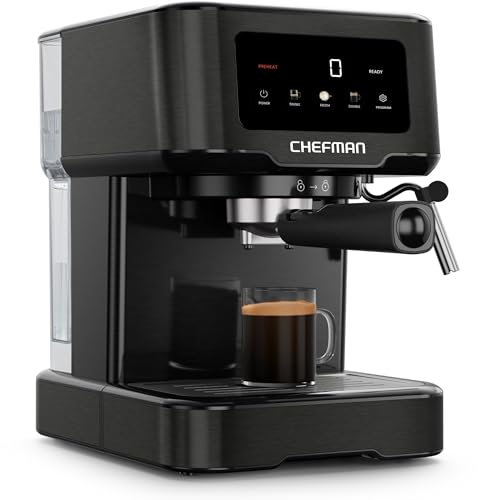


As an Amazon Associate we earn from qualifying purchases at no extra cost to you. Ratings are shown as listed on Amazon.
Quick choices by situation
| Situation | Best machine type | Typical 2026 price | Main compromise |
|---|---|---|---|
| Lowest cost and occasional use | Manual lever or basic semi-automatic | $100–$300 | More manual preparation and weaker milk steaming |
| One or two milk drinks daily | Compact semi-automatic with a separate grinder | $300–$700 | Small boilers and slower recovery between drinks |
| Frequent espresso and learning control | Single-boiler prosumer machine | $700–$1,500 | Usually cannot brew and steam at the same time |
| Several milk drinks in succession | Heat-exchanger or dual-boiler machine | $1,200–$3,000+ | Greater size, heat-up time, and maintenance cost |
| Convenience over barista control | Bean-to-cup super-automatic machine | $700–$2,500+ | Less control and more specialized cleaning |
Under $300: the sensible entry point
At this level, choose between a manual lever machine, a compact semi-automatic machine, or a capsule system. A manual lever machine can deliver excellent pressure control and has fewer electrical parts, but it requires a good grinder, accurate dosing, and a willingness to manage the shot by hand. Capsule machines are fast and tidy, but ongoing capsule costs and limited coffee choice can outweigh the lower purchase price.
Basic semi-automatic machines from brands such as De’Longhi can be practical for occasional espresso and modest kitchen spaces. Look for a standard 58 mm or 51 mm portafilter, a metal brew group where possible, a removable water tank, and a steam wand that is not permanently restricted to one automatic setting.
What you give up at this price
- Pressure control: “15-bar” or “20-bar” pump labels describe maximum pump capability, not the pressure at the coffee puck. Espresso is commonly brewed near 9 bar, and a pressure-regulating valve is more meaningful than a high headline number.
- Temperature stability: Thermoblock systems heat quickly but may vary more during a shot than a heavier boiler or thermally stable brew group.
- Milk texture: Small machines often make airy foam rather than smooth microfoam, especially when using an automatic frothing attachment.
- Durability: Plastic panels are not necessarily a problem, but lightweight portafilter parts, steam valves, pumps, and seals may wear sooner with daily heavy use.
For this tier, budget for a separate burr grinder if you want repeatable espresso. A machine with a pressurized basket can compensate for inconsistent grinding, but it cannot match the control of freshly ground coffee in a proper single-wall basket.
$300–$700: the best value for most home users
This is the strongest value range for people who want real espresso without turning the kitchen into a coffee station. The Breville Bambino and Bambino Plus are compact examples of fast-heating semi-automatic machines, while the Gaggia Classic line and De’Longhi Dedica represent different approaches to traditional home espresso. The Breville Barista Express combines a machine and grinder, which saves counter space but means replacing the entire unit is less flexible if either side becomes outdated.
A separate grinder-and-machine setup is usually the better long-term choice. A compact espresso grinder with stepless or fine adjustment gives you control over dose and grind size, while the machine supplies brewing and steaming. If you drink mostly straight espresso, prioritize grinder quality and temperature consistency. If you drink cappuccinos, prioritize steam power and a comfortable steam wand.
Who should buy here?
- Beginners: Choose automatic volumetric dosing or a forgiving pressurized basket initially, then move to a single-wall basket as your grinding improves.
- Small kitchens: Measure height with the water tank removed or opened. Some compact machines need additional clearance above the machine, not merely a suitable footprint.
- Daily users: Prefer a removable brew screen, accessible gasket, and replaceable parts. Convenience features are less valuable if cleaning requires dismantling the machine.
Expect to make one drink at a time comfortably. After brewing, many single-thermoblock machines need a short transition before steaming. That delay is a normal design limitation, not necessarily a fault.
$700–$1,500: better control and stronger steam
In this range, machines such as the Rancilio Silvia and Profitec GO offer more substantial construction and a more capable manual workflow than entry-level models. You may get a metal chassis, a larger portafilter, a sturdier steam valve, a pressure gauge, improved temperature control, or a serviceable boiler. Exact features vary by version, so confirm the current specification before buying.
Single-boiler machines are particularly good for a user who values espresso quality and does not mind a deliberate routine. They generally brew first and steam second. A typical workflow is to extract the shots, switch to steam mode, wait for the boiler to reach steam temperature, texture the milk, then allow the machine to cool or flush before the next brew.
A machine in this class can last many years when its water quality is managed and its seals are replaced as needed. However, greater repairability does not mean zero maintenance. Boiler scale, worn group gaskets, clogged steam tips, and failing vibration pumps remain normal ownership issues.
Over $1,500: speed, volume, and fewer compromises
Spend above $1,500 when you regularly make several drinks, want to brew and steam at the same time, or care about repeatability more than minimizing cost. Dual-boiler machines provide separate heating systems for brewing and steam. Heat-exchanger machines use one boiler with a dedicated brew path and can also support simultaneous brewing and steaming, though their temperature management may be less direct.
For a conventional espresso workflow, brands such as Lelit, Profitec, ECM, Rocket Espresso, and Rancilio offer machines in the prosumer segment. A dual-boiler model can be especially useful for a household making four or more milk drinks in a short period. The benefits are real, but so are the costs: a larger footprint, higher electricity use during warm-up, more expensive components, and more involved descaling or water-treatment requirements.
Super-automatic machines from brands such as Jura, De’Longhi, and Philips suit households that value one-touch convenience. They grind, dose, brew, and often froth milk with minimal skill. Their weak point is not necessarily cup quality; it is limited control over extraction and a more specialized internal cleaning routine. Milk pathways must be cleaned promptly, and the brew unit or internal mechanism may require regular rinsing and servicing.
Pressure, milk, and durability: the specifications that matter
| Feature | Useful target | Why it matters |
|---|---|---|
| Brew pressure | About 9 bar at the puck | More meaningful than a pump’s 15–20 bar maximum rating |
| Portafilter | 54 or 58 mm for common home systems | Offers wider access to replacement baskets and accessories |
| Water tank | 1.5–2.5 litres | Reduces refilling, although steaming and flushing consume water |
| Boiler capacity | 0.3–0.6 litres for single boiler; 1.5 litres or more for steam boiler systems | Larger steam capacity improves consecutive milk drinks |
| Warm-up | 3–10 minutes, depending on design | Fast heat-up improves convenience but may not equal thermal stability |
| Steam wand | Manual, multi-hole tip | Provides better control of smooth microfoam than an automatic frother |
Do not judge a machine by wattage alone. A high-wattage thermoblock may heat quickly, while a lower-wattage boiler may hold temperature more steadily. For milk, the boiler design, steam valve, wand tip, and recovery time matter more than the advertised electrical rating.
Ownership costs and a maintenance routine
Suppose a $500 machine lasts five years and you make 300 drinks annually. The machine cost is about $0.33 per drink before coffee, milk, electricity, water treatment, and repairs: $500 divided by 1,500 drinks. A $1,500 machine used for 1,500 drinks per year over five years costs about $0.20 per drink, but only if you actually use its extra capacity. The cheaper machine is not automatically cheaper when its performance encourages replacement after two years.
Use this routine to protect the machine:
- Empty and rinse the portafilter immediately after brewing so oils do not harden in the basket.
- Purge and wipe the steam wand immediately after every milk drink. Dried milk can block the tip and create a hygiene problem.
- Backflush with water regularly if the manufacturer permits it, and use a cleaning tablet at the interval specified for the model.
- Replace the group gasket when it leaks around the portafilter or becomes visibly flattened.
- Test your water hardness and follow the manufacturer’s descaling guidance. Excessive descaling can be harmful on some machines; prevention with suitable filtered water is often better.
- Clean the grinder, if included, before changing beans or whenever the grind becomes inconsistent.
Final buying rule
Choose under $300 for occasional drinks and a low-commitment start, $300–$700 for the best balance of cost and capability, $700–$1,500 for control and repairable construction, and above $1,500 for high-volume milk drinks or maximum convenience. Whichever tier you choose, reserve part of the budget for a good grinder, suitable water, a scale, and cleaning supplies: those accessories often improve the cup more than a larger pressure number on the machine’s box.








Write Your Review
No reviews yet. Be the first to share your experience!