

Key takeaways
- Best for: Daily users who want the tamper’s weight to do most of the work
- Watch for: Cheaper chrome-plated zinc alloy bases sold as “stainless look” – they chip and lose their edge quickly
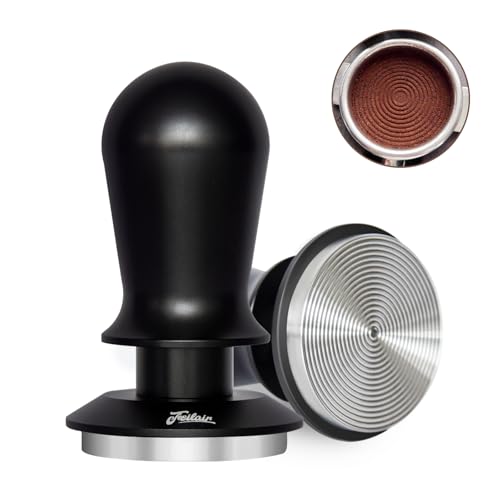
The best 54mm espresso tampers for even extraction on Breville portafilters are 53.3mm precision-fit tampers with a weighted stainless steel base, with calibrated spring models being the best choice for consistency and non-calibrated models being better for hands-on control and feel.
Breville’s 54mm portafilters (found on the Barista Express, Barista Pro, Barista Touch, Bambino and Bambino Plus) actually measure about 53.5-54mm inside, so a standard 54mm tamper leaves a ring of untamped coffee around the edge that causes channeling. A 53.3mm tamper fits the basket with ~0.2mm clearance, which is why most of the best options for these machines are marketed as 53.3mm rather than flat 54mm.
Our top picks


As an Amazon Associate we earn from qualifying purchases at no extra cost to you. Ratings are shown as listed on Amazon.
Stainless Steel vs. Aluminum: Which Base Material Matters More
The base material changes weight, durability, and how the tamper feels in the basket, not just how it looks.
Stainless Steel Bases
Stainless steel (typically 304 food-grade) is the standard for even extraction because of its density. A stainless base weighs 250-400g on its own, so you need less muscle pressure to achieve a level, compact puck. It holds a polished finish longer, resists corrosion from coffee acids and water, and keeps its sharp, flat edge that prevents grounds from creeping up the sidewall. The downside is that a full stainless tamper can weigh 450-550g total, which can fatigue wrists during back-to-back shots.
- Best for: Daily users who want the tamper’s weight to do most of the work
- Watch for: Cheaper chrome-plated zinc alloy bases sold as “stainless look” – they chip and lose their edge quickly
Aluminum Bases
Anodized aluminum bases are much lighter, usually 100-180g for the base. That makes the tamper easier to maneuver and cheaper, with market ranges generally $20-$40 versus $35-$70 for stainless. Aluminum is softer, so the edge can round or ding if dropped, and thin anodizing can wear through over time, leaving a rougher surface that grips coffee fines.
- Best for: Budget buyers, travel setups, or anyone who prefers to control pressure entirely by hand
- Watch for: Aluminum transfers heat quickly, so it can feel very cold or hot if left near the machine
For even extraction, stainless steel wins for most Breville owners because the extra mass helps keep the tamp level without pushing at an angle. Aluminum only makes sense if you intentionally want a lighter tool or need to keep costs down.
Calibrated vs. Non-Calibrated Tampers: Pressure Consistency Explained
The ideal tamping pressure is widely cited as 30 lbs (about 15kg) of force, but consistency matters more than hitting that exact number. Calibrated and non-calibrated tampers achieve that consistency differently.
Calibrated (Spring-Loaded) Tampers
Calibrated tampers use an internal spring that clicks or collapses only when you reach a set pressure, typically 25-35 lbs. You push until you feel the click, then stop. This removes guesswork and is especially valuable for beginners or households where multiple people make coffee.
- Pros: Identical pressure every time, reduces channeling from under-tamping, great for training muscle memory
- Cons: Fixed pressure – you cannot easily tamp lighter for darker roasts or harder for lighter roasts without swapping springs; more moving parts to clean
- Common types: Normcore V4 Spring-Loaded, Espro Calibrated Tamper, Force Tamper (Bravo) with auto-leveling
Non-Calibrated (Traditional) Tampers
A traditional solid tamper has no spring. You rely on body weight and feel. Experienced baristas often prefer this because puck resistance changes with grind size, dose, and roast freshness. You can adjust on the fly.
- Pros: Simpler, more durable, full pressure control, easier to clean, usually 50-100g lighter without the spring mechanism
- Cons: Pressure varies shot to shot until your technique is solid, which can create uneven extraction
- Common types: Pullman Barista Tamper, Crema Coffee Products Traditional Tamper, MATOW Flat Base Tamper
If your shots often taste sour, watery, or spray from the portafilter, a calibrated tamper will fix the variable of pressure. If you already dose and grind consistently and want to fine-tune extraction, a traditional tamper gives more control.
Handle Ergonomics for Breville Portafilters
Breville portafilters have a shallower basket depth and a handle that sits lower than commercial 58mm portafilters, so ergonomics matter more than you think.
Palm vs. Finger Grip: Flat-palm tampers (like those with a low-profile, mushroom-style top) let you press with your palm directly over the center, which promotes a level tamp. Traditional straight handles force a finger grip that can tilt if your wrist bends.
Height and Knuckle Clearance: Look for a handle height of 75-90mm. Taller handles give more knuckle clearance above the portafilter fork when tamping on the machine’s edge, while very short handles can cause you to hit the counter.
Material: Wood (walnut, oak) stays warm and provides grip but needs occasional oiling and should not be soaked. Aluminum handles are cold but wipe clean and are dishwasher-safe on most models. Silicone-coated or textured polymer handles offer the best wet grip.
Leveling Ridge: Auto-leveling designs like the Normcore V4 and Force Tamper have an outer guide ring that rests on the portafilter rim to guarantee a 90-degree angle. For Breville’s narrow 54mm basket, this feature prevents the most common beginner mistake: a slanted puck that channels on one side.
Spec Comparison: Top 54mm Tampers for Breville in 2026
All of these are sold specifically as 53.3mm to fit Breville 54mm baskets. Weights include handle and base.
| Model / Type | Actual Diameter | Base Material | Total Weight | Calibration | Handle Material |
|---|---|---|---|---|---|
| Normcore V4 Spring-Loaded | 53.3mm | 304 Stainless Steel | 462g | Calibrated, 25lb / 35lb dual spring | Anodized Aluminum |
| Crema Coffee Products Calibrated | 53.3mm | Stainless Steel | 438g | Calibrated, 30lb spring | Walnut Wood + Aluminum |
| Pullman Barista Tamper | 53.3mm | Stainless Steel | 510g | Non-calibrated | Australian Hardwood |
| MATOW Flat Base | 53.3mm | Stainless Steel / Aluminum options | 320g (Aluminum) / 485g (Steel) | Non-calibrated | Aluminum / Walnut |
| Espro Calibrated Tamper | 53.3mm | Stainless Steel | 495g | Calibrated, 30lb click | Polished Aluminum |
| Breville Original (included with machine) | 53.0mm | Plastic with aluminum cap | 98g | Non-calibrated | Plastic |
Notice the included Breville plastic tamper is both undersized at 53.0mm and extremely light. It leaves a 0.5mm gap around the puck and requires significant downward force to compress, which is why upgrading improves extraction even before you change grind or dose.
Decision Matrix: Which Tamper Should You Choose?
| Your Situation | Recommended Type | Why |
|---|---|---|
| New to espresso, inconsistent shots, multiple users at home | Calibrated + Auto-Leveling (e.g., Normcore V4, Force Tamper style) | The spring and guide ring eliminate the two biggest variables: pressure and angle |
| Intermediate, dialing in single-origin and light roasts | Heavy Non-Calibrated Stainless (e.g., Pullman, Crema traditional) | You need variable pressure to adjust for roast density; weight helps with levelness |
| Budget under $40, brewing 1-2 shots per day | Non-Calibrated Aluminum/Stainless hybrid (e.g., MATOW) | Low cost, low weight, still gets you to 53.3mm precision fit |
| Wrist pain or limited hand strength | Calibrated Palm Tamper or short-handle stainless | Lower handle height and spring mechanism reduce force needed; palm pressure is more ergonomic |
| Small kitchen, tamping on the machine or crowded counter | Compact height (75-80mm) with silicone or anodized grip | Less top-heavy, easier to store, won’t slip when hands are wet |
Fit, Durability and Ownership Realities
Getting the Right Fit
Always confirm 53.3mm for Breville 54mm baskets. A true 54.0mm tamper will wedge and suction in a Breville basket, while a 51mm or 53mm will leave an un-tamped ring. If you use both the single and double Breville baskets, test the tamper in both – the double basket is slightly deeper and more forgiving. For a precision fit, you should be able to place the tamper in an empty basket and see it fall under its own weight with a faint hiss of air, not drop freely or stick.
What Wears First
The base edge dulls first on aluminum, leading to grounds building up on the basket wall. Stainless holds its edge for years but can develop micro-scratches that trap oils. Calibrated springs lose about 1-2 lbs of tension after 2-3 years of daily use; most brands sell replacement spring sets for $8-$15. Wood handles will crack if soaked or put in a dishwasher – wipe only.
Cleaning and Common Mistakes
Wipe the base with a dry microfiber after each tamp. At the end of the day, rinse the base with hot water only – soap leaves residue that affects crema. Never knock the tamper against the portafilter to shake off grounds. Do not store it base-down on a wet counter; moisture pits aluminum and swells wood.
Three mistakes that cause uneven extraction even with a good tamper:
- Tamping on an uneven surface or while holding the portafilter in the air – always tamp on a flat, stable mat or tamping station.
- Twisting or polishing with pressure – a light spin without weight is fine, but grinding the tamper into the puck fractures it.
- Ignoring distribution before tamping – tampers compress, they do not fix clumps. Use a WDT tool or tap the portafilter to settle grounds first.
How to Get an Even Tamp Every Time
Even extraction comes from a level bed at a consistent density, not from tamping harder.
- Dose consistently (18-19g for Breville double baskets is standard) and level with a distribution tool or finger sweep before tamping.
- Hold the tamper like a flashlight with your elbow directly above it, not at an angle. If using an auto-leveling tamper, let the guide ring sit on the rim.
- Press straight down until you feel hard resistance or hear the calibrated click. Do not double-tamp. Once is enough.
- Lift straight up without twisting under pressure. Check that the puck surface is flat and the gap between puck and rim is even all the way around.
Frequently Asked Questions
Is a 53.3mm or 54mm tamper better for Breville?
53.3mm is better. Breville advertises 54mm as the outer diameter of the portafilter, but the internal basket diameter is closer to 53.5mm. A 53.3mm tamper gives full coverage without sticking.
Do I need a calibrated tamper if I have a Breville with auto pressure?
Machine pressure controls water, not puck density. Even with Breville’s PID and low-pressure pre-infusion, an uneven or soft tamp will still channel, so a calibrated tamper still improves consistency.
Can I use a 58mm tamper with an adapter?
No. Adapters add height and instability and will not seal correctly. Use a native 53.3mm tamper designed for 54mm Breville baskets.
How much should a good 54mm tamper cost?
In 2026, non-calibrated stainless models generally range from $35 to $65, calibrated and auto-leveling models from $60 to $110, and premium hardwood-handled options up to $130. The included plastic tamper is functional but not a long-term solution.





Write Your Review
No reviews yet. Be the first to share your experience!